4-Axis vs 6-Axis Cobot Palletizers: Architecture First
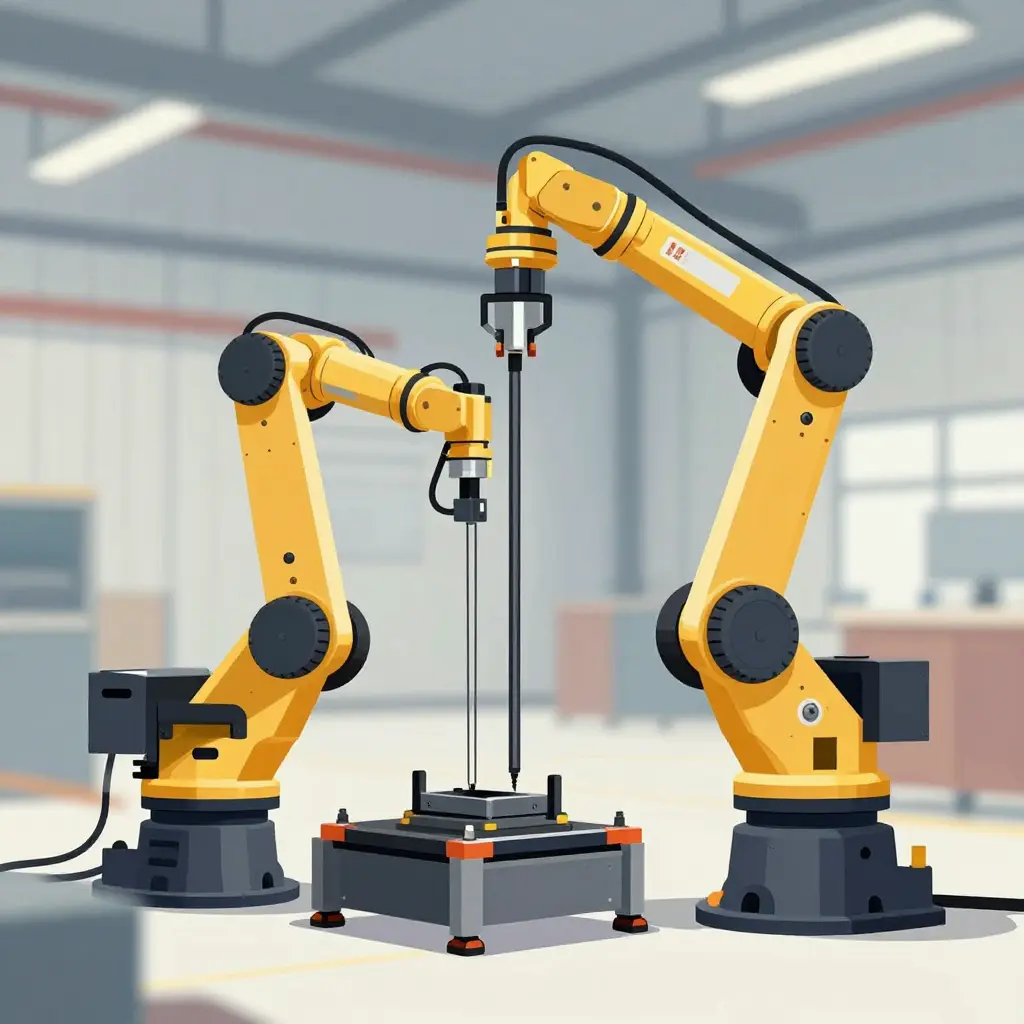
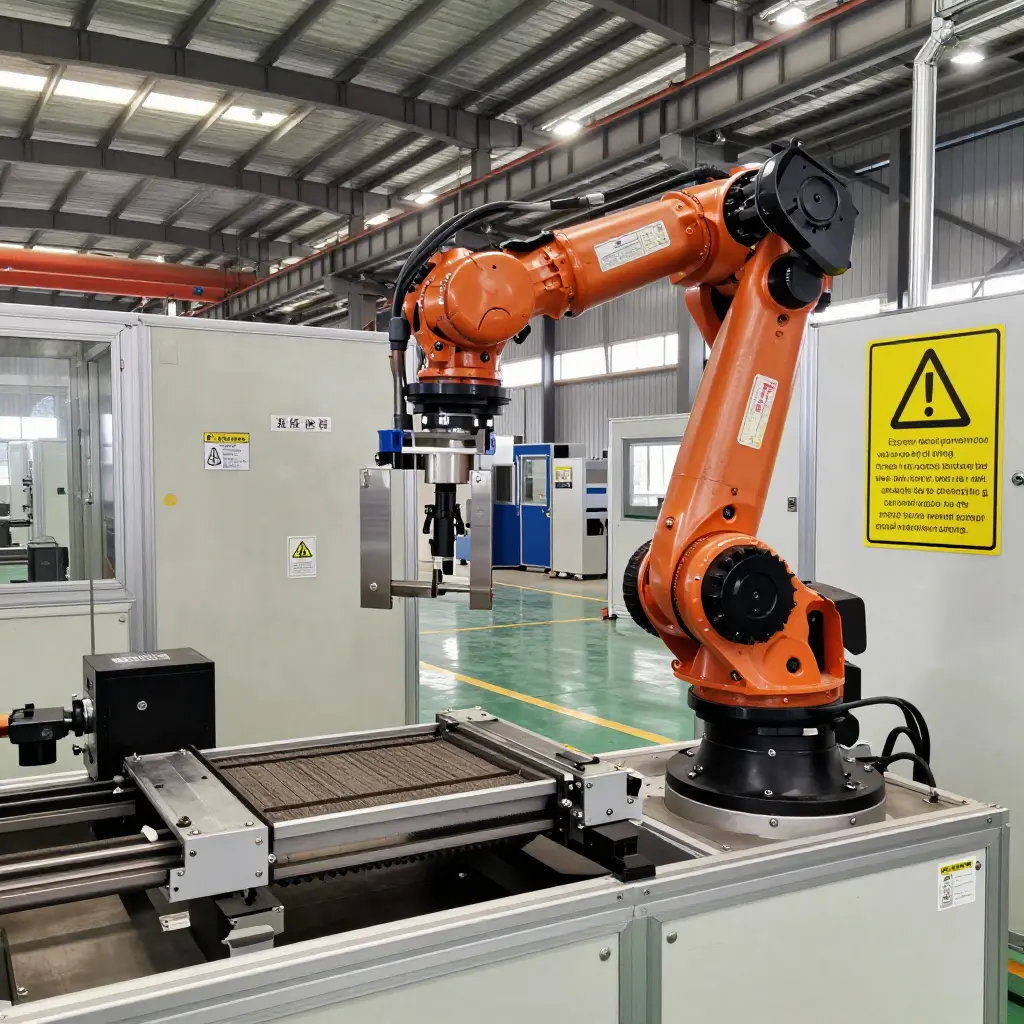
Nearly every cobot palletizing cell is built on one of two architectures, and they differ at the wrist: how many rotations the tool can perform between pick and place.
A 4-axis cobot palletizer uses base rotation (J1), shoulder (J2), and elbow (J3) to put the tool in space, plus a fourth axis that turns the tool about a vertical or otherwise fixed reference axis. That fourth axis is yaw only. The flange cannot pitch or roll, so the gripper presents the carton in one fixed approach attitude, top-down in most cells, and can spin it only within the horizontal plane.
A 6-axis cobot palletizer adds wrist pitch and wrist roll. The three wrist rotations intersect at a common point, so the controller can solve tool position and tool orientation separately. The gripper can come at a carton from the side, stand it on an edge, tilt it, and set it down at any orientation inside the reach envelope.
Pallet pattern flexibility and cycle time are the two variables that most often decide the axis count. Payload, reach, and footprint usually get settled earlier in the specification; the axis question comes back when a pattern will not fit the wrist’s orientation set, or when the takt time will not fit the motion profile.
| Attribute | 4-axis cobot palletizer | 6-axis cobot palletizer |
|---|---|---|
| Wrist degrees of freedom | Yaw about a vertical or fixed axis | Yaw, pitch, and roll (spherical wrist) |
| Reachable carton orientations per drop point | One approach attitude, unlimited yaw | Full orientation set |
| Typical pattern fit | Uniform cartons, 90-degree courses, column or basket weave stacks | Interlocked, rotated, tilted, and void-filled patterns; mixed SKU |
| Moving mass at the wrist | Lower | Higher (extra motor, brake, gearbox) |
| Motion segments per place | Fewer | More, including wrist reorientation |
How Wrist Degrees of Freedom Become Carton Orientations
Every layer position is a slot that demands a specific carton pose. A carton resting on a pallet has three rotational degrees of freedom, and each one has to come from the arm, not from a person, a fixturing rail, or a second gripper.
A 4-axis machine supplies one of the three. Its tool axis is fixed, so position and orientation stay coupled through the arm geometry, and every drop point inherits the same approach attitude. Courses built at 90-degree increments fit: the fourth axis can index a carton from one heading to the next. A carton that has to stand on end, lean into an interlock, or fill a void at a non-orthogonal angle does not fit, because the other two rotations are not available.
A 6-axis machine supplies all three. That is what pallet pattern flexibility means geometrically: the pattern asks for an orientation and the arm can produce it, with no added hardware and no operator touching up the layer. Infeed cartons can also arrive in a sloppier orientation, because the wrist can straighten them at the pick.
Where the Cycle Time Goes
Each added axis brings mass at the arm: a motor and gearbox, an encoder and cable run, a closed-loop control channel. That mass is carried through every acceleration, so inertia rises and settling time at the drop point lengthens.
Each wrist rotation is also a motion segment. A 6-axis place may need yaw, pitch, and roll coordinated before the gripper descends, and the controller has to solve inverse kinematics and blend the trajectory on every cycle. Small wrist moves still consume acceleration, deceleration, and settle time. Reviewing payload and reach trade-offs before locking axis count keeps those penalties visible in the specification.
A 4-axis palletizer is not universally faster. On a single-SKU column pattern, though, it moves fewer joints, carries less inertia, and finishes the place with less settling and less control overhead, all of which shortens cycle time. A 6-axis machine running that same simple pattern pays for wrist freedom it never uses. Where the pattern does need an orientation change, the 6-axis machine wins, because the alternative is slower re-gripping, a custom end effector, or an operator correcting layers by hand.
Inspection rule of thumb: count the unique carton orientations in the busiest layer, then time one complete pick-and-place cycle at that layer. The first number drives axis count; the second confirms it.
The Three Evaluation Axes Used in This Guide
The rest of this guide looks at each axis decision through three lenses. Pattern repertoire covers the orientations and layer types a wrist can produce, and the gripper changes each one implies. Motion-time structure covers how joints, segments, settling, and control overhead add up to a real cycle time at a real drop point. Service access covers what each architecture demands in maintenance clearance, seal and cable inspection, and access to wrist components during a stoppage. Together the three turn an axis count into a machine choice you can defend and maintain.
Pallet Pattern Flexibility: What Each Axis Count Can Physically Achieve
Pattern flexibility is a geometric consequence, not a software checkbox: it depends on how many independent orientations the tool can present to a carton. Two palletizers can run the same pattern library and still reach different repertoires, because the limit is the tool orientation the pattern demands at the pick point and again at the placement point. Map each pattern family against those two demand points before you specify a machine.
What Each Pattern Family Demands
- Column stacking. Every carton in every layer keeps the same yaw. The gripper approaches vertically, descends, releases, and retracts with no orientation change between pick and place. This is the least demanding pattern, and it runs on a single top-down tool axis, provided cartons arrive on the infeed in the orientation the layer requires.
- Interlocking brick patterns. Alternate layers are rotated 90 degrees about the vertical axis while the approach stays top-down. Yaw comes from the fourth axis, so the carton long axis has to line up with that rotation, and the gripper must hold through the turn without fouling the cartons next to it.
- Pinwheel patterns. Four cartons rotate 90 degrees about the vertical axis around a center void. The approach is still vertical, but clearance between finger geometry, carton corners, and already-placed units tightens quickly; wrist envelope and gripper footprint, not payload, usually decide feasibility.
- Mixed-SKU layers. The same layer carries different footprints and heights. Approach height now changes carton by carton, and tall units already on the pallet can block a straight vertical descent into a neighbouring position. This is where the orientation requirement stops being constant.
| Pattern family | Orientation at pick | Orientation at placement | 4-axis capable |
|---|---|---|---|
| Column stack | Single, top-down | Identical to pick | Yes |
| Interlocking brick | Top-down | Top-down, 90 degree yaw per layer | Yes, via the fourth axis |
| Pinwheel | Top-down | Top-down, 90 degree yaw, four positions | Conditional on wrist clearance |
| Mixed-SKU layer | Top-down, height varies | May need tilt or side entry | Conditional |
The Design Rule
A 4-axis cobot palletizer handles patterns where the gripper can approach from a single top-down orientation and where the fourth axis can deliver the carton yaw the layer needs. A 6-axis cobot palletizer adds pitch and roll, which buys tilted approaches, side-entry placement into gaps a vertical descent cannot reach, and reorientation of cartons whose long axis changes between pick and place. Apply this rule before any pattern library is built: ask whether every carton in the layer can be released from directly above, with yaw as the only required rotation. If yes, 4 axes is the right specification. If any unit needs a non-vertical approach, the extra axes are not optional.
Mixed-SKU work exposes the gap first. Cartons that arrive long-edge leading and have to land short-edge leading, or units that must slide in beside a taller neighbour, sit outside what a fixed vertical tool axis can do. That is why mixed-SKU pallet pattern setup deserves its own commissioning phase rather than being folded into generic pattern teaching.
The Trade-off: Repertoire Versus Validation Burden
Pattern repertoire grows with axis count, and so does the work behind it: offline simulation, collision checking, pattern-programming validation. Each added orientation multiplies the collision pairs to check, raises wrist-singularity and joint-limit questions near the pallet corners, and makes dry-run acceptance criteria harder to write. Concretely:
- 4-axis cells can be validated layer by layer in a short session, with a handful of worst-case corner approaches to confirm.
- 6-axis cells should be simulated end to end, including the transition moves between pick and place, before any carton is handled at full speed.
- A pattern that needs tilt or side entry should be checked at reduced speed with an operator present, and the joint configuration recorded in the validated program revision.
Budget engineering time with that in mind. A 6-axis machine buys pattern coverage, and along with it simulation hours and a heavier change-control load. Teams that plan for the workload up front get the repertoire without the commissioning surprises, which is what a disciplined approach to pattern programming and offline simulation buys.
Matching Arm Geometry to Your Pattern Mix
Settle the axis count before you compare throughput numbers. The 4-axis versus 6-axis decision is a mismatch test, not a tier ladder. A 4-axis machine places cartons top-down; it does not reorient them. Whenever a layer needs a different face of a carton or bag presented to the pallet, the 4-axis cell has to hand that rotation to tooling or give up the pattern. A 6-axis arm spends cycle time and envelope to approach a layer from more than one direction.
Use the table below as a screening tool, not a specification. It narrows the field; the floor layout and payload confirmation decide the final case.
| Parameter | 4-axis cobot palletizer | 6-axis cobot palletizer |
|---|---|---|
| Usable degrees of freedom | 4 – X, Y, Z plus wrist yaw about vertical | 6 – three positioning, three orienting |
| Reachable tool orientations | Top-down approach only; yaw variation | Full orientation set; side, angled, inverted approaches |
| Pallet pattern flexibility (patterns typically supported) | Top-load single-layer; uniform footprints; column and simple pinwheel | Interlocked, split-layer, mixed-SKU; bags and stand-up reorientation |
| Typical cycle time impact per additional reorientation | Not available without an added axis; tooling rotation adds about 1.0-2.0 s | Wrist reorientation adds about 0.4-1.2 s plus accel/decel settling |
| Programming and changeover effort | Point teaching per pattern; low per-pattern effort; small pattern library | More approach poses per pattern; offline simulation normally required |
| Floor space and vertical clearance implications | Small swept envelope; overhead clearance for lift-and-place arc; no side approach | Larger swept envelope; clearance for side and rear approach; taller mast possible |
| Primary wear and inspection points | Linear rail and belt, vertical axis brake, wrist rotation bearing | All six joint gearboxes and belts, wrist bearings, wrist harness flex |
| Relative hardware and integration cost | Lower arm cost; higher custom tooling cost for reorientation | Higher arm cost; lower tooling and per-SKU pattern cost |
Values are representative ranges; confirm against a specific cell layout and payload.
Reading the Table in Service Terms
Cost is where evaluations tend to go wrong. A 4-axis cell is cheaper at the quote and can become the more expensive asset at the first pattern change, if that change needs a rotation tool, a second fixture, or a manual reorientation station feeding the cell. A 6-axis arm earns its premium only when the reorientation demand is real and repeats. On layers that are uniform and top-loaded, the extra three axes are cycle time you buy and never use.
Wear points follow the same logic. The 4-axis machine concentrates load on a small number of elements – rail, belt, vertical brake, wrist bearing – so inspection is fast and predictable. A 6-axis machine spreads the same workload across six joints plus a flexing wrist harness, which means more inspection points per shift and a real risk of harness fatigue at the wrist. Both profiles are manageable; they need different check sheets. If your mix is high-variety, look at how pattern libraries are set up for mixed-SKU pallet runs before committing to an axis count: a well-built pattern library can move work off the robot and back onto the tooling.
Treat the two cycle-time rows as budgeting figures. Reorientation time depends on payload inertia, suction or clamp release lag, and how much settle time the layer needs before the next pick, so measure it with your own gripper and carton before you sign.
Cycle Time Anatomy: Where the Seconds Actually Go
A cycle time on a 6-axis cobot palletizer is a chain of six measurable elements. Log each one separately from the controller trace for ten cycles instead of timing the cycle as a whole, and the bottleneck usually identifies itself.
| Element | Starts when | Ends when | Main lever |
|---|---|---|---|
| Pick approach | return move complete | gripper at pick pose | approach clearance, path smoothing |
| Grip and verify | at pick pose | part-present or vacuum switch confirms | sensor type, vacuum flow rate |
| Lift and transfer | confirmation received | tool above target layer | acceleration limit, payload |
| Tool reorientation | transfer ends | tool aligned with layer orientation | number of orientation groups |
| Place and release | aligned and descending | gripper open and retracted | layer height accuracy, release delay |
| Return | retract complete | next approach begins | waist travel, pick sequencing |
Why Each Reorientation Costs More Than It Looks
On a 6-axis arm the wrist is a serial chain: J4 roll, J5 pitch, J6 yaw, all hanging off the end of the arm. Commanding a 90-degree product rotation is rarely a single-joint move. The controller blends J4, J5, and J6 together, so the slowest joint sets the duration, and the tool center point traces a longer arc than the joint delta suggests.
Large rotations also drift toward a wrist singularity, where the J4 and J6 axes line up. The planner either slows through that region or detours around it. Put a full carton on the tool and wrist inertia rises, which stretches the servo settling window; the arm cannot release until it holds position inside the programmed tolerance band. Every orientation change therefore bills you twice, motion time plus settle time. The same arithmetic decides whether a cell beats fixed automation, as our comparison of cobot palletizer versus gantry palletizer cycle time and floor space sets out.
Axis Count Is Not the Dominant Variable
When a layer repeats a single orientation, the wrist command barely changes from pick to pick. Those extra degrees of freedom add no reorientation motion, so the 6-axis arm runs close to the simpler machine; on a column stack the residual gap (7.2 s against 6.5 s) comes from wrist mass and inertia, not from orientation work. What separates the two machines is pallet pattern flexibility: whether one can reorient at all, and what each reorientation costs. Count reorientations per layer rather than axes per robot.
Corrective Guidance
- Split patterns into consistent-orientation sub-layers. Finish every pick in one orientation, then reorient once for the interlocked sub-layer. That turns a per-pick penalty into a per-layer one, and a 12-pick layer can drop from twelve wrist rotations to two. The same logic sits behind throughput planning by cases versus pallets, where per-layer events dominate the shift total.
- Sequence picks to minimise wrist travel. Group picks by orientation, then order each group so the yaw command accumulates in one direction instead of weaving back and forth. A monotonic sweep of the wrist costs a fraction of an alternating one.
- Verify acceleration and settling settings against the gripper’s payload. Check the payload value in the controller against the real mass of gripper plus heaviest carton, then confirm the acceleration ramp and settling window suit it. Tuning on your lightest SKU produces overshoot on the heaviest, and the resulting jitter microstops add seconds to every pick without announcing themselves.
Change one thing at a time, ten cycles per change, and keep the split log. Whichever element moves is your answer.
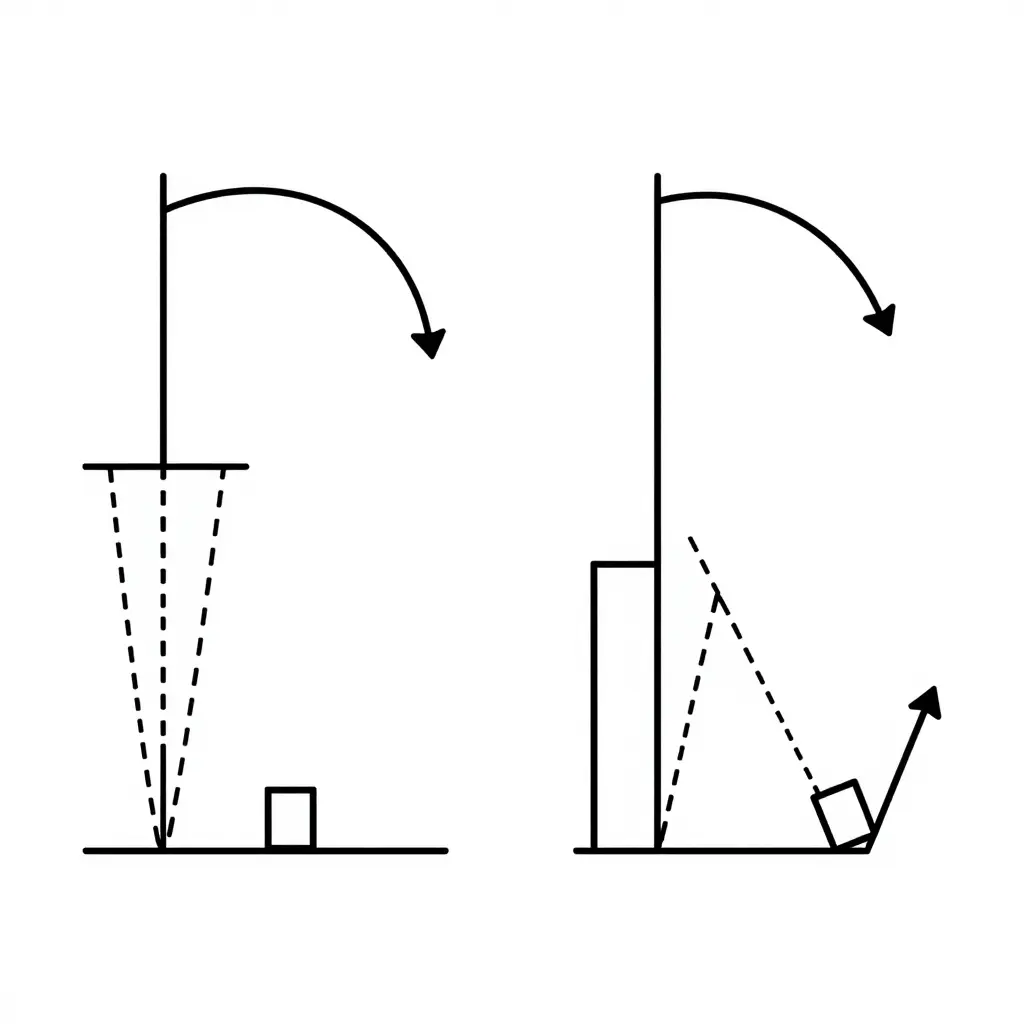
Compare the panels for reachable tool orientations, not arm length. On the left, the tool face stays parallel to the floor and the only freedom at the drop point is a spin around the vertical axis, so every placement is a flat, top-down set-down. On the right, two additional wrist rotations let the tool face tilt in two planes, which is what allows interlocked bricks, pinwheel corners and tilted-layer patterns to be laid down without fighting the box edges. If your SKU mix already demands those patterns, read the setup rules for mixed-SKU pallet patterns before you commit to a four-axis machine.
Cycle Time by Pallet Pattern Type
Cycle time on a palletizer datasheet is not one number; it depends on the pattern the machine has to build. The chart below splits the same pick-and-place motion across four pattern families, which is where the two kinematics classes diverge.
How to Read the Comparison
- Column stack is the cleanest case for both machines. Each carton lands on the X/Y position it held in the layer below, so the 4-axis unit holds a small advantage (6.5 s versus 7.2 s): with nothing to reorient, it carries less mass through the same motion.
- Interlock brick patterns add alternating row offsets. The gap narrows to under half a second because both machine types now spend time on lateral positioning.
- Pinwheel is the crossover point. Four cartons have to go around a center void with little room between finger geometry and the units already placed, and the 6-axis wrist pays for itself in shorter approach and clearance moves: 8.1 s against 9.2 s.
- Mixed-SKU layer is the widest gap and the most realistic figure for high-mix, low-volume plants: 9.4 s versus 11.5 s, since the 4-axis machine must plan around a fixed tool orientation while the 6-axis unit approaches each carton from a different roll angle.
These are representative reference values, not commitments from any specific cell. Real values depend on payload, gripper type, travel distance, and how much of the pattern set falls inside the pattern-programming and offline simulation scope at acceptance. If your pattern library is still growing after handover, re-baseline the numbers instead of comparing against the original quote.
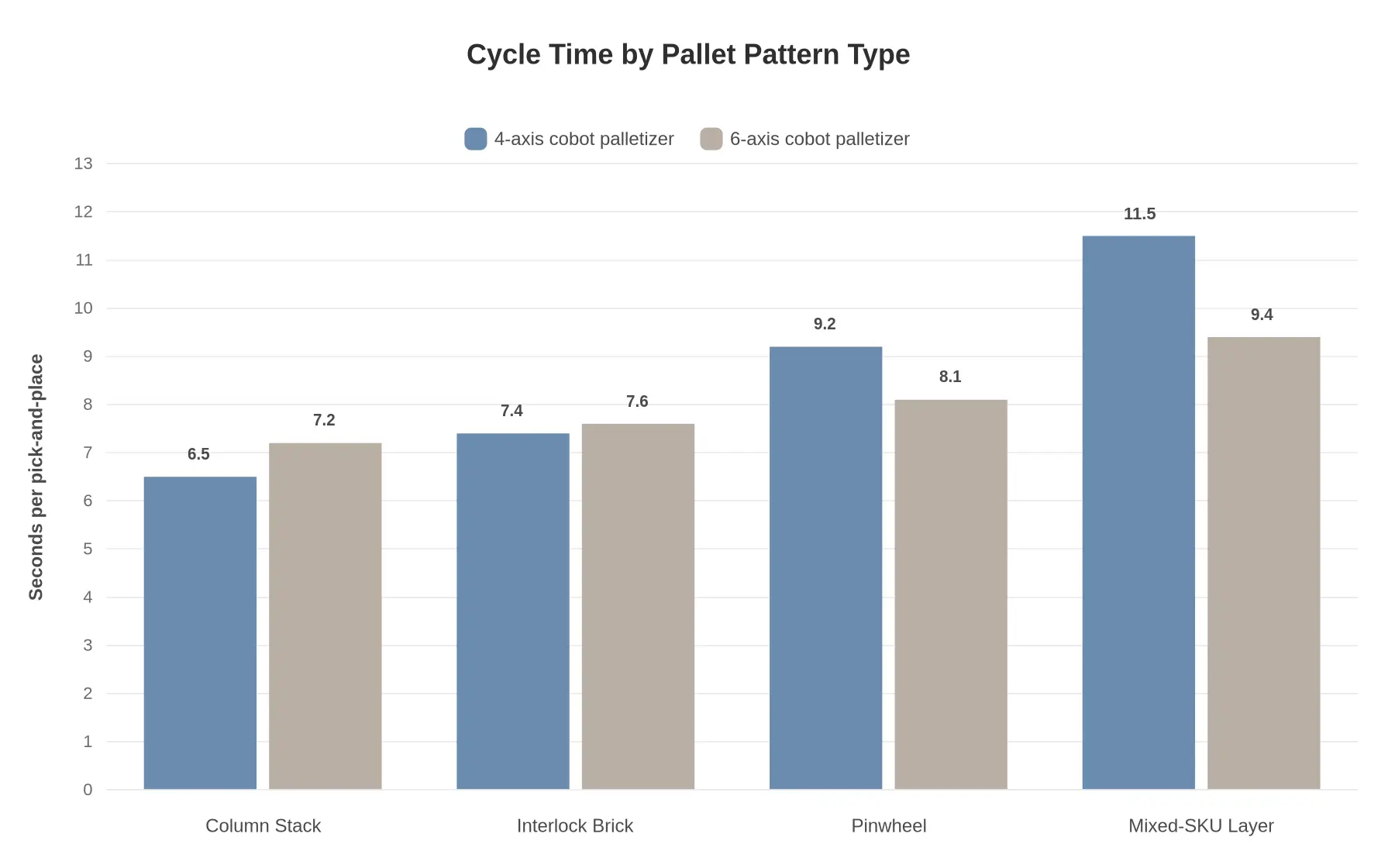
Figure: Representative cycle time in seconds per pick-and-place by pattern type for 4-axis versus 6-axis cobot palletizers. Values are illustrative reference points only – actual cycle time depends on payload, gripper type, travel distance, and the scope of pattern programming configured for the cell.
Inspection and Corrective Actions for Pattern Misplacement and Cycle-Time Drift
Pattern misplacement and cycle-time drift seldom show up as one dramatic failure. They accumulate a few millimeters and a few hundred milliseconds at a time, until pallets start failing stability or stretch-wrap checks. Work through the list below in order and log every reading; the trend carries more information than any single measurement.
- Wrist and gearbox temperature rise reducing positional repeatability. Placement drifts in late-shift pallets once housing temperatures climb past the cold-start baseline, because thermal expansion changes link geometry. Check wrist and gearbox temperatures with an infrared thermometer daily; re-baseline TCP offsets; add duty-cycle rest or airflow; review the trend weekly; inspect bearings and grease condition quarterly.
- Oil weeping from wrist or gearbox seals. A film or drip on the housing signals lubrication loss, or over-pressurization from a blocked breather or an overfilled reservoir. Inspect seals and breather vents weekly, wipe and trace the source, then top up to the specified level, replace weeping seals, and clear the vent at the quarterly service.
- Backlash developing in the wrist axes. Placement shifts a few millimeters in the same direction after each reversal, typically from worn gears or lost preload. Measure backlash with a dial indicator during the weekly pattern-accuracy audit, then correct it by re-adjusting preload or replacing the affected axis at the quarterly inspection.
- Gripper vacuum or clamp pressure decay. Grip-verify time lengthens and cycle time stretches because cups leak, filters clog, or supply pressure sags. Run a leak-down check daily; replace worn cups, change filters, and re-set the regulator as the corrective action.
- Encoder or positioning drift after firmware changes. Picks land at a consistent offset after an update, usually from changed defaults or cleared calibration data. Validate axis zero and TCP immediately after every firmware change and after any recovery event; then reload the saved calibration file or re-zero the encoder.
- Conveyor index timing errors offsetting pick positions. Cartons arrive ahead of or behind the taught pick point when belts slip, photo-eyes fault, or the index delay is mistuned. Verify index timing daily with a marked test carton, re-teach the pick offset, and tighten or replace the belt and clean the sensors.
- Pattern-file inconsistencies after SKU changes. Wrong layer counts, mirrored rows, or overlapping cartons appear when a reused file carries stale case dimensions. Compare the active recipe against the SKU spec at every changeover and at the weekly recipe audit, then correct file geometry and gripper offsets before releasing the pattern.
These checks sit inside a wider schedule. For the baseline cadence and the wear points that drive it, read our guide to cobot palletizer maintenance intervals, daily checks, and common wear points.
Frequently Asked Questions
Can a 4-axis cobot palletizer handle mixed-SKU pallet patterns?
Yes, as long as every case is placed flat. A 4-axis cobot palletizer controls X, Y, Z and rotation about the vertical axis, which covers column stacks, pinwheels and split patterns where each carton lies flat in one of the pattern’s orientations. It cannot tilt a case about a horizontal axis, so brick-interlocked builds from tall cartons, or placements that slide a case under an overhang, need a re-grip station, a turntable, or a 6-axis arm. Run the tallest, heaviest and least stable SKU in the mix through the pattern simulation before sign-off.
How much cycle time does a 6-axis cobot palletizer lose to wrist reorientation?
Budget roughly 0.6-1.5 s per pick for a full wrist flip on a mid-payload arm, settle time included, and 0.2-0.4 s for small yaw corrections. To measure the real loss, log the same pattern with wrist rotation enabled and then locked, and compare steady-state pick intervals rather than ramp-up. At 10 picks per minute the gap is often 10-15 percent of throughput. If that shortfall matters, sequence the wrist rotation during the traverse instead of at the drop point.
Which axis count gives better payback on high-mix, low-volume lines?
The 4-axis option usually pays back faster when patterns vary only in layer layout and changeovers run on recipe recall. A 6-axis cell earns its premium when one arm serves several lines, handles tilted placements, or absorbs frequent gripper swaps. Model payback on changeover minutes and tool changes rather than axis count alone; those two variables normally dominate the total.
How is temperature rise or oil weeping at the wrist diagnosed and corrected?
Measure wrist housing temperature with an infrared thermometer at the same payload and duty cycle as the baseline; a rise beyond 15-20 degrees C above ambient points to overhung load, excessive wrist acceleration or grease breakdown. Wipe any oil film from the seal area, run an eight-hour shift, then re-inspect. A film that returns at the seal lip means the lip seal needs replacement; a single smear after greasing is normal purge. Fix the root cause first: trim gripper mass, reduce wrist acceleration, and verify the tool center-of-gravity offset against the rated wrist moment.
Is pallet pattern flexibility limited by the cobot or by the gripper?
In most cells it is the gripper. The arm sets the kinematic outer bound, but the tool decides which cases it can hold: clamp jaws need free access to two or more sides, and vacuum cups need a flat, sealed top surface. When the SKU mix spans cartons, trays and bags, tool changes rather than axes cap the pattern library; comparing vacuum versus clamp grippers on cobot palletizers usually explains more lost patterns than arm choice does.
Closing Evaluation and Selection Guidance
The two calculations stay separate. Pallet pattern flexibility is a kinematic question: which placements a wrist can reach, and how far it can tilt before linkage or gripper geometry interferes with the layer below. Cycle time is a throughput question: picks per minute on the actual SKU mix, including cartons that need a re-grip, a layer pad, or a slip sheet. Model both per SKU, then weight each result by its share of volume. A pattern that is awkward for 4 percent of cases is a nuisance; a pattern that is awkward for 40 percent of cases redefines which platform you buy. Reach and payload limits cut the usable envelope further, so pin those figures down before the pattern library is frozen, starting from a structured reading of payload and reach trade-offs.
Selection Rule
- Specify a 6-axis cobot palletizer when patterns require tilted or multi-orientation placement: interlocked brick patterns, mixed carton heights on a single pallet, bags that must be laid flat then rotated, or any layer where the tool must approach from more than one angle.
- Specify a 4-axis cobot palletizer when the pattern repertoire repeats in consistent orientation, such as column stacks, simple pinwheel layers, or uniform single-SKU cases, and cycle time is the binding constraint.
On mid-volume lines the 4-axis case usually rests on throughput per unit of floor space, so build the business case from measured picks per hour rather than quoted nominal ratings; a mid-volume ROI model shows how sensitive the payback is to that single measured number.
Four Verification Steps Before Freezing the Specification
- Pattern repertoire test – run every SKU and pattern combination on the shortlisted machine, outliers included, and record every placement the wrist cannot reach or hold.
- Cycle-time measurement under representative SKU mix – time complete pallets across a weighted mix of cases, not a single hero SKU, and log stops, re-grips, and layer-pad interruptions.
- Wrist thermal and seal inspection baseline – log joint temperatures and photograph seal faces after sustained cycling, so later oil weeping or drift can be traced to a known starting condition.
- Gripper pressure-stability check – confirm vacuum or clamp pressure holds within tolerance over extended cycles, at both empty and rated load, before the tooling is signed off.
ZBOSN designs and manufactures its cobot palletizers in-house and supports mechanical integration plus OEM/ODM programs for integrators and end users building palletizing cells.