
Food Cobot Palletizer — Collaborative Palletizing Robots for Food Production Lines
A food cobot palletizer automates the last step of your packaging line: it picks sealed cartons, cases and trays of food products straight from the conveyor and builds stable, transport-ready pallet loads — no heavy manual lifting, no end-of-shift fatigue, no forklift traffic weaving between your packing lines. ZBOSN collaborative palletizing cells are already at work in frozen food, confectionery and snack plants, handling everything from marshmallow and biscuit cases to frozen food cartons.
At a glance: 30 kg payload · up to 2600 mm stack height · <9–12 picks/min · ±0.04 mm repeatability · IP54 protection · 220 V single-phase power
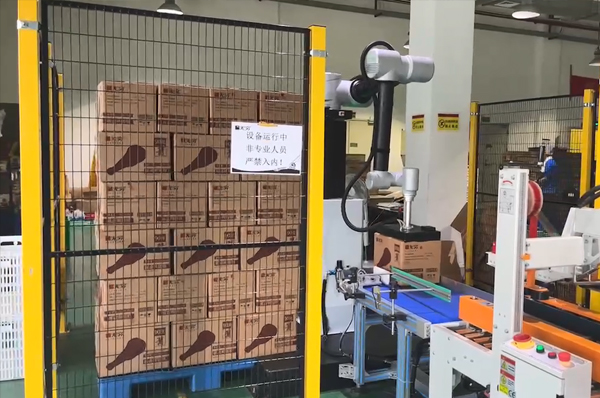
What Is a Food Cobot Palletizer?
A food cobot palletizer is a collaborative robot cell that takes case-packed, bagged or tray-packed food products from the end of the packaging line and stacks them onto a pallet in a programmed layer pattern. Because it is built on a collaborative robot arm rather than a heavy industrial palletizer, it works behind light safety fencing in the same room as your operators, plugs into standard 220 V single-phase power, needs no pit or heavy foundation, and is typically installed and running within one to two days.
For food factories this means palletizing automation can sit directly beside the case sealers and shrink tunnels at the end of each line — where the cartons are — instead of in a separate palletizing hall.
Why Food Producers Choose Collaborative Palletizing
- Hard-to-fill shifts. Palletizing is repetitive, heavy and often sits in cold or humid zones that are difficult to staff. A cobot palletizer takes the position permanently.
- Frequent SKU changeovers. Seasonal packs, promotional cases and private-label runs mean layer patterns change constantly. New patterns are taught on the touchscreen in minutes — no integrator visit, no code.
- Delicate retail packaging. Food cartons and display-ready cases crush easily. The robot places each layer with controlled force and consistent alignment, so pallets arrive at the distributor looking as good as they left the line.
- Tight floor space. With an operation footprint from 3150×1716 mm, the cell fits where a conventional palletizing system cannot.
- Food-plant environment. IP54-rated protection and a 0–55 °C operating range suit chilled packing areas and dusty bakery or snack environments alike.
Food Palletizing Applications
Frozen Food Carton Palletizing
Frozen meat and poultry producers use the cell to stack printed shipper cartons straight off the sealing line. The robot runs beside the line behind safety fencing while operators stay outside the cell.
Marshmallow & Confectionery Case Palletizing
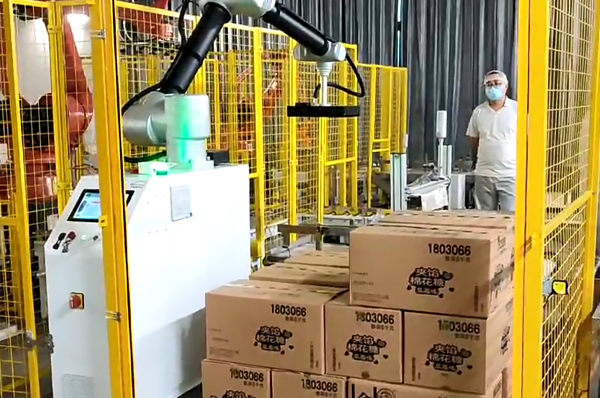
Soft-goods cases such as marshmallow and candy cartons are picked with a vacuum gripper and stacked in interlocked layers that keep even light, low-profile cases stable during shrink wrapping and transit.
Snack & Biscuit Case Palletizing
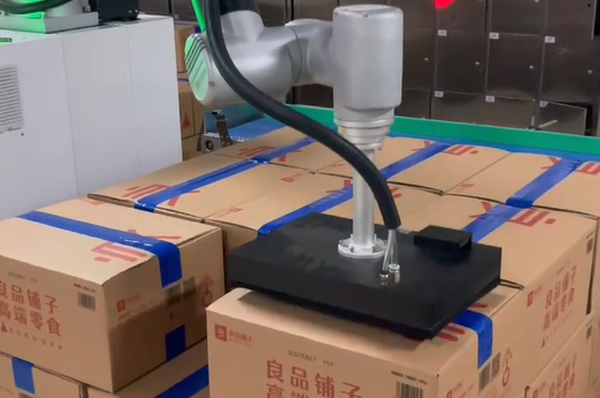
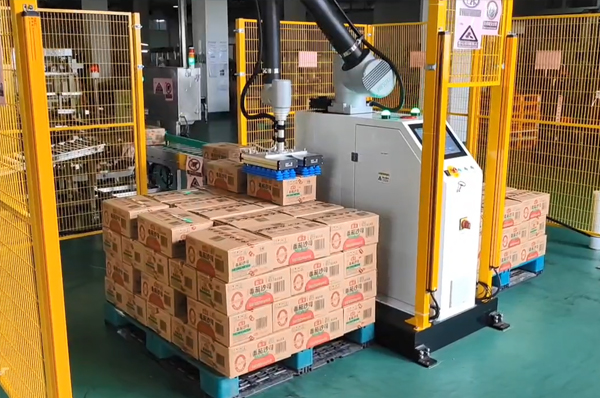
High-SKU snack and biscuit lines benefit the most: one cell handles multiple carton sizes by calling up the stored pallet pattern for each product, and full-pallet layer forming keeps output high even on the busiest consumer-goods lines. The high-speed ZBS-MD25MAX-G keeps pace at up to 12 picks per minute.
One robot, one gripper — frozen, chilled and dry food cases alike.
Recommended Food Cobot Palletizer Models
| Parameter | ZBS-MD30PRO | ZBS-MD30MAX | ZBS-MD25MAX-G |
|---|---|---|---|
| Type | Fixed cobot palletizer | Lift-type cobot palletizer | High-speed lift-type |
| Payload | 30 kg | 30 kg | 25 kg |
| Max palletizing height | 2100 mm | 2600 mm | 2600 mm |
| Palletizing speed | <9 pcs/min | <9 pcs/min | <12 pcs/min |
| Pallet size | 1200×1200 mm | 1400×1400 mm | 1400×1400 mm |
| Repeatability | ±0.04 mm | ±0.04 mm | ±0.04 mm |
| Power supply | 220 V / 50 Hz single-phase | 220 V / 50 Hz single-phase | 220 V / 50 Hz single-phase |
| Protection rating | IP54 | IP54 | IP54 |
- ZBS-MD30PRO fixed cobot palletizer → — compact choice for single-line food plants stacking to 2100 mm.
- ZBS-MD30MAX lift-type cobot palletizer → — built-in lifting column reaches 2600 mm for high, transport-efficient pallet loads.
- ZBS-MD25MAX-G high-speed lift-type cobot palletizer → — up to 12 cartons/min for high-throughput snack and confectionery lines.
All ZBOSN cobot palletizers run on 220 V single-phase power with IP54 protection and TCP/IP communication. The final configuration is matched to your carton sizes, layer patterns and line layout.
From Case Sealer to Pallet — How the Cell Fits Your Line
- Cartons arrive sealed from the case sealer or shrink tunnel at the end of your packaging line.
- Infeed conveyor centers and squares each case for a clean pick.
- The robot picks single cases or full layers with a vacuum or clamp gripper selected for your packaging.
- Layer forming and stacking follow the stored pattern for each SKU, with optional slip-sheet placement between layers.
- Full pallets discharge to the wrapper or handover point, and the next empty pallet indexes in automatically.
Because the palletizer is collaborative, it works in the same bay as your packing operators behind light fencing — no machine pit, no heavy guarding line, and installation usually takes one to two days.
Food Cobot Palletizer FAQ
Q1: What carton weights and sizes can it handle?
The standard payload is 25–30 kg per pick, which covers most food shipper cases. Carton dimensions are set in the recipe for each SKU; typical food applications range from small display cases to full-depth transport cartons.
Q2: How fast can it palletize food cases?
The fixed model reaches <9 picks per minute and the high-speed lift-type reaches <12 picks per minute. Actual line speed depends on case size, layer count and infeed arrangement — we calculate your real cycle during line layout.
Q3: Can it handle shrink-wrapped trays and retail-ready cases?
Yes. Vacuum and clamp grippers are configured for your exact packaging, and placement force is controlled so retail-ready packaging arrives intact.
Q4: Does it work in cold or humid food-plant environments?
The cell is IP54 rated and operates from 0–55 °C, which covers chilled packing areas. For frozen warehouses below 0 °C, the standard approach is to install the cell in the ambient packing zone outside the freezer and convey cases through.
Q5: How difficult is programming and SKU changeover?
Patterns are taught on the touchscreen — select the recipe, confirm carton size, and run. Your operators handle changeovers without a robot programmer.
Q6: How much space and power does it need?
Operation footprints start at 3150×1716 mm, minimum ceiling height is 3.2 m, and it runs on ordinary 220 V single-phase electricity — no three-phase supply or compressor required for most configurations.
Get a Free Food Line Palletizing Layout
Talk to a palletizing engineer. Send us your carton dimensions, line speed and plant layout — we will reply with a recommended model, layer pattern and quotation, free of charge.
Email: info@zbosn.com