What Cobot Palletizer Pick Point Variation Actually Means
Cobot palletizer pick point variation is the gap between where a product actually appears at the pick station and where the robot program expects it to be. Small offsets that look harmless in a simulation turn into real faults on the floor: a suction cup lands half on a case flap, a clamp closes on air, or the robot nudges a carton and the rest of the layer goes crooked.
On high-mix, low-volume lines the gap grows for four ordinary reasons. Case dimensions change from SKU to SKU, so a single station may see a dozen different lengths, widths and heights within one shift. Cartons slide, rotate or catch a guide rail and arrive at a different angle than the one they left the case packer with. Conveyor infeed adds its own error – belt slip, accumulation pressure, uneven gaps between slugs – which pushes the stop position around. And frequent changeovers reset tooling, recipes and reference positions far more often than a dedicated line ever would, which is why mixed-SKU pallet patterns need a deliberate approach to referencing.
Two strategies absorb that variation. A fixed pick position enforces repeatability mechanically: locating features, nests, backstops and lane guides push every case to the same known spot, so the taught program stays valid. Vision guidance goes the other way, using a camera to measure the pose of each part before the grasp and offsetting the robot to wherever the case actually sits.
Neither approach is universally correct. The choice depends on your SKU mix, where the variation comes from and how often you change over, and the two options load cost onto different budgets – which is the part worth working through before design freeze.
Fixed pick position: the robot meets the product halfway
A fixed pick position reverses the problem. Rather than giving the robot eyes and letting it search for the carton, you build the geometry so the carton has nowhere else to go. Mechanical locating features nudge, wedge or block the product into one pose, cycle after cycle, and the cobot palletizer simply repeats a taught point.
The locating hardware, piece by piece
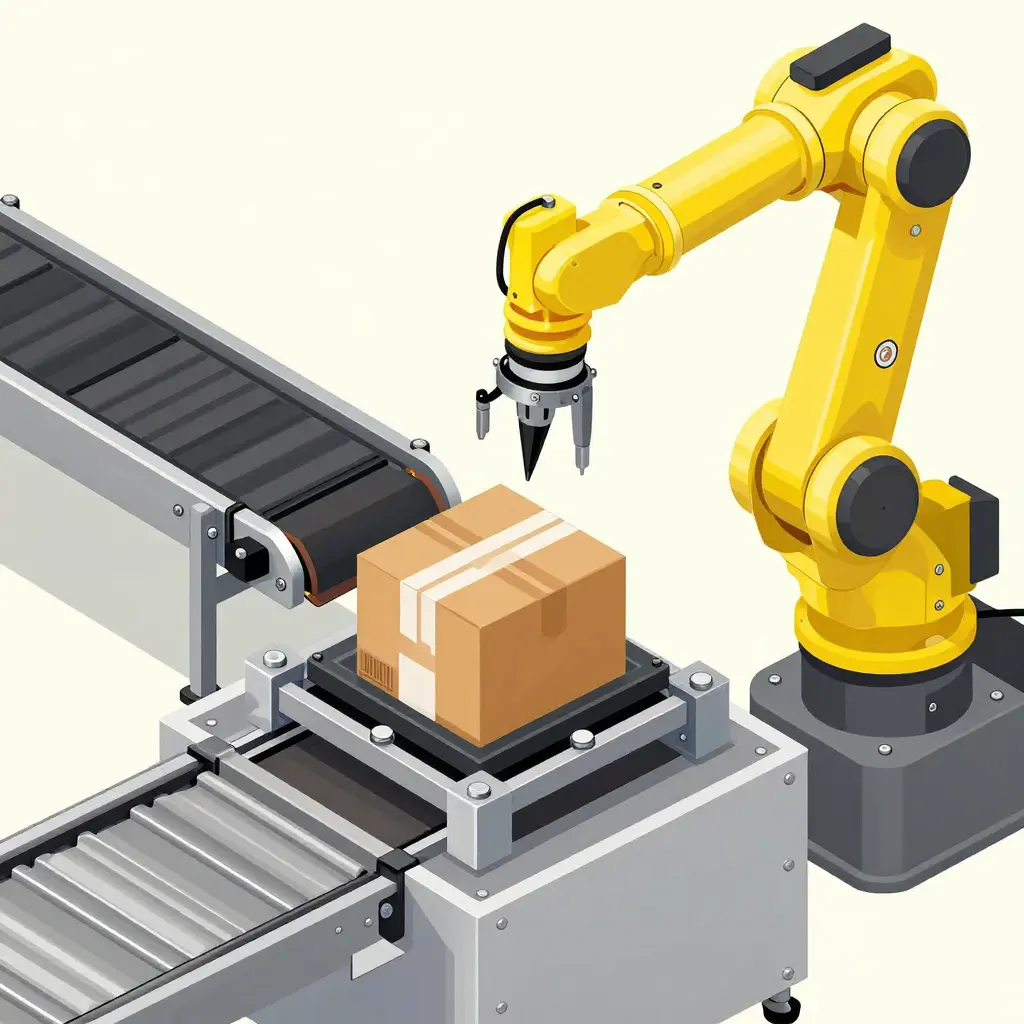
- End stops and backstops: hard datum faces that define the upstream and rear limits of the product, so the pick point cannot drift forward or back.
- Guide rails and converging side fences: tapered entry openings that funnel a slightly off-center carton into the correct lateral position as the conveyor carries it in.
- Centering lugs and wedge blocks: paired features that squeeze the product onto a common centerline, which matters most for bags that want to slump.
- Orientation fences and lane dividers: vertical or angled plates that hold a flap, tab or label edge on the correct side, so the gripper always lands on a flat, known surface.
- Dedicated pick nests: a pocket machined or fabricated to the footprint of one SKU. The most repeatable option and the least forgiving.
What you get for that simplicity
The parts are ordinary fabrication – plate, tube, brackets, a few adjustment slots – not sensors or software. There is no camera to calibrate, no lighting to fight, no lens to clean, and the pick logic needs no per-SKU pose offsets. Program logic stays short: move to the pick point, close the gripper, lift, place. Cycle time becomes predictable enough to plan throughput around, pallet pattern timing included.
Where the bill arrives
That same mechanical contact is the catch. Guide rails that center a rigid carton will also crush a soft bag or scuff a printed display pack, and the contact repeats thousands of times per shift. Size tolerance is narrow: a carton that grows five millimeters after a supplier change may jam, ride up over a backstop or stop short of the nest. Every SKU wants its own insert set, so fixture changeover becomes a real labor line item on high-mix lines – worth reading more on commissioning and changeover downtime. And when a product does arrive out of position, the robot has no way to know: it picks air or clips a flap, and the fault surfaces later as a dropped case or a gap in the pattern.
The pick station is also only as good as the conveyor feeding it, which is easy to overlook. Accumulation pressure, roller gaps, transfers and belt speed variation decide whether the product reaches the fixture in a pickable state. No fixture fixes surge, and none fixes a gap wide enough for a carton to tip between two zones.
Judging the fit before you commit
Four questions settle most of it. Is the geometry stable – a rigid carton, a well-formed case, or a bag that holds its shape rather than slumping? Is the SKU count low enough that a handful of fixture sets covers the line? Does the existing conveyor already deliver products in a consistent stream with controlled accumulation? And is there someone on site who will own fixture maintenance, adjustment and cleaning?
If the answers lean yes, a fixed station will hold position to within a few millimeters of the taught point, which is well inside the offset its gripper absorbs before picks start failing, so vision would mostly be spending money to solve a problem you already engineered away.
Where fixed pick position remains the better choice
- Rigid, uniform cartons on a dedicated or lightly mixed line: geometry is stable and fixture changeover is rare.
- Budget-driven first automation step: capital goes into the robot, gripper and guarding rather than cameras, lighting and integration engineering.
- Conveyor already delivering a disciplined single-file stream: no surge, no tipped cartons, no random gaps.
- Short payback horizon with predictable SKU mix: cycle time and throughput can be quoted with confidence, which helps justify the project internally.
Fixed pick position often gets treated as the low-tech option. It is the better one when the product and the conveyor already behave, and when the engineering budget is better spent at the pallet end than at the pick end.
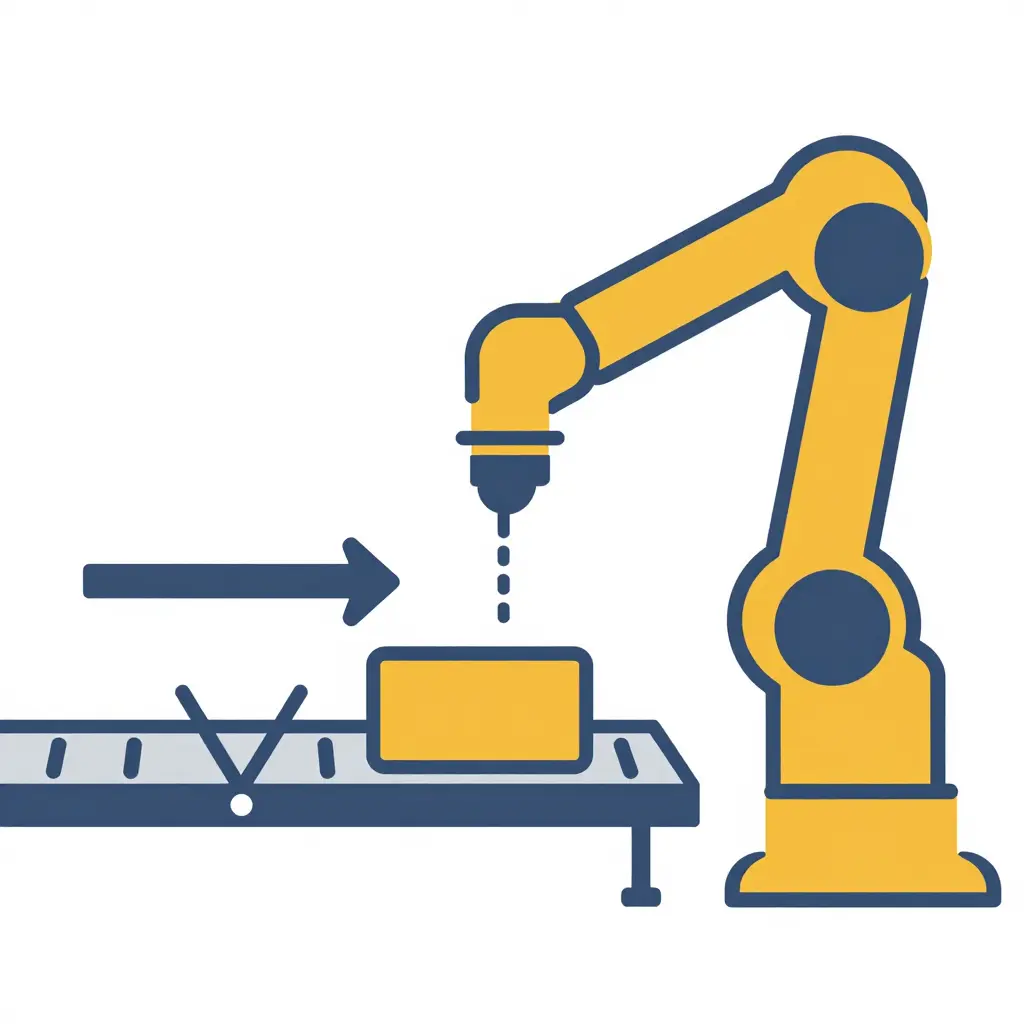
Here the geometry does the locating. The conveyor pushes the case into a pair of rails and an end stop, so every product arrives at the same known x-y position and orientation, and the robot repeats one trajectory: a straight vertical descent, grip, lift, place. No camera, no pose estimation, no per-SKU arrival offsets. The trade-off is mechanical discipline, because the nest, rails and stop must be adjusted whenever carton footprints change between runs. How that work interacts with line-side hardware is covered in our guide to cobot palletizer integration with conveyors.
Vision Guidance for Cobot Palletizer Pick Point Variation
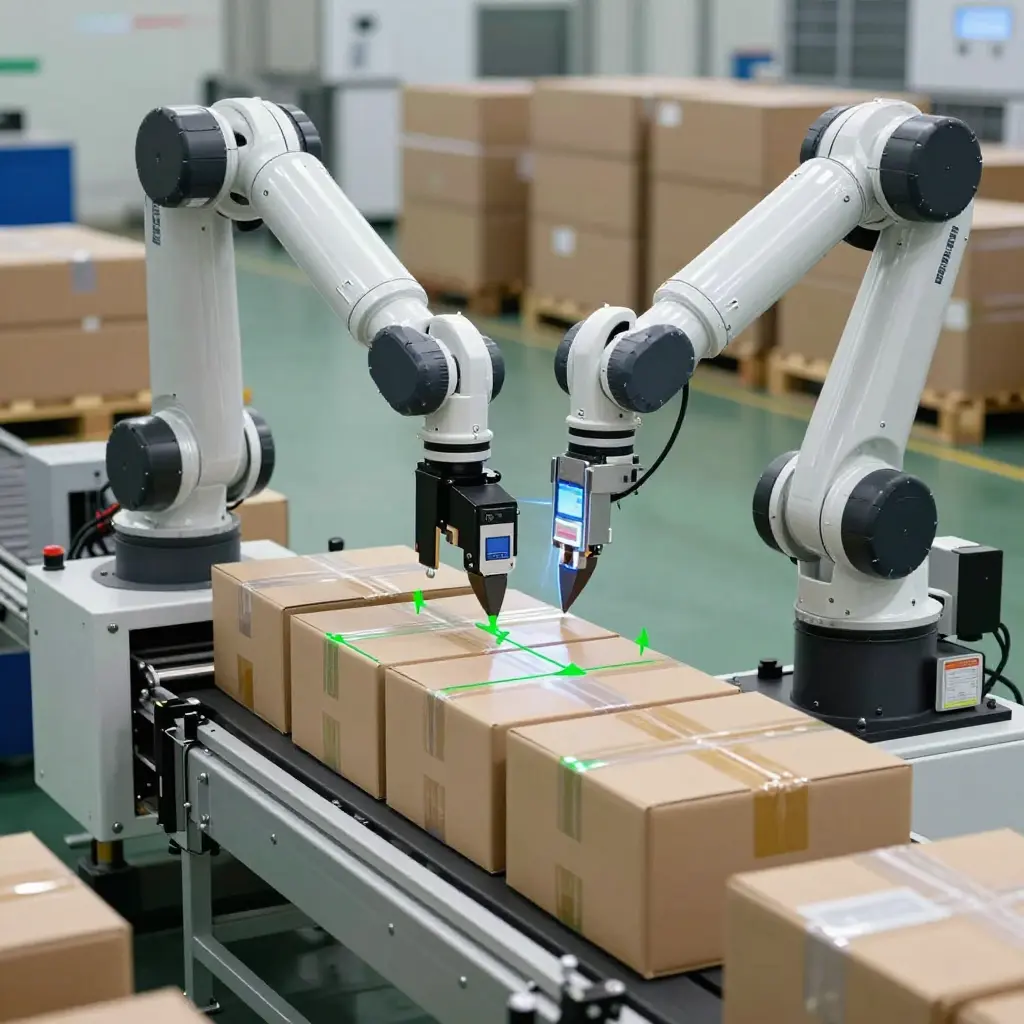
In a fixed-pick cell the robot knows one point: the spot where the case sat during commissioning. If a bag slides 40 mm, or a carton arrives rotated, the gripper lands half-on and the line stops. Vision guidance replaces that taught coordinate with a measurement. The robot asks the scene where the product is, then goes there.
The four building blocks
1. A camera or 3D sensor watching the pick zone. Depending on the product, this is a 2D camera with strong contrast lighting for cartons and trays, or a 3D depth sensor or structured-light unit for bags, sacks and stacked cases where height variation matters. The sensor mounts above the conveyor or on the robot arm itself.
2. Pose estimation that returns X, Y, Z and rotation. For every detected product, the software fits a bounding box and outputs a full 6-degree-of-freedom pose: lateral offset, height and yaw at minimum, plus roll and pitch where the packaging allows. That pose is the number the robot consumes.
3. Hand-eye calibration. The relationship between camera frame and robot frame is measured once and validated with a target or a set of touch points. Drift here is the quiet failure mode, so a good integrator re-verifies calibration after any mechanical impact and at each service interval.
4. Per-pick grasp adjustment. The robot offsets its grasp pose for each pick instead of repeating one taught point. A bag that arrives askew gets approached at an angle; a carton that crept 30 mm forward gets picked 30 mm forward. Pattern placement then follows a separate reference, which is where pattern programming and offline simulation earns its place in the workflow.
The result is a workable pick pose tolerance: an envelope of position and angle error the cell absorbs without stopping, which is what lets mixed-SKU running feel calm instead of fragile.
The trade-offs, stated plainly
| Cost side | Benefit side |
|---|---|
| Higher upfront spend on sensor, lighting and calibration | Wide pick pose tolerance, so jitter and drift are absorbed |
| Sensitivity to lighting changes, ambient glare and shadow shifts | Fewer fixtures and less precise mechanical presentation hardware |
| Difficult surfaces: glossy film, reflective shrink wrap, transparent packaging | Faster SKU changeover without re-teaching a point per product |
| Software tuning for thresholds, exposure and model parameters | Picking from a broader area rather than a single taught point |
| Extra engineering hours during commissioning and tuning | Less operator intervention when products shift on the conveyor |
Solving cobot palletizer pick point variation with vision-guided picking is not a plug-and-play upgrade. Expect the first days of commissioning to go into lighting, exposure and surface-specific tuning, especially with shiny film or clear cartons where the sensor sees the conveyor through the product. That time belongs in the budget from the start.
Vision does not replace presentation discipline
Vision does not remove the need for mechanical discipline at the infeed. Products should still be separated and non-overlapping within the camera field of view. A sensor can find a box in unexpected places, but it cannot reliably resolve two boxes fused into one blob, nor reason about a bag lying half under another. Keep gaps between products, keep the field of view clear of obstructions, and keep the pick zone free of loose film and tape. Vision widens the tolerance envelope; it does not delete the need for a well-presented stream.
Fixed pick position vs vision guidance – typical performance ranges
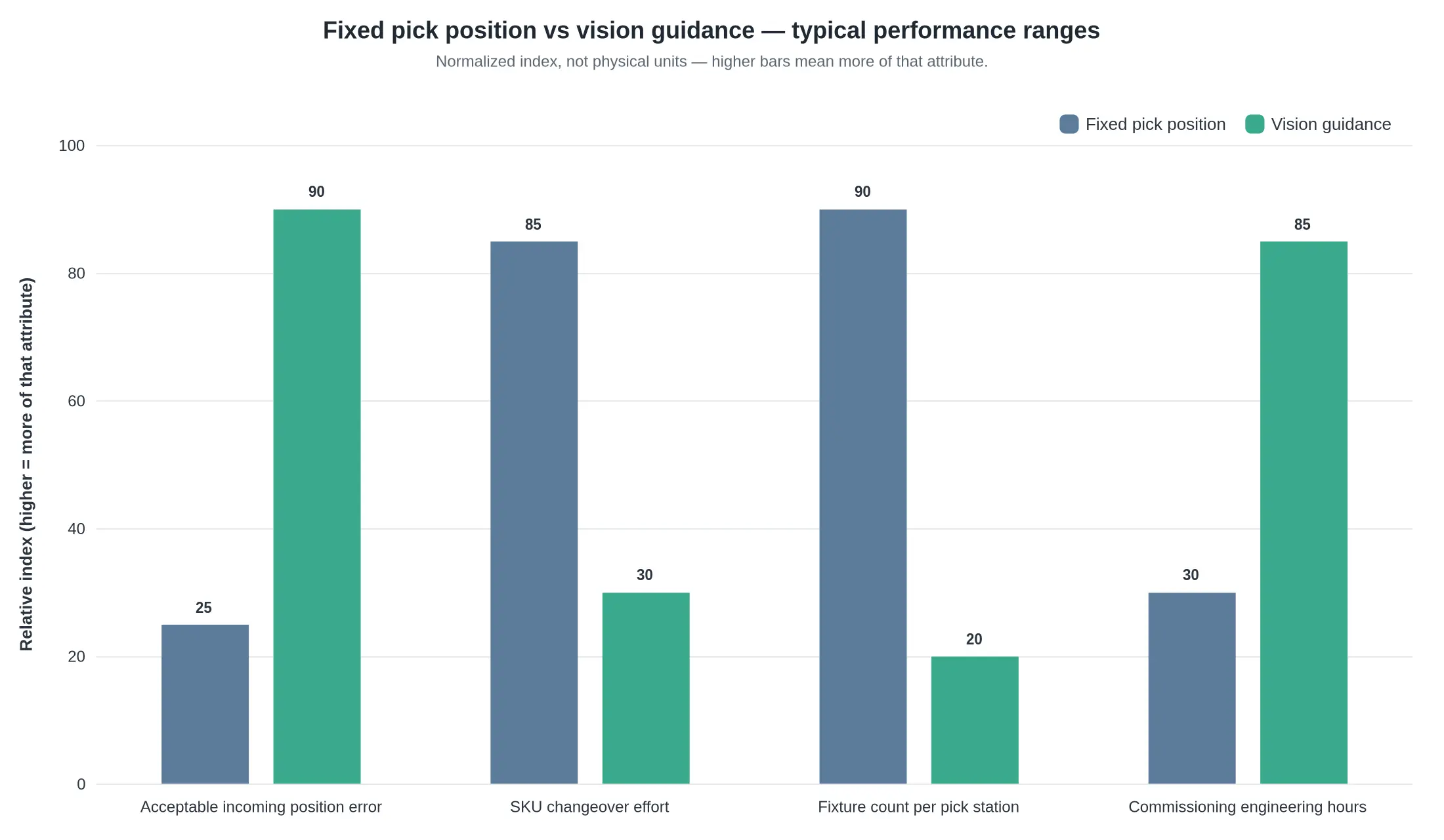
Bars are a normalized 0-100 relative index, not physical units. Higher bars simply mean more of that attribute – read each pair as a trade-off, not a score.
| Category | Fixed pick position | Vision guidance |
|---|---|---|
| Acceptable incoming position error | 25 | 90 |
| SKU changeover effort | 85 | 30 |
| Fixture count per pick station | 90 | 20 |
| Commissioning engineering hours | 30 | 85 |
How to read the chart
- Fixed pick position trades tolerance for mechanical work. Accepting almost no incoming position error means every carton, tray or pallet corner has to arrive in the same place, every time. That requirement shows up as heavy fixturing and long changeover when SKUs change: high bars on fixture count and changeover effort, low bars on error tolerance and engineering hours.
- Vision guidance trades engineering hours for flexibility. The camera absorbs incoming variation, so fixture count drops and changeover becomes a recipe swap rather than a mechanical rebuild. The cost arrives earlier instead, in commissioning: camera mounting, calibration, lighting and pattern teaching.
- The crossover is your mix. High-mix, low-volume lines with frequent changeovers usually land on vision, while long runs of a narrow SKU set often justify the fixed mechanical approach. Anything in between is a judgment call on how much engineering time you have up front against how many changeovers you face per week. For the changeover and downtime side of that math, see integration with conveyors, commissioning and changeover downtime.
The practical takeaway
Neither approach is “better” in the abstract. They move cost between the mechanical and software sides of the same project. Budget the fixture work and changeover labor if you go fixed; budget the calibration and programming hours if you go vision. Getting that trade-off backwards is the most common reason a palletizing cell looks cheap on paper and expensive in month three.
Decision Checklist: Fixed Pick Position vs Vision Guidance
Apply this checklist SKU family by SKU family, not to the plant as a whole. A single line often mixes families that behave very differently, so a verdict that fits your main carton may be wrong for the odd-shaped or slippery items in the same range. Score each family honestly, and let the totals decide whether a cobot palletizer should run on a fixed pick position, on vision guidance, or on a hybrid of both.
- Product geometry stays consistent across your SKU range, so a fixed pick position can hold tolerance.
- Incoming product position varies little enough that the cobot palletizer repeats the same approach each cycle.
- Changeovers per shift are low enough that locating fixtures are not rebuilt several times a day.
- Your products tolerate mechanical contact and surface marking from stops, guides and fixture walls.
- The pick station offers stable lighting and free mounting space for a camera used in vision guidance.
- Your team has engineering hours available for calibration and software tuning if vision guidance is chosen.
- Expected product-mix growth over the next two years can still be covered by a small set of stable pick poses.
- Total cost of building and storing fixtures per SKU stays below the installed cost of camera-based picking.
If several families score toward fixtures, review your mixed-SKU pallet pattern setup before locking the design freeze. If the scores split, plan for one pick station that supports both modes and switch per family rather than per plant.
Cost and Tolerance Comparison: Fixed Pick Position vs Vision Guidance
| Criterion | Fixed pick position | Vision guidance |
|---|---|---|
| Upfront hardware cost | Low camera and sensor spend; money goes into precision fixtures and locating nests | Higher camera, sensor and lighting spend; fixtures need far less precision machining |
| Engineering and commissioning effort | Shorter programming, but long mechanical alignment, trial runs and stop position tuning | Longer hand-eye calibration, lighting tuning and integration testing before the first production pallet |
| Pick pose tolerance | Tight tolerance of a few millimeters; incoming position errors stall or drop picks | Wider tolerance; the camera corrects offset and rotation on every pick |
| SKU changeover time | Hours of stop repositioning, mechanical adjustment and requalification per pack size change | Minutes of recipe recall and pattern selection; no mechanical rework for new SKUs |
| Fixture and storage burden | Dedicated nests, jigs and racking per SKU; storage and floor space grow with variety | Single flexible pick zone; fixtures simplified or removed, freeing floor and rack space |
| Cycle time and grasp repeatability | Fast cycle on stable parts; repeatability drifts with fixture wear across shifts | Slightly longer per-pick compute; consistent grasp repeatability despite upstream drift |
| Sensitivity to lighting and packaging surface | Insensitive to lighting, but glossy film and reflective cartons still shift in position | Sensitive to glare, low contrast and shrink wrap; needs controlled lighting and background |
| Maintenance and spares | Wear on stops, locating pins and contact surfaces; low-cost spares, frequent checks | Camera, lens and light upkeep; recalibration after bumps, cleaning and lens replacement |
| Best-fit production profile | Stable, high-volume, few SKUs with repeatable upstream positioning and long runs | High-mix, low-volume lines with frequent changeovers and drifting incoming positions |
The two paths load cost very differently. A fixed pick position front-loads cost into fixtures, precision nests and changeover labor, so every added SKU keeps charging rent in tooling and downtime. Vision guidance puts the money into engineering hours and calibration instead, trading a bigger commissioning bill for flexibility against pick point variation. Either way, price the hardware and the integration separately before you commit.
What the Diagram Shows
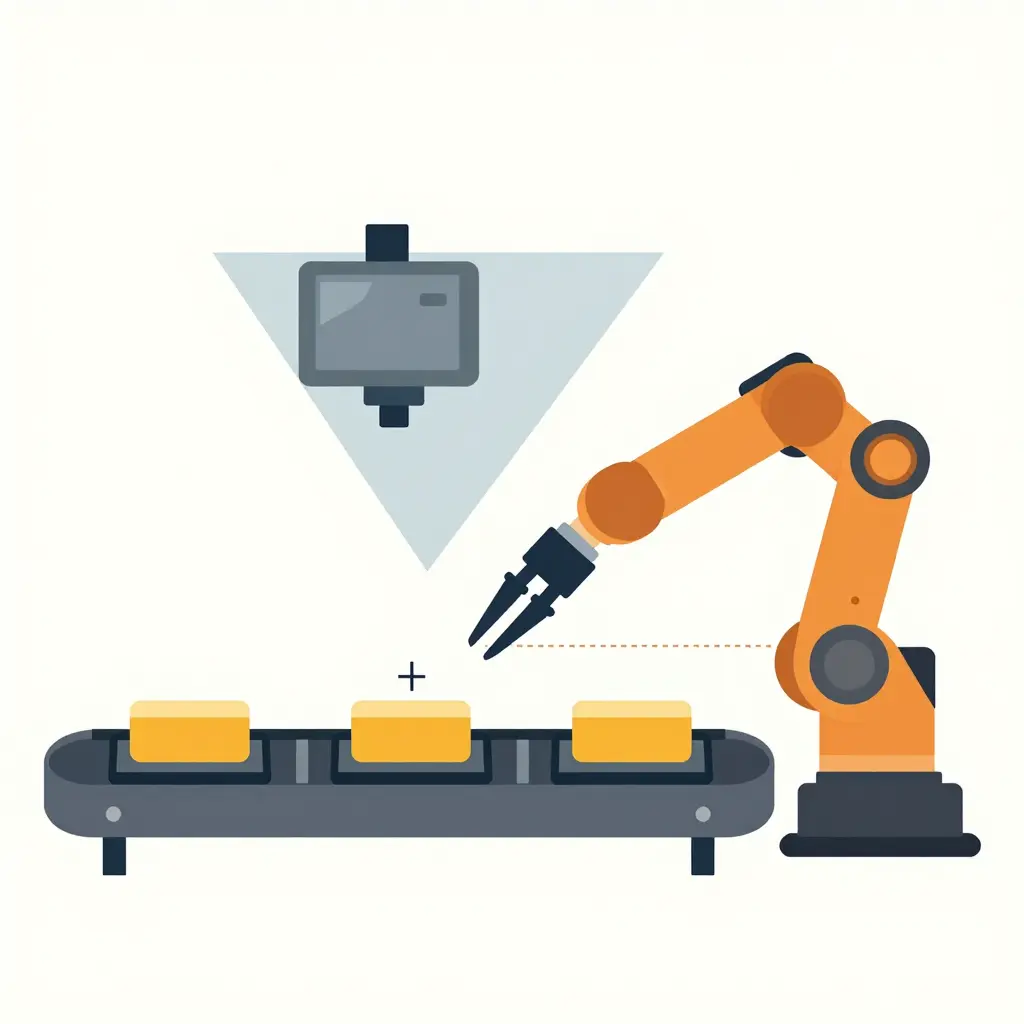
The three rectangles on the conveyor sit at different offsets and rotations, which is the everyday reality of mixed-carton flow. A fixed pick position assumes every case arrives in the same spot; vision measures where each one actually landed. The camera’s triangular field of view covers the whole pick zone, the crosshair marks the detected product, and the dashed line traces the corrected approach vector that lets the gripper meet the carton at its real angle rather than a taught one.
That difference matters most when a line runs many SKUs in short batches. If you are weighing how much pattern variability your cell can absorb, these notes on cobot palletizer setup for mixed-SKU pallet patterns are a practical next read.
Hybrid Configurations and Final Guidance
Most lines do not need to choose a pure architecture. The practical middle ground is a coarse mechanical presentation upstream combined with vision guidance at the pick point. Guides, short conveyor lanes or lane dividers do the heavy lifting and bring products roughly into the same zone; the camera then only has to resolve the residual cobot palletizer pick point variation near the gripper. A small search area keeps the model and the lighting simple and cycle times predictable, while the system still absorbs the SKU variation that mechanical guidance alone cannot handle. Coarse mechanics shrink the problem; vision finishes it.
Staged adoption: fixed now, flexible later
The other route is staged adoption. Commission a fixed pick position first, with the product presented against a hard stop or nesting fixture. That is the cheapest and most repeatable configuration to prove out, and it gets production running on a known cycle time. The key is to commission it with a camera-ready mounting provision already in place: reserved bracket space, power and network drops, and a mounting height that clears the gripper travel. When SKUs multiply, adding vision becomes a fixture change rather than a structural rebuild.
What should drive the decision
Two signals matter more than the specification sheet. The first is product mix growth: how many distinct footprints and pack shapes the cell will see in two or three years, not just at handover. The second is pallet pattern complexity: interlocked layers, mixed cases on one pallet and frequent pattern changes push you toward vision sooner. Pattern flexibility has its own payload and reach limits, which are worth reviewing separately from the sensing question – see payload and reach trade-offs and the practical work of mixed-SKU pallet patterns. ZBOSN is an in-house designer and manufacturer of cobot palletizers, offering mechanical integration and tailored OEM/ODM cooperation for teams working through these trade-offs.
Match the pick method to the real spread of incoming product positions you measured on the line, not to the assumption that products arrive where the drawing says they do.
Frequently Asked Questions About Cobot Palletizer Pick Point Variation
Does vision guidance remove the need for upstream product separation?
No. Vision guidance locates each case, but the robot still needs enough spacing for vacuum cups or clamp jaws to close on a single item without touching its neighbor. Lane dividers, metering belts or a short accumulation section remain part of the cell design, and most of that layout gets settled during conveyor integration and changeover planning. Vision compensates for position error, not for overlapping or shingled product.
How much incoming position error can a fixed pick position realistically absorb?
A fixed pick position typically tolerates roughly 10 mm to 25 mm of lateral offset and a few degrees of rotation, depending on gripper type and carton size. Beyond that range, vacuum cups lose their seal or clamp jaws grab the box off-center, and the failure shows up as dropped cases or a pallet pattern that drifts. The acceptable cobot palletizer pick point variation shrinks as carton weight and stack height increase.
Does vision guidance always reduce cycle time?
No. Vision guidance adds a capture and processing step, often 0.2 to 0.5 seconds per pick, so where incoming position is already tight, a fixed pick position paired with a simple conveyor stop can be faster. Vision wins when it removes manual repositioning, handles random orientation, or lets the line run without precise metering. Cycle time still depends on reach and payload trade-offs in the cell.
What is required to make vision-guided picking reliable on reflective or transparent packaging?
Shrink wrap, foil and clear film need controlled lighting, usually a diffuse dome or polarizing filter, plus a camera angle that avoids specular glare into the lens. Detect case edges or printed features rather than bare surfaces, and keep backgrounds matte and consistent. Pair the camera with a tolerant gripper, such as a wide vacuum array or mechanical clamping, so a partial detection still produces a secure pick.
Can a vision system be retrofitted to an existing cobot palletizer?
Yes, in most cases. A retrofit adds a wrist- or frame-mounted camera, lighting, calibration targets and updated pick logic running either on the cobot controller or on a separate vision box. Confirm the controller has spare I/O, Ethernet and mounting space, and plan a recalibration step after any gripper or tooling change.