Scope: What a Deployment Program Actually Consists Of
Deploying a cobot palletizer in an overseas plant is an engineering program, not an equipment purchase. It starts with site data: pallet patterns, case weights and dimensions, line speeds, floor flatness, safety distances, and the state of the upstream conveyor and downstream stretch-wrapper interfaces. It ends when the cell holds rated cycle time under local power, climate and labor conditions. Between those two points sit three workstreams that constrain one another: mechanical and controls integration, spare parts planning, and operator training. Optimizing one and deferring the other two is the usual route to an installation that passes factory acceptance and then underperforms in production.
A cobot palletizer is easier to install than to keep at specification from a distance. Controls integration decides whether the cell commissions to the agreed cycle time and whether it can be adapted later during conveyor integration and commissioning changeover. Spares planning decides how long a stopped line stays stopped. Training decides how often it stops at all, and whether a shift team recovers without escalating to the OEM.
Capital Cost Is the Small Share of the Bill
The visible number in a project approval document is the robot, gripper, safety scanners and frame. Over a ten-year horizon that capital figure is a minority share of total cost of ownership. Consumables, wear parts, firmware support, changeover re-teaching and unplanned downtime dominate the arithmetic.
The argument here is narrow: deployment capital cost is a small share of total cost of ownership, and line availability is set by after-sales readiness, which means parts availability plus operator competence. Once availability rather than equipment delivery is the objective, spares stocking policy and operator certification stop being support work. They become engineering deliverables with named owners, budgets and acceptance criteria, scheduled before shipment instead of after the first failure.
ZBOSN designs and manufactures cobot palletizers in-house and provides full export support covering technical documentation, spare parts provisioning, and on-site commissioning assistance.
Engineering Assessment: Clear These Five Gates Before the Container Ships
A cobot palletizer can ship in weeks. Retrofitting one into an overseas plant can take months. Run the assessment below with the system integrator, the local plant engineer and EHS in the same review, and sign off each gate in writing.
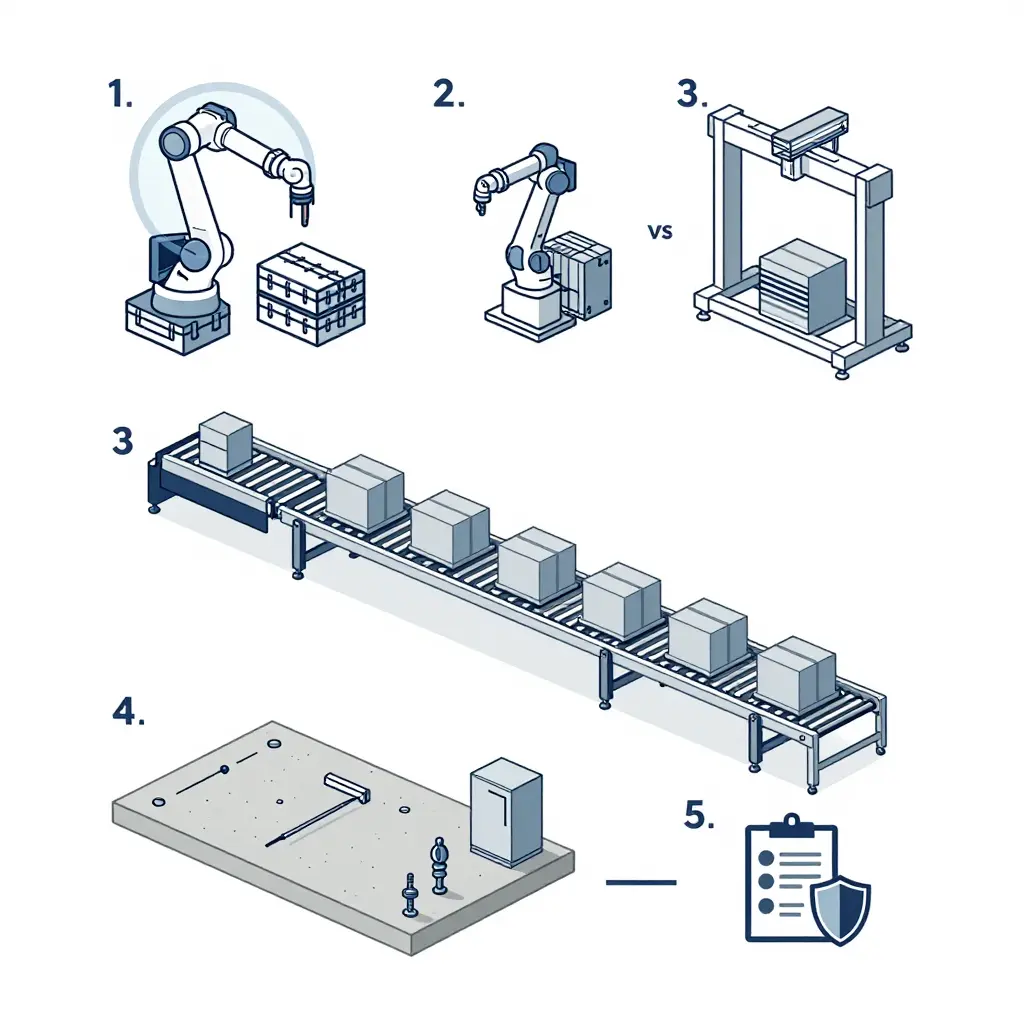
1. Payload and Reach: Verify Against the Real Case and Pattern Matrix
Build the payload budget first. Add the unit load mass, the end-of-arm tooling, the gripper frame, hoses and cable carriers, then hold that total at or below 70% of the robot’s rated payload. Read the payload curve at the worst-case reach, not at the base.
Then check the envelope. It has to cover the pick point, all four pallet corners and the top tier at full approach height, and it has to clear conveyor guide rails and the pallet dispenser frame.
Do not work from the datasheet. Build a pattern matrix as a spreadsheet:
- SKU, case length, width, height, and mass
- Pallet pattern ID, tier count, and maximum pallet height
- Pick orientation and label-facing requirement
- Number of teach points per pattern
Dry-cycle the heaviest case at the highest tier and the farthest corner. Confirm axis-stretch margin and tooling rotation clearance. Settle the trade-offs before you fix the arm, because more reach usually costs payload and acceleration. Compare configurations using these payload and reach trade-off criteria.
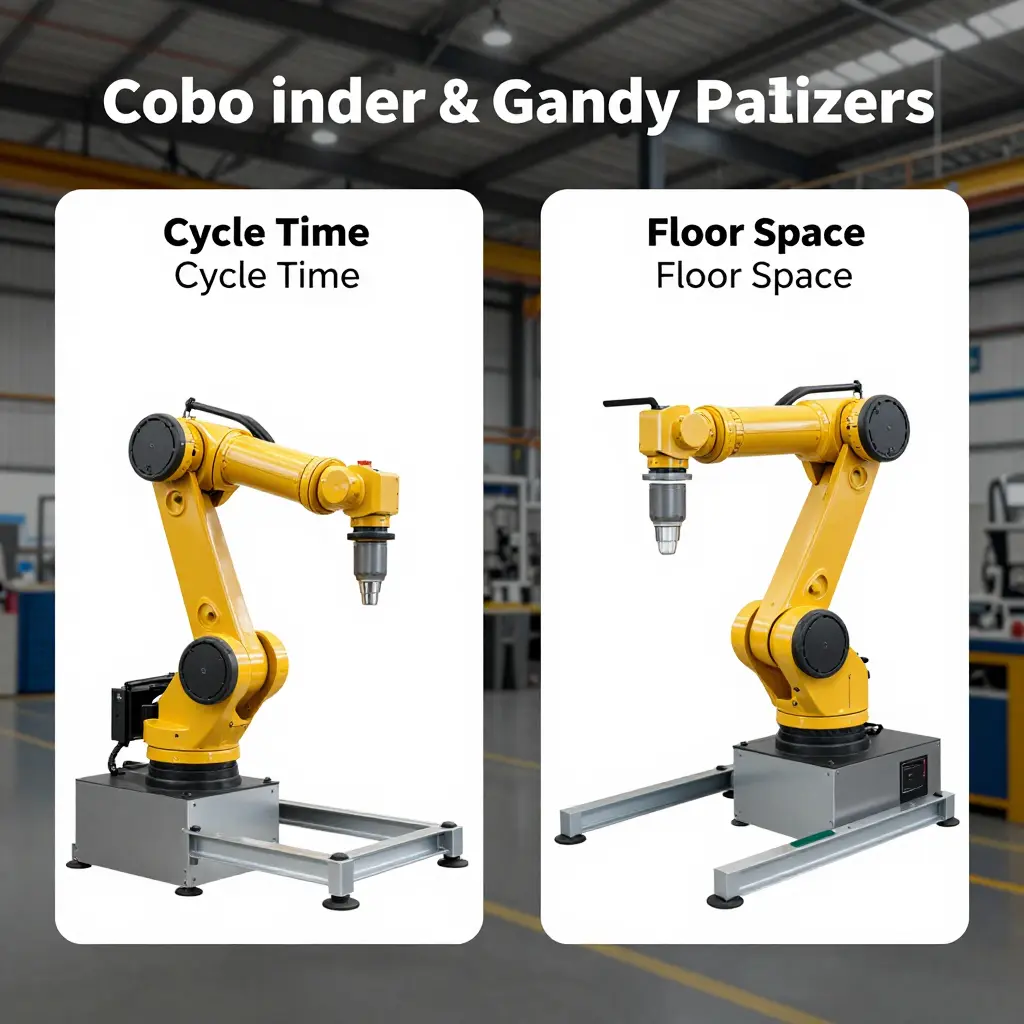
2. Cycle Time Versus Floor Space
Cycle time here means pick-to-place seconds per case at nominal reach. Multiply by cases per pallet, add pallet change time, convert the result to pallets per hour, and compare that figure against peak shift demand with 15-20% headroom for changeovers and stops.
Then count floor space honestly. The footprint includes the robot base, pallet dispenser, infeed, operator aisle and safety-rated clearance. A gantry palletizer wins on throughput and loses on layout flexibility. A cobot cell wins on layout and may need two cells to match the rate. Model both with the cycle time and floor space comparison on your own pattern matrix, not on catalog numbers.
3. Conveyor Integration, Infeed Buffering, and Changeover
Fix the handshake before shipment. Confirm discrete I/O versus fieldbus (EtherNet/IP, PROFINET, Modbus TCP), and match what the local integrator can support rather than what the OEM prefers.
Verify the mechanical interfaces:
- Conveyor deck height against the robot working plane
- Roller pitch, with a minimum of three rollers under the shortest case
- Guide rail adjustment range and transfer gap
- Sensor positions for case-present and pallet-present signals
Size infeed accumulation for 60-90 seconds of peak demand. Undersized accumulation turns every upstream stop into a robot stop.
Quantify changeover while it is still a paper exercise. Count teach points per new pattern, expect re-teaching of pick position, pallet corner definition and layer offsets, set a documented changeover target, then rehearse it at factory acceptance testing. Review these conveyor integration and changeover downtime benchmarks before you commit to a throughput figure.
4. Site Readiness: Floor, Anchoring, Power, and Compressed Air
Confirm the following with measured values, not verbal assurances.
| Item | Requirement to confirm | Verification method |
|---|---|---|
| Floor flatness | 3 mm deviation over 3 m at the cell footprint | Precision level or floor profilometer survey |
| Slab and structure | Slab thickness, reinforcement, and point load capacity | Structural drawing review and core test |
| Anchoring | Anchor type, embedment depth, and edge distance | Pull-out test on one anchor per cell |
| Power | 3-phase voltage, 50/60 Hz, dedicated circuit, breaker rating | Nameplate check and site measurement |
| Earthing | Earth resistance per local electrical code | Earth tester reading, recorded |
| Compressed air | 0.5-0.7 MPa (5-7 bar), dry and filtered, peak flow at gripper | Flow and dew point measurement |
Supply frequency is the most common surprise. A 60 Hz machine on a 50 Hz supply changes drive behavior. State the supply in the purchase order.
5. Documented Safety Risk Assessment and EHS Sign-Off
Perform the risk assessment to ISO 12100. Apply ISO 10218-1/-2 to the robot and ISO/TS 15066 to collaborative operation, working from the editions in force in the destination market. Then map the local overlay: in the EU, the Machinery Directive 2006/42/EC and its harmonized EN standards, until the Machinery Regulation (EU) 2023/1230 replaces the Directive on 20 January 2027; in the US, ANSI/RIA R15.06; in Canada, CSA Z434; elsewhere, the applicable national code.
File these deliverables before shipment:
- Risk assessment report with hazard list and risk reduction measures
- Safety function specification and validated performance level
- Guarding, interlock, and reset logic drawings
- Teach pendant and manual-mode operating rules
- Local-language documentation and machine labels
EHS signs off on lockout/tagout, maintenance access and residual-risk communication. Keep that sign-off in the local language and in the plant’s own EHS format, because an English-only file often stalls the acceptance audit.
Pre-Deployment Readiness Sequence
Run this sequence before the equipment is released for shipment. The plant engineering lead and the procurement lead sign every line jointly; that shared signature is what stops engineering assumptions and purchasing commitments from drifting apart between factory acceptance and site installation.
- Freeze the pallet and case specification. Lock carton dimensions, weights, layer patterns and pallet tolerances into one signed specification sheet, so that no late change reopens the mechanical design.
- Verify payload and reach against the pattern matrix. Confirm the selected cobot handles the heaviest case at the worst-case center of gravity and the farthest placement point in the real layer pattern.
- Survey floor condition and anchoring. Measure slab flatness, load capacity and anchor positions at the final installation footprint, then record the results against the civil drawing.
- Provision power, air, and network. Verify voltage, phase, breaker capacity, compressed-air quality and flow, plus network drops and IP addressing at the cell.
- Review local safety and EHS documentation. Check the risk assessment, guarding layout, certification requirements and lockout procedures against host-country regulations and site permits.
- Approve the spare parts budget and initial stocking list. Sign off the critical spares list, the annual consumables forecast and the holding-cost assumptions before the first purchase order closes.
- Name a training coordinator and trainee roster. Assign one accountable internal coordinator and list the named operators, maintenance technicians and supervisors with their shift coverage.
- Prepare customs classification and import documentation. Confirm HS codes, valuation, certificates of origin and duty treatment for the machine and for future service-parts shipments.
- Define the OEM support escalation path. Document tiered contacts, response-time commitments, remote-diagnostics access and on-site dispatch terms for the warranty period.
Item two is usually the long pole. Teams that settle payload and reach trade-offs early tend to clear items two and three in a single site visit, which can cut weeks off the sequence.
Spare Parts Stocking Matrix for an Overseas Cobot Palletizer
Before you negotiate a service level agreement or commit capital to a spares cabinet, put the whole bill of materials in one place. The matrix below groups a typical cobot palletizer by function, ranks the operational consequence of each failure, and assigns a stocking tier, so that air freight and customs clearance are not the things setting your recovery time.
| Part category | Representative components | Effect of failure on line availability | Recommended stocking tier (on-site kit / regional hub / OEM consignment) | Typical replenishment lead time | Suggested on-site quantity |
|---|---|---|---|---|---|
| Collaborative arm joints and motors | Joint modules, harmonic drives, joint motors, encoders | High: one failed joint stops all palletizing motion | On-site kit for highest-wear axis; OEM consignment for remaining joints | 4 to 8 weeks | 1 joint module (axis with highest duty), 0 spare motors |
| Robot controller and power module | Controller cabinet, CPU and I/O boards, 24 V power supply, brake release unit | Critical: full cell stop, no manual recovery | On-site kit plus regional hub backup unit | 2 to 4 weeks | 1 power module; 1 controller at hub |
| Teach pendant | Pendant, coiled cable, enabling switch | Medium: blocks teaching and fault diagnosis, auto cycle continues | Regional hub | 2 to 3 weeks | 1 shared across the palletizing cell group |
| End-of-arm tooling and vacuum grippers | Vacuum generator, ejectors, gripper frame, quick-change flange | High: no pick possible, immediate throughput loss | On-site kit | 1 to 3 weeks | 1 complete EOAT set plus 1 vacuum generator |
| Safety devices | Safety laser scanner, safety PLC, E-stop modules, interlock switches | Critical: cell cannot legally run until restored | On-site kit for E-stops; regional hub for scanner and safety PLC | 3 to 6 weeks | 2 E-stop modules; 1 scanner at hub |
| Wear items | Belts, suction cups, seals, dress-pack cables | Low to medium: gradual rate loss, quality rejects | On-site kit, consumable stock | 1 to 2 weeks | 12 months of consumption, for example 20 to 30 suction cups |
| Conveyor and infeed sensors | Photoelectric sensors, encoders, VFD, infeed motor | Medium to high: infeed stop, one lane starved | On-site kit | 1 to 2 weeks | 2 of each sensor type, 1 encoder |
| Firmware, software media and licenses | Controller firmware image, license dongles, validated configuration backup, HMI runtime | Medium: blocks restart after a crash or a failed upgrade | On-site kit for backup media; OEM consignment for licenses | 1 to 2 weeks | 1 validated backup set plus duplicate license media |
Note: quantities and lead times in this matrix are planning references only. Recalculate them per plant with the criticality and consumption method in the next section, because duty cycle, ambient conditions, local supplier coverage and inbound logistics differ significantly between sites.
The validated firmware image and configuration backup belong on the spares list in their own right. Review these firmware upgrade failure and rollback checks before any version change goes live on a production cell.
From Stock Matrix to Planning Method
A stock matrix records what you hold. What it cannot tell you is what to buy next quarter. Spare parts planning becomes repeatable when the matrix turns into a five-step loop that runs on every cell in the fleet and is re-scored on a fixed review cycle.
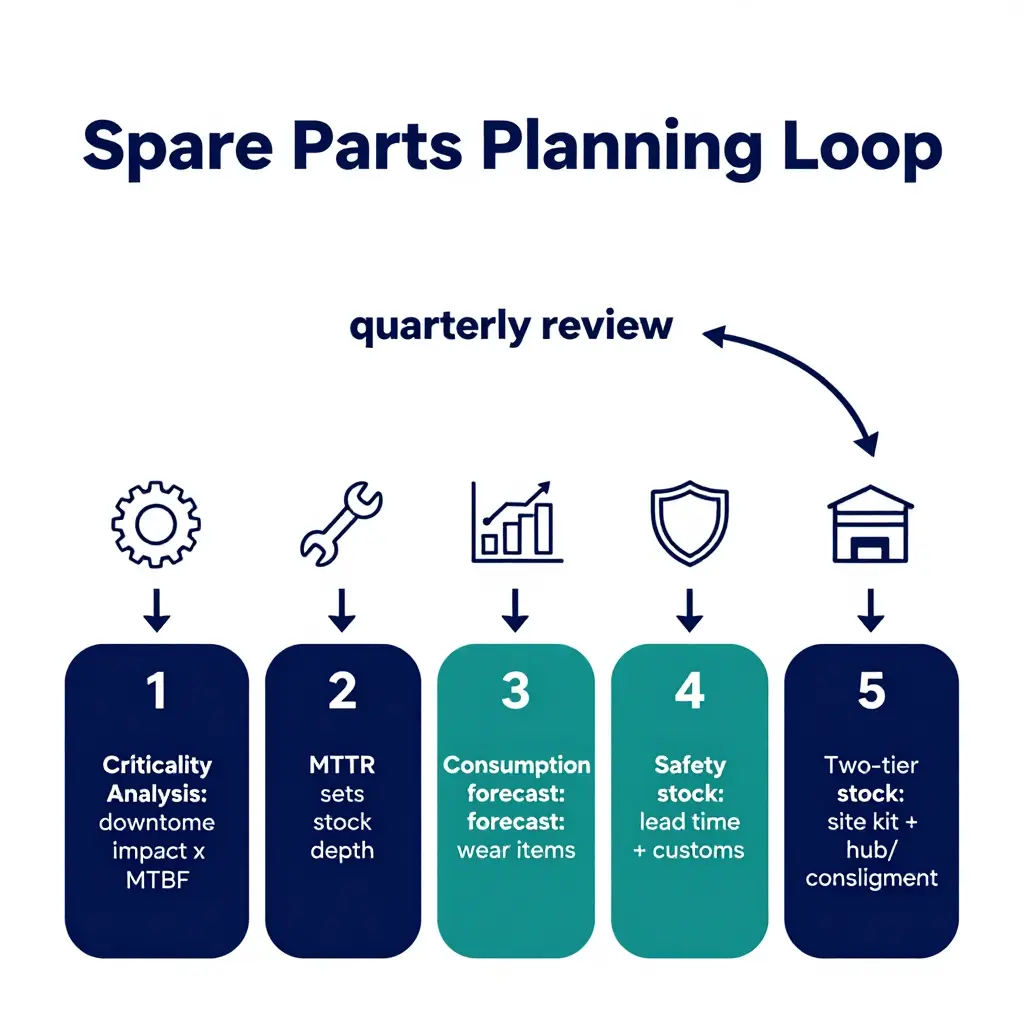
The loop is closed on purpose: field consumption feeds back into the criticality scores, so the method sharpens with every maintenance event instead of drifting out of date.
Step 1 – Criticality analysis: downtime impact x mean time between failures
Criticality analysis ranks every line item on two axes. The first is downtime impact, meaning what happens in the hours after a failure. The second is mean time between failures (MTBF), taken from vendor reliability data and, once the cell has run a full quarter, from your own event log.
| Criticality class | Downtime impact | Typical MTBF | Stock depth decision |
|---|---|---|---|
| A | Cell stops; dispatch gate blocked | 8,000-20,000 h | Hold on site, at least 1 unit, regardless of price |
| B | Cell runs degraded or at reduced rate | 20,000-40,000 h | Hold at regional hub; site kit optional |
| C | No throughput loss; cosmetic or scheduled | 40,000 h+ | Buy on demand with a validated alternate source |
| D | Consumable wear item | Days to weeks of use | Forecast by consumption, not by calendar |
Score each part as impact x frequency. A cheap sensor with a 9,000-hour MTBF that halts the line outranks an expensive servo drive with a 15-year life, and the matrix should show that. This is where a flexible, safety-rated end-of-line palletizing design pays off: fewer guarded-zone interlocks means fewer A-class items to stock.
Step 2 – Mean time to repair sets the depth of stock
MTTR, not criticality on its own, decides how many units of an A-class part you hold. If the documented MTTR for a failed gripper assembly is 90 minutes, one unit on site is sufficient. If the same failure needs 6 hours of mechanical work plus a 2-hour requalification of pallet patterns, two units may be cheaper than the exposure. As a rule of thumb, required on-site quantity = 1 + (MTTR in hours x number of cells the part serves) / 24, rounded up. A written, rehearsed repair procedure matters as much as the part: unrehearsed changeover and commissioning steps routinely double the real MTTR.
Step 3 – Consumption-based forecasting for wear items
Wear items – suction cups, bellows, seals, belts, brake pads, teach-pendant cabling – should never be forecast by calendar. Take the last 90 days of issues, divide by actual pallet throughput to get a consumption rate per 1,000 cycles, then multiply by the forecast volume for the next period. Then check the trend, because a new pallet format or a faster recipe can move vacuum-cup life by 20-30% inside one quarter.
Step 4 – Safety stock logic for cross-border supply
Safety stock covers two uncertainties that domestic planners often ignore: international lead-time variability and customs clearance. Both are lumpy, and both behave like a distribution rather than a fixed number.
- Replenishment lead time: quoted transit time plus a measured spread (max observed minus mean, not the vendor’s optimistic quote).
- Customs clearance variability: historical distribution of clearance days by HS code and port of entry, including the occasional inspection hold.
- Service-level target: 95% for A-class, 90% for B-class, 80% for C-class.
- Forecast error and MTBF confidence: a conservative multiplier where the installed base is small.
- Order-cycle review period: how often you actually place orders, not how often you intend to.
A workable formula: safety stock = Z x standard deviation of demand during lead time, where lead time includes the customs tail. For a part crossing borders with a 30-day mean and an 11-day spread, the safety stock quantity can easily exceed the average monthly consumption, which is exactly why it belongs in the plan and not in a surprise freight invoice.
Step 5 – Two-tier inventory structure
Split the stock into a fast tier and a slow tier. The fast tier is an on-site critical kit: A-class items plus the tools and jigs needed to install them, held inside the plant and audited monthly. The slow tier sits regionally, either in a hub serving several plants or as consignment stock on your floor that the supplier owns and invoices on withdrawal. Consignment converts a capital cost into a per-use cost, which is the cleanest arrangement for high-value B-class parts with long, unpredictable lead times.
Budgeting: initial stocking list and ongoing replenishment
Price the initial stocking list as a one-off project line, not a maintenance expense, and size it against the machine’s annual operating cost. A defensible planning band is 3-5% of annual operating cost for the first list and 2-3% per year for replenishment after that.
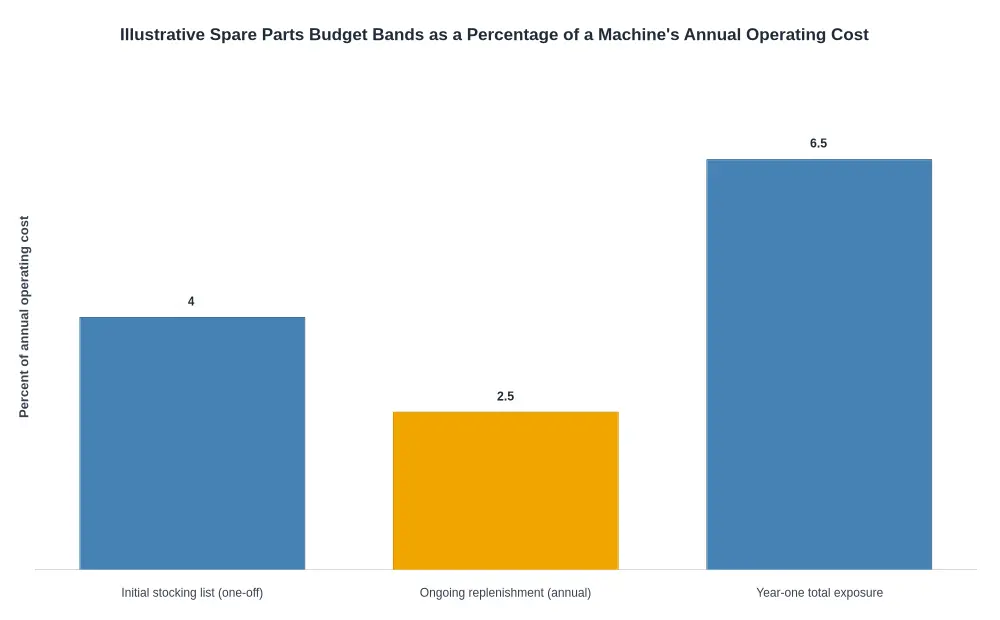
Those bands are check figures, not targets. If the initial list prices above 6% of annual operating cost, the criticality analysis is probably over-inclusive and should be re-scored against actual MTBF data.
Why reactive ordering is not an option at a gating cell
An end-of-line cobot palletizer gates dispatch. When it stops, finished goods stop moving, trailers sit, and the cost per hour is counted in dock slots and missed windows rather than in parts. Ordering an A-class item from overseas after a failure puts 4-8 weeks of transit and clearance between you and recovery. No service-level agreement survives that arithmetic, and no amount of expedited freight buys back a month. Reactive purchasing is acceptable for C-class items with validated local substitutes. For everything upstream of dispatch, the stock has to be planned, scored and funded before the cell is commissioned.
The Two-Tier Structure in One Drawing
The schematic maps how parts move among three holdings: the on-site critical kit at the machine, regional hub or distributor stock within shipping reach, and the OEM factory as the final replenishment source.
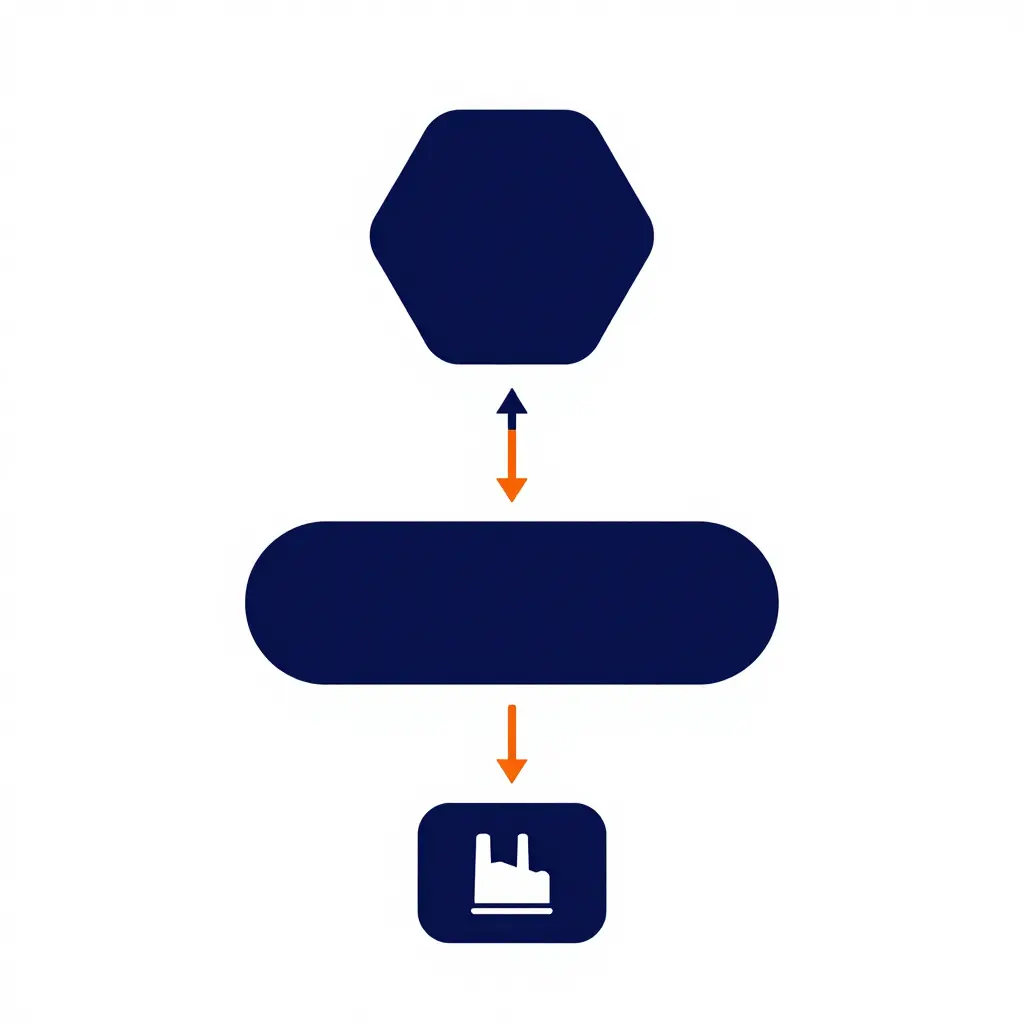
Read it in two directions. Solid arrows are normal replenishment: consumption at the line is refilled from regional stock, and regional stock is topped up from the factory on planned lead times. Dashed arrows are the exception path, released when a critical failure exhausts the on-site kit and a hub transfer or a factory air-freight shipment has to move ahead of schedule. Keeping the two paths apart is the point of the drawing, because it shows that buffer sizing at each tier, not heroics at the top, is what protects availability.
Overseas Logistics, Customs and Local Sourcing of Service Parts
A cobot palletizer deployment rarely fails because the robot arm was wrong. It fails because a low-cost suction cup sat in a customs queue while the end-of-line was down. Once the cell is running abroad, logistics becomes a reliability function: the spare parts strategy, the customs paperwork and the local supply network together decide whether the line recovers in hours or in weeks. The decisions below are the ones a procurement or supply chain manager should take deliberately and document in writing before the first container ships. For background on how these cells are usually laid out and commissioned, see this overview of collaborative cobot palletizers.
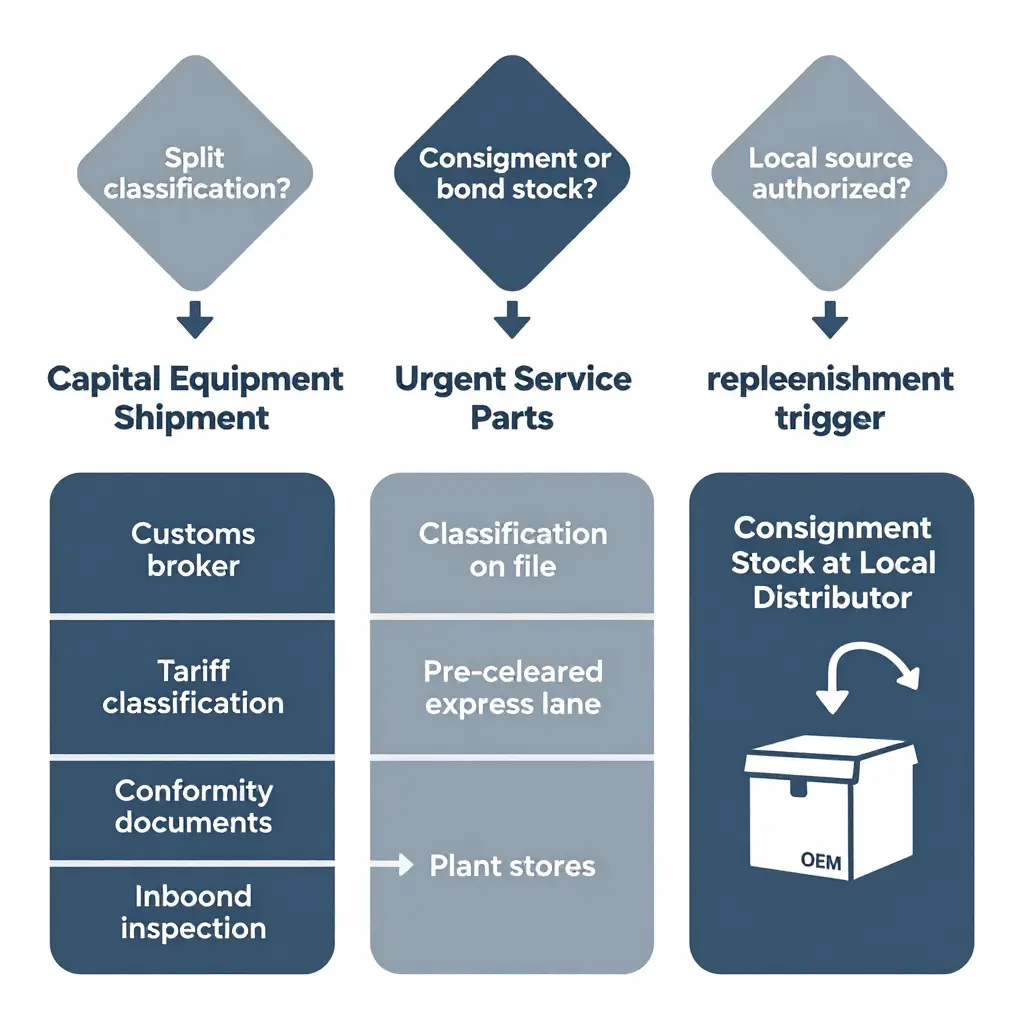
Decision 1: One tariff classification or two?
The cell ships as capital equipment; the parts ship as spares. They are not the same customs line, and treating them as one creates avoidable delay. A complete palletizing cell is declared on the basis of the machine’s principal function, with the robot, gripper, guarding and conveyor interface usually covered by a single heading and a stated country of origin. Individual components – a vacuum cup, a photoelectric sensor, a motor cable – may carry a different classification and, in free-trade-agreement contexts, a different origin qualification.
Settle before the first shipment: a binding classification and country-of-origin code per SKU, the declared-value basis (transaction value, plus freight and insurance where applicable), and one master data sheet shared with the broker, the distributor and the plant’s receiving team. Inconsistent descriptions between the invoice, the packing list and the bill of lading are the most common trigger for an inspection hold.
| Shipment type | Typical content | Documentation emphasis |
|---|---|---|
| Capital equipment | Robot, pedestal, gripper, guarding, controller cabinet, cables | Function-based classification, conformity and electrical-safety declarations, serial-number traceability, weight and lifting plan |
| Urgent service parts | Cups, sensors, cables, teach pendant, drive modules | Pre-filed classification on master data, part-number-to-machine mapping, returnable-goods or warranty-value declaration |
| Consignment stock | Criticality-tiered kit held at distributor | Ownership and duty-treatment statement, stock value reporting, replenishment and reconciliation schedule |
Decision 2: What clearance time will you design the buffer for?
Capital equipment clearance commonly runs in days to weeks, because it triggers conformity assessment, electrical-safety documentation and, in some jurisdictions, on-site inspection or a temporary-import regime for commissioning tools. Low-value service parts with pre-filed classification and complete documentation usually clear in a day or two on an express lane, but only if the paperwork already exists. The question is not whether the difference exists; it is whether your buffer absorbs it.
Agree in writing: a target clearance time per shipment class, the buffer stock level that covers the worst realistic case, and an escalation contact for both the broker and the plant’s customs team. Criticality tiering, line-stopping versus scheduled-maintenance parts, belongs in the same document.
Decision 3: Consignment stock, or distributor-owned bond stock?
This decision moves more cash than any other in the section. Consignment stock puts physical inventory in-country while title stays with the supplier until consumption; distributor-owned bond stock shifts the inventory risk to the partner but usually buys less responsiveness at the top criticality tier. Either way the parts are a truck ride away instead of a customs file away, which is the point for an overseas plant.
Write into the agreement: who holds title, who bears duty and import VAT, who insures the stock, the min/max levels per criticality class, the replenishment trigger and lead time, the reconciliation and audit cadence, and the treatment of slow-moving and obsolete items at contract end.
Decision 4: Which SKUs can be locally sourced, and which cannot?
Commodity items are legitimately localizable: pick-up bellows cups and flat cups in standard durometers, standard inductive and photoelectric sensors, M12 and M8 cordsets, pneumatic tubing and push fittings, brackets and fasteners. Qualify them on measured equivalence – cup material hardness and chemical resistance, sensor sensing range and output type, cable flex and bend-radius rating, temperature range – not on the drawing alone.
Anything carrying a validated safety function or sitting in the controls chain stays OEM-authorized and OEM-sourced: safety-rated I/O and relays, light curtains, the controller, the teach pendant, firmware-bearing modules, and any component covered by a functional-safety declaration. Local substitution in these positions voids warranty and invalidates the risk assessment.
Keep on file: an approved-local-sourcing matrix per SKU, the substitution approval route and its turnaround, and the explicit list of safety-critical and controls components that remain OEM-supplied under all circumstances.
Decision 5: How are currency, payment terms and warranty claims handled?
Invoicing spares in the OEM’s currency while the plant budgets in local currency creates a recurring variance on small, frequent orders. Decide whether to invoice spares in a single contract currency with a periodic price review, or to accept local-currency invoicing at a stated conversion convention.
Warranty handling needs the same precision: the currency and conversion convention, payment terms split between capital equipment and service parts, the failure-reporting route and evidence pack (controller logs, cycle counts, date codes, photographs), who issues the return authorization, who pays inbound and outbound freight on a valid claim, and the credit mechanism for downtime-critical failures.
Decision 6: What goes into the supply agreement?
None of the above lasts unless it is contractual. A workable overseas support schedule fixes a criticality-classified spare parts list with committed dispatch lead times; consignment stock levels and replenishment service levels; the approved local sourcing matrix and the OEM-authorization boundary; price validity, currency and escalation terms; the warranty claim procedure and freight allocation; and a last-time-buy and end-of-life notification window for discontinued components.
Review that schedule on the same cadence as the plant’s maintenance plan. On a cobot palletizer deployment, the difference between a two-hour recovery and a two-week outage is usually settled in the procurement paperwork, long before anyone reaches for a wrench.
Illustrative Distribution of Spare Parts Consumption by Category Over a Three-Year Service Window
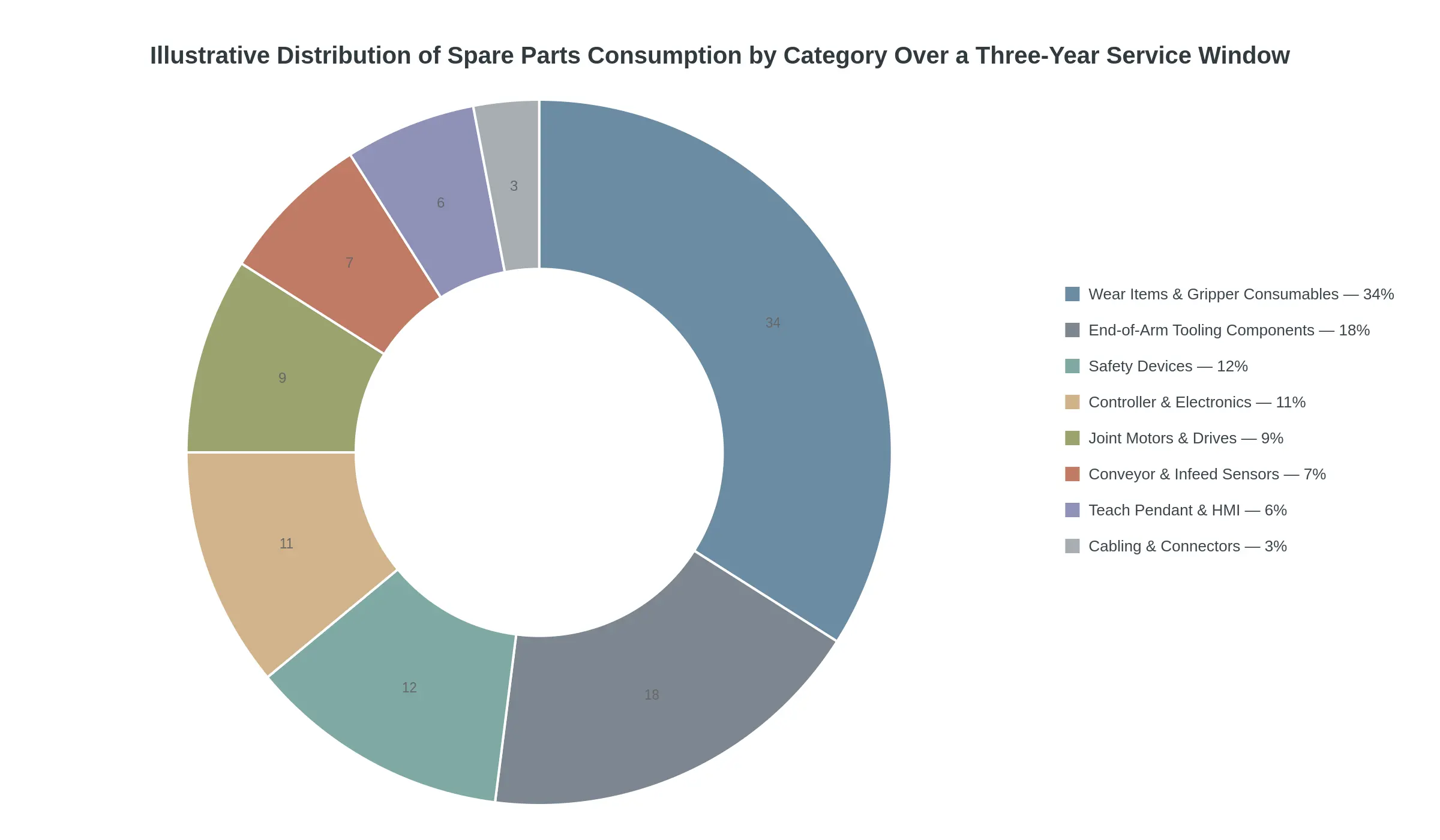
Caption: This split is a planning reference derived from typical field consumption patterns and should be replaced with the plant’s own maintenance data after the first operating year.
Designing the Operator Training Program: A Role-Based, Competency-Gated Approach
At an overseas plant the cell usually stops for a reason that has nothing to do with the robot: at 02:00 the arm parks itself after a zone violation, the line backs up, and nobody on shift knows the recovery sequence. That makes training a design deliverable, scoped and budgeted alongside spare parts planning, not an onboarding formality bolted onto commissioning. The program below is built so that every learner leaves with a signed competency record tied to a named role, not a certificate of attendance.
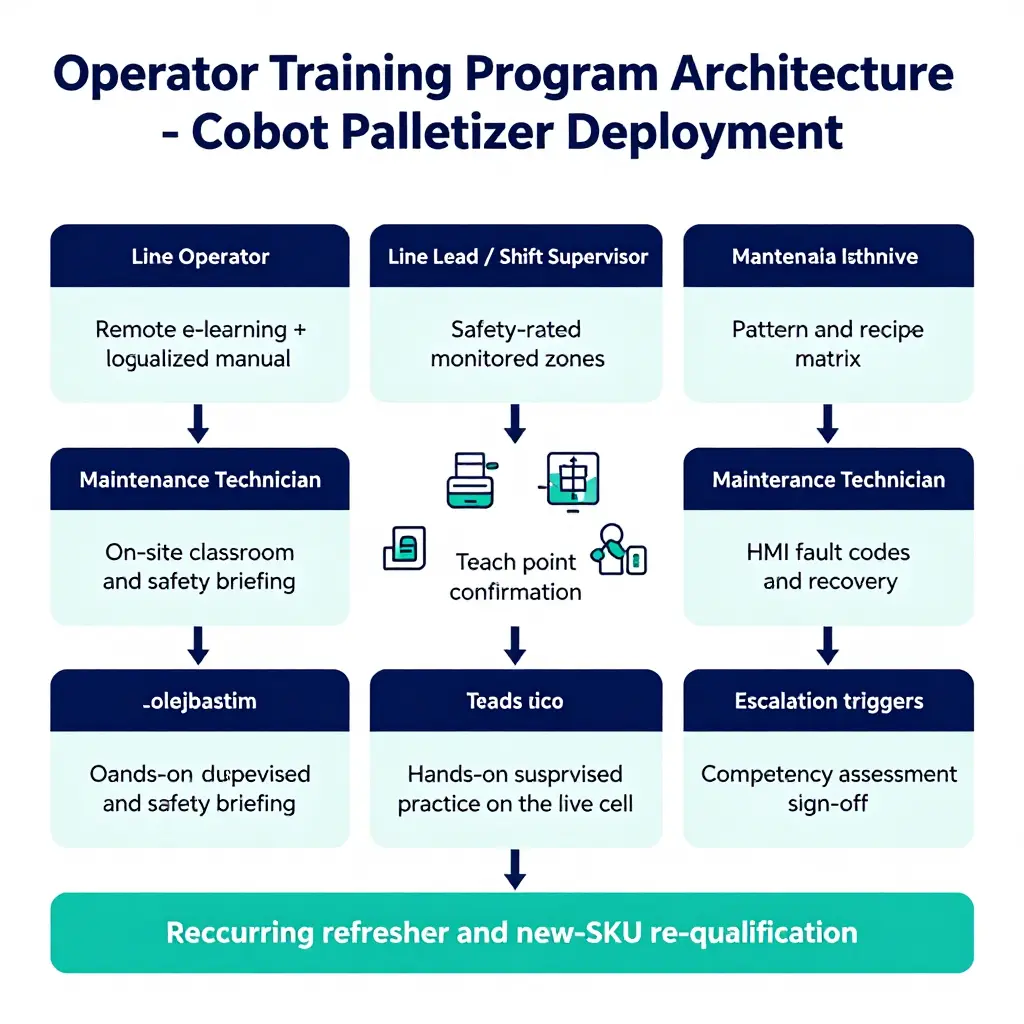
Build the framework around three roles, not three shifts
Resist the temptation to train everyone to the same syllabus. The practical division of labor in an overseas plant is almost always three-tiered, and the competency framework should mirror it.
| Role | Primary responsibility | Depth of knowledge |
|---|---|---|
| Line operator | Runs the cell, selects recipes and patterns, performs first-line recovery | Perform tasks correctly and consistently |
| Line lead / shift supervisor | Authorizes restarts, confirms teach points after changeover, manages escalation | Perform, verify and authorize |
| Maintenance technician | Diagnoses faults, intervenes inside the cell, restores function | Diagnose, repair and document |
Each tier holds a defined set of skills. A line operator has to work safely around the collaborative arm and understand the safety-rated monitored zones: where the cell slows, where it stops, and why stepping into a zone is never a shortcut. Operators select the correct pattern and recipe on the HMI, confirm teach points after a changeover, read basic fault codes, and execute the approved first-line recovery actions. They also have to know where their authority ends, so the escalation triggers for a repeated fault, a loss of gripper vacuum, a misplaced pallet or any unexpected arm motion should be memorized rather than looked up.
Line leads add verification: confirming teach points with the cell in a safe state, checking that the selected recipe matches the work order, releasing the cell after a changeover and logging the event. Maintenance technicians go deeper, into monitored-zone configuration logic, gripper and sensor servicing, axis recovery, and the diagnostic trees behind each HMI fault code. A practical test of any sign-off is that nobody is certified on a competency they cannot demonstrate unprompted, twice, on the production cell.
Blend remote, on-site and hands-on instruction with published hours
Training delivered entirely on site wastes expensive commissioning days. Training delivered entirely remotely produces confident people who have never touched the HMI. Sequence the modalities deliberately: remote modules before travel, classroom and safety briefings on arrival, and most of the hours on the live cell under supervision.
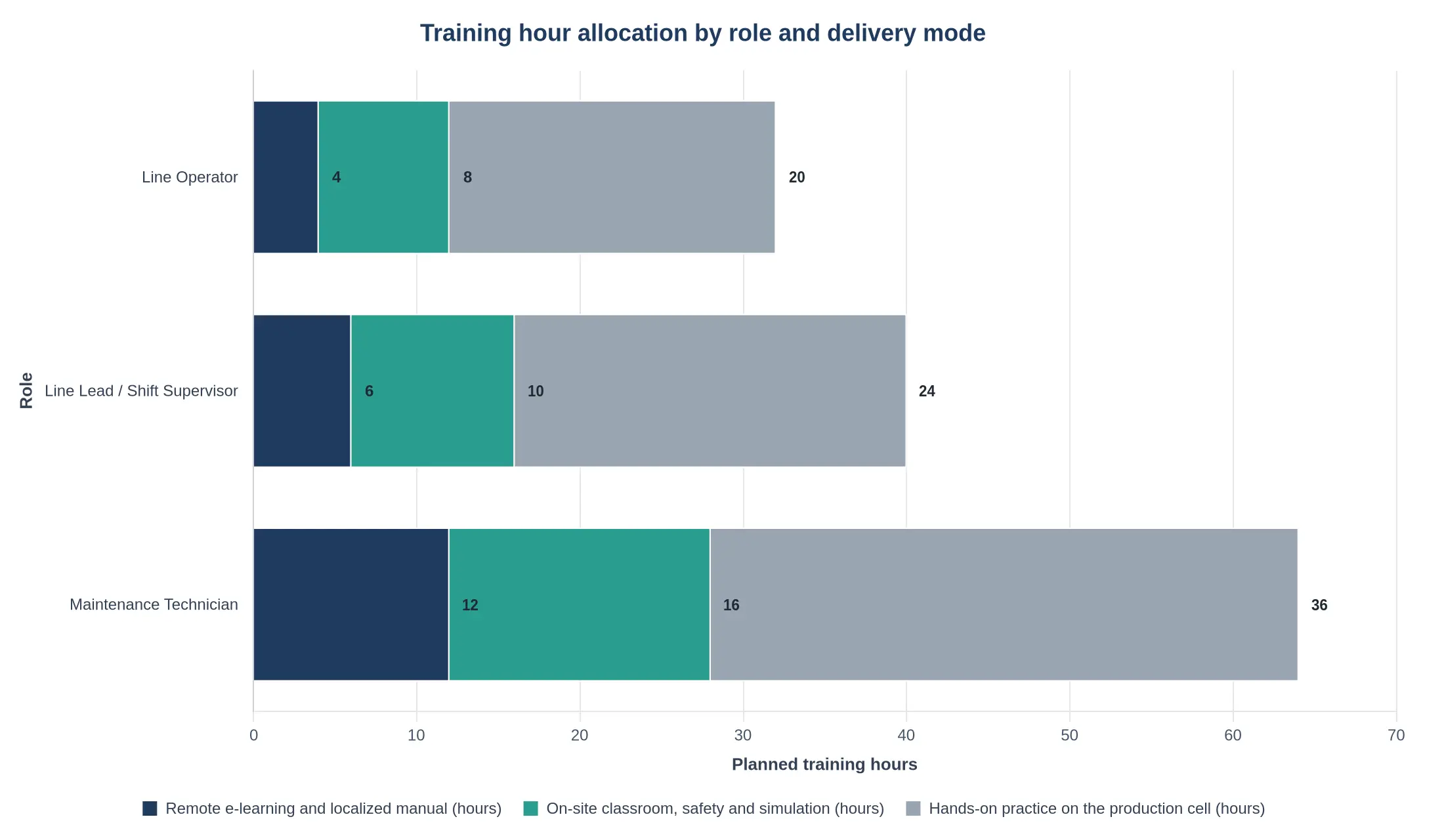
Those allocations are planning baselines, not ceilings. Two adjustments matter in practice. Front-load the remote modules at least three weeks before shipment, so that language problems surface early enough to fix. And spread hands-on hours across more than one shift pattern, because a learner who has only run the cell on day shift has not been trained for the night shift, when the only person available is a line operator.
Train on the real pattern matrix and changeover sequence
Demonstration cases are comfortable and misleading. A cell demonstrated with three tidy SKUs on one pallet size teaches nothing about the forty-recipe pattern matrix that actually runs in the plant. Train on the production matrix itself: every pattern and recipe in the live library, the naming convention, the parameters that must never be edited without authorization, and the exceptions that come up monthly rather than daily.
The changeover sequence deserves the same treatment. Walk it in the order it happens – line stop, cell state confirmation, tooling or gripper adjustment, recipe selection, teach point confirmation, dry run, restart authorization – and have each learner execute it end to end while the trainer says nothing. Silence is the assessment. For a closer look at how changeover discipline affects uptime, see this guide on cobot palletizer integration with conveyors, commissioning and changeover downtime.
Localize manuals, labels and HMI screens properly
Localizing manuals, labels and HMI screens is a safety task before it is a translation task. The text has to be in the language the shift actually speaks, using the terms operators already use on the floor rather than a literal engineering translation. Three rules keep it manageable. Keep HMI strings short enough to fit the screen at the target language’s word length. Keep fault codes and numbers identical across languages, so that a phone call to a remote engineer still works. And validate the localized screens with a small group of actual operators before sign-off, because the real test is whether a competent operator can find a menu without help.
Assess each competency with a defined method
Assessment should mirror the competency, not the syllabus.
| Competency | Assessment method | Pass criterion |
|---|---|---|
| Safe interaction with the arm and monitored zones | Observed walk-through with deliberate zone entry | Stops at the correct boundary without prompting |
| Pattern and recipe selection | Live task on the production matrix | Correct recipe for 10 of 10 work orders |
| Teach point confirmation | Supervised execution after changeover | Correct sequence, correct confirmation, no missed points |
| Basic fault reading on the HMI | Fault-code recognition exercise | Correctly identifies fault family and required action |
| First-line recovery actions | Practical recovery drill | Cell restored or safely parked within the defined time |
| Escalation triggers | Scenario interview plus logbook entry | Escalates at the defined trigger, with complete information |
Record every result against a named role and a revision of the cell configuration. When the pattern matrix changes or a new SKU family arrives, re-qualify rather than assume. That single habit keeps training, palletizer performance and uptime targets aligned long after the commissioning team has gone home.
Training Curriculum Modules for the Cobot Palletizer Program
The nine modules run in sequence, from safety awareness through supervised practice to independent operation and first-line maintenance. Each one closes with a verified competency check before the next opens.
- Collaborative robot safety and safe zones – 3 hours – Trainee maps every safety-rated zone on the cell layout, demonstrates correct behavior for each stop category, and scores 100% on the critical safety checkpoint items.
- HMI and pattern/recipe management – 2 hours – Trainee creates, edits, saves, and restores a pallet pattern recipe, and confirms version control so a prior recipe can be recalled without engineering support.
- Teach pendant basics and teach point verification – 4 hours – Trainee jogs the cobot in joint, base, and tool frames, records teach points to ±1 mm positional tolerance, and validates a revised point via single-step dry run.
- Changeover and infeed handshake procedures – 3 hours – Trainee completes a full SKU changeover, including conveyor handshake and interlock verification, inside the target changeover window with no unverified bypasses.
- First-line fault diagnosis and recovery – 4 hours – Trainee decodes alarm codes, isolates faults to the gripper, vacuum, vision, conveyor, or controller subsystem, executes the documented recovery, and escalates within the defined response window.
- Preventive maintenance tasks and inspection intervals – 2 hours – Trainee executes the daily, weekly, and quarterly PM checklist, logging vacuum level, belt tension, and fastener torque against specification tolerances.
- Wear item replacement – 3 hours – Trainee replaces suction cups, gripper pads, drive belts, filters, and backup battery per procedure, then confirms function with a post-replacement validation cycle.
- Firmware and software update procedure with rollback awareness – 2 hours – Trainee performs a staged update on a training controller, confirms the pre-update backup, and demonstrates rollback to a known-good version.
- Documentation, records, and escalation protocol – 1.5 hours – Trainee maintains shift logs, PM records, and incident reports, and applies the escalation matrix with correct contact tiers and response times.
Guided instruction totals roughly 24.5 hours, typically scheduled across three days and followed by a 30-day supervised operation sign-off. A failed update is one of the most disruptive events an overseas cell can suffer with limited local support, so Module 8 should be re-validated annually; review these firmware rollback checks when you refresh it.
Train-the-Trainer and Competency Sign-Off: Sustaining Competence After Commissioning
The commissioning team leaves, which is the design intent. What decides whether the line stays productive is whether the plant can produce competent operators and maintainers without flying in OEM engineers for every new hire, every pattern change and every firmware release. That takes a closed training system: certified internal trainers, a three-level competency ladder with objective sign-off criteria, records that survive staff turnover, and an audit loop that measures competence in deviations and recovery time rather than in attendance hours.
Because a collaborative cobot palletizer platform shares a teach-pendant and configuration model across cell variants, material written once stays transferable when the plant adds a second or third cell. Build the curriculum around that platform logic, not around a single serial number.
Step 1: Select and Certify Internal Trainers
A trainer is not simply the most experienced operator. Nominate candidates against explicit criteria, then certify them through the same gateway the OEM used.
- Selection criteria: minimum 12 months on the cell or equivalent automation, zero safety deviations in the preceding 6 months, demonstrated changeover capability, and written endorsement from the shift supervisor.
- Train-the-trainer pathway: co-delivery of two operator cohorts under OEM observation, then solo delivery of one cohort with an OEM or lead-trainer assessor present.
- Trainer assessment: a written examination on cell theory plus a practical assessment covering fault recovery, pattern changeover and safe intervention. Both must pass independently.
- Authorized trainer registry: certified trainers listed by name, level, scope and expiry date. A plant with fewer than two active trainers per shift pattern has a single point of failure and should flag it in the training plan.
Certified trainers own delivery, records and the first-line competence audit. OEM support moves from travel to remote review.
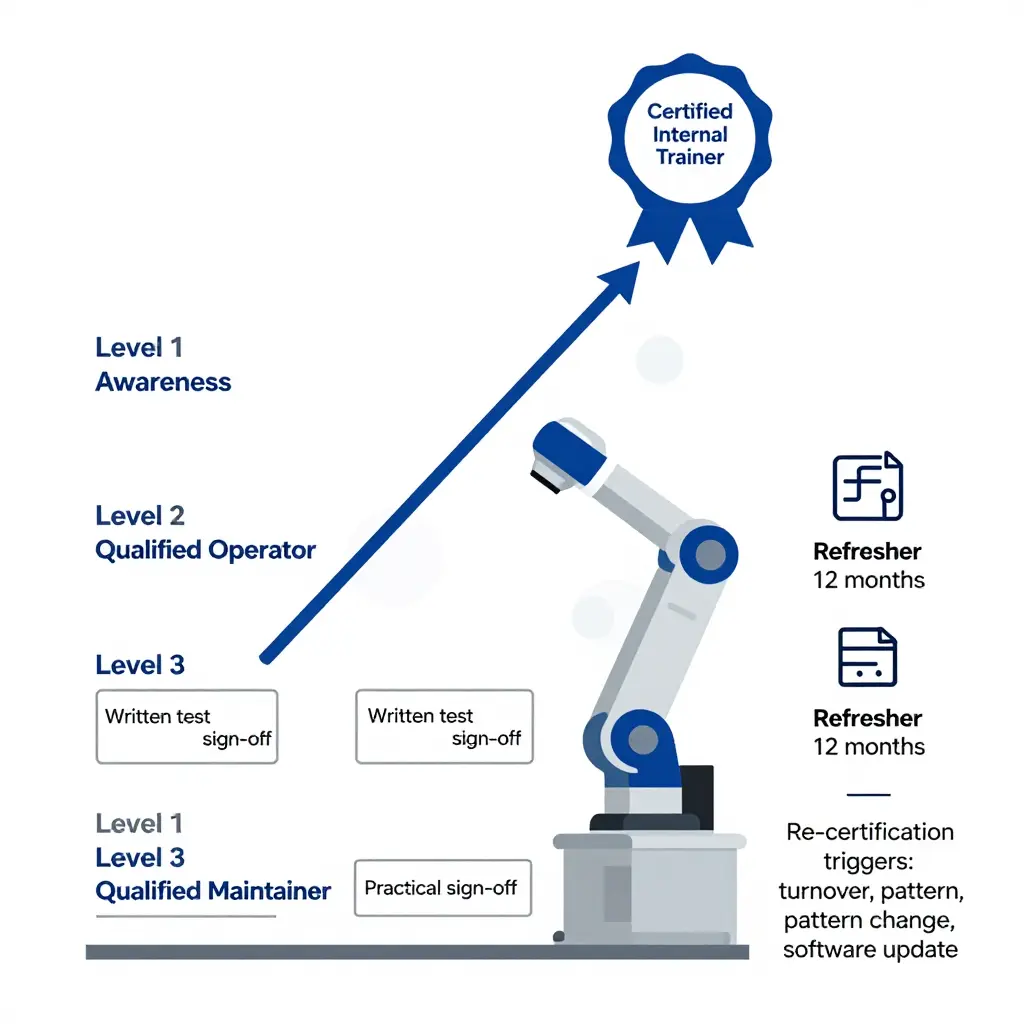
Step 2: Apply Three-Level Certification with Objective Sign-Off
Every level requires both a written and a practical pass. Neither substitutes for the other: a candidate who can recite the safety envelope but cannot run a changeover is not qualified, and the reverse holds too.
| Level | Scope | Written criterion | Practical criterion | Sign-off authority |
|---|---|---|---|---|
| 1 – Awareness | Safety envelope, mode selection, e-stop locations, restricted zones, escalation path | Closed-book, 25 questions, 80% pass | Supervised walk-through of cell boundaries and stop functions, 100% of checklist items | Certified internal trainer |
| 2 – Qualified Operator | Start-up and shutdown, recipe and pattern selection, changeover, first-line fault clearing, end-of-shift handover | 40 questions, 85% pass | Two consecutive clean changeovers, three fault scenarios cleared without assistance, correct escalation on one induced fault | Certified internal trainer plus shift supervisor |
| 3 – Qualified Maintainer | Preventive maintenance, gripper and vacuum service, calibration checks, firmware update execution, rollback verification, post-maintenance validation | 50 questions including firmware and recovery logic, 85% pass | Full PM performed unassisted, firmware update and rollback drill completed, one fault diagnosed from logs and corrected | Maintenance manager plus certified trainer |
Record the pass mark, the assessor name and the date for every level. A verbal confirmation is not a sign-off.
Step 3: Maintain a Training Record the Plant Can Defend
The record has to answer one question quickly: who is competent to do what, right now, on this cell?
| Record field | What to capture | Refresh and retention |
|---|---|---|
| Personnel profile | Name, employee ID, role, shift pattern, hire date | Updated on role change |
| Competency level | Current level per cell or cell group, with pass marks | Reviewed every 12 months |
| Assessment evidence | Scored written paper, practical checklist with assessor signature | Retained for the employment period plus 3 years |
| Trainer authorization | Trainer level, scope, expiry, cohorts delivered | Renewed every 24 months |
| Refresher log | Date, content, duration, trainer, outcome | Operators every 12 months, maintainers every 12 months, awareness every 24 months |
| Re-certification trigger | Trigger type, date raised, retraining completed, re-assessment result | Closed within 30 days of the trigger |
Define the triggers in writing, so that the plant does not wait for an incident before reactivating training:
- Staff turnover: any new hire entering the cell requires Level 1 before unsupervised access and Level 2 before operating production patterns; a vacancy that drops a shift below two Level 2 operators triggers immediate cross-training.
- Pattern changes: a new pallet pattern, carton format, layer configuration or conveyor interface invalidates the changeover practical and requires re-assessment at Level 2.
- Major software updates: any firmware or configuration release that alters motion sequences, safety monitoring or fault codes requires re-assessment at Level 3 before the update runs in production.
- Post-incident review: any safety deviation, near miss or repeated fault clears the relevant level pending re-assessment.
Step 4: Build Firmware Discipline into Maintenance Training
Firmware is among the least-trained maintenance tasks on most palletizing cells, because it fails rarely and fails expensively. Treat it as a procedural competency with a supervised drill, not a reading assignment.
Qualified maintainers must demonstrate the rollback verification steps before and after every upgrade: confirm that the current version and configuration are backed up and restorable, that the target image is available offline at the cell, and that the defined rollback trigger is documented and understood. After the update, they confirm that the reported version matches the target, run a functional cycle test, and validate safety and I/O status before releasing the cell to production.
Run the drill annually, on a non-production cell or during a planned stop. A maintainer who has never executed a rollback is not qualified to execute an upgrade.
Step 5: Audit Effectiveness in Deviations and Recovery Time
Attendance and test scores measure delivery, not competence. Audit the outcome instead.
- Observed deviations: tracked deviations and manual interventions per 1,000 palletized units, compared before and after each training cohort. A cohort that does not move the rate points to a curriculum or delivery problem.
- Recovery time: time from fault occurrence to first good pallet, measured from cell logs. This is the clearest single indicator of operator competence, and it needs no opinion to measure.
- Checklist fidelity: percentage of maintenance tasks completed with the correct sequence and documentation, sampled during observed audits rather than self-reported.
- First-time-right changeover: proportion of pattern changes completed without assistance or rework.
Sample monthly, review quarterly. Where recovery time drifts upward on one shift, retrain that shift before escalating to engineering. Where it drifts upward on every shift, review the curriculum and the OEM’s baseline data together.
Competence is a maintained asset. A plant that certifies its own trainers, signs off levels against written and practical criteria, keeps defensible records and audits recovery time will not need the commissioning team back.
Training-to-Handover: The Sequence at a Glance
The path an overseas operating team travels runs from factory acceptance testing at the OEM’s facility to full local ownership in the plant. The diagram maps it end to end.
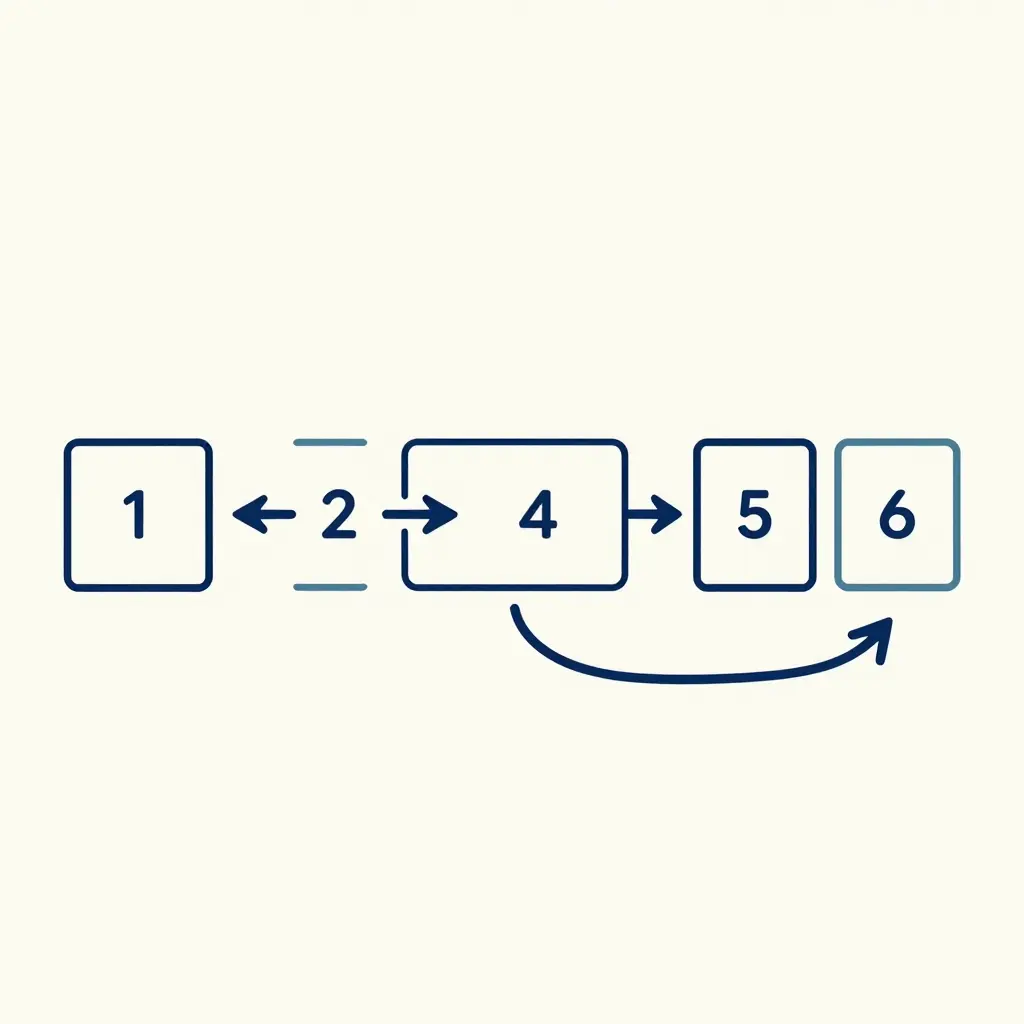
Figure: Training-to-handover process logic – six stages from factory acceptance to local ownership, with a refresh loop returning to competency assessment.
Classroom and remote modules build a shared vocabulary before anyone touches the cell. On-site hands-on training transfers technique onto the real palletizer. Supervised production running turns technique into throughput across real shifts and real changeovers. Assessment and sign-off confirm that the team can run, clean, recover and hand over the line unaided. Local trainer certification builds internal capability instead of permanent dependence on visiting engineers, and a refresher cycle keeps that capability from quietly decaying.
The loop-back arrow matters. Refreshers feed straight back into assessment instead of restarting the whole program, which is what keeps periodic requalification short, targeted and cheap to schedule around production. Treat each stage as a gate rather than a date on a calendar and the handover becomes auditable: an auditor or a new plant manager can see which stage the local team has passed and where support is still required. Teams planning the ramp-up phase will find useful context on commissioning and changeover downtime, since supervised running is where those hours are actually consumed.
Performance Monitoring and Continuous Improvement
A spare parts plan and an operator training program are hypotheses, not guarantees. The only way to find out whether either is working is to measure the cell against a small, fixed set of indicators every month and to change the plan when the data says so. In overseas plants, where a technician visit costs days rather than hours, that discipline matters more than the equipment specification.
Seven indicators to track every month
Keep the set narrow enough that the plant manager, the maintenance lead and the OEM or integrator all read the same numbers. Define each indicator once, in writing, and leave the definitions alone mid-year.
| Indicator | How it is measured | Typical target | Action trigger |
|---|---|---|---|
| Line availability of the palletizing cell | Uptime divided by scheduled production time, excluding planned maintenance | 95% or higher | Below 93% for two consecutive months |
| Mean time to repair (MTTR) | Clock time from fault call to first good pallet, averaged across all corrective work | 4 hours or less | Any single event above 8 hours |
| First-time-fix rate by fault code | Share of interventions resolved without a repeat call on the same code within 7 days | 85% or higher | Any top-5 fault code below 70% |
| Spare parts consumption versus plan | Parts issued against the forecast baseline, by part number and by month | Within plus or minus 20% | Three months of sustained over- or under-consumption |
| Stockout incidents | Count of events where a required part was not on site and blocked the repair | 0 | First occurrence of any A-class part |
| Operator-induced stoppages | Stoppages attributed to incorrect load, pattern, or restart sequence after review | Downward trend month on month | Share above 25% of all stoppages |
| Average recovery time per stoppage | Mean minutes from stop to resumed production, split by root cause group | Under 20 minutes for operator-correctable faults | Rising trend for three months |
The chart below shows the pattern a healthy deployment should produce: availability and first-time-fix rate climbing as training matures, while stockout incidents fall once the parts list has been re-baselined.
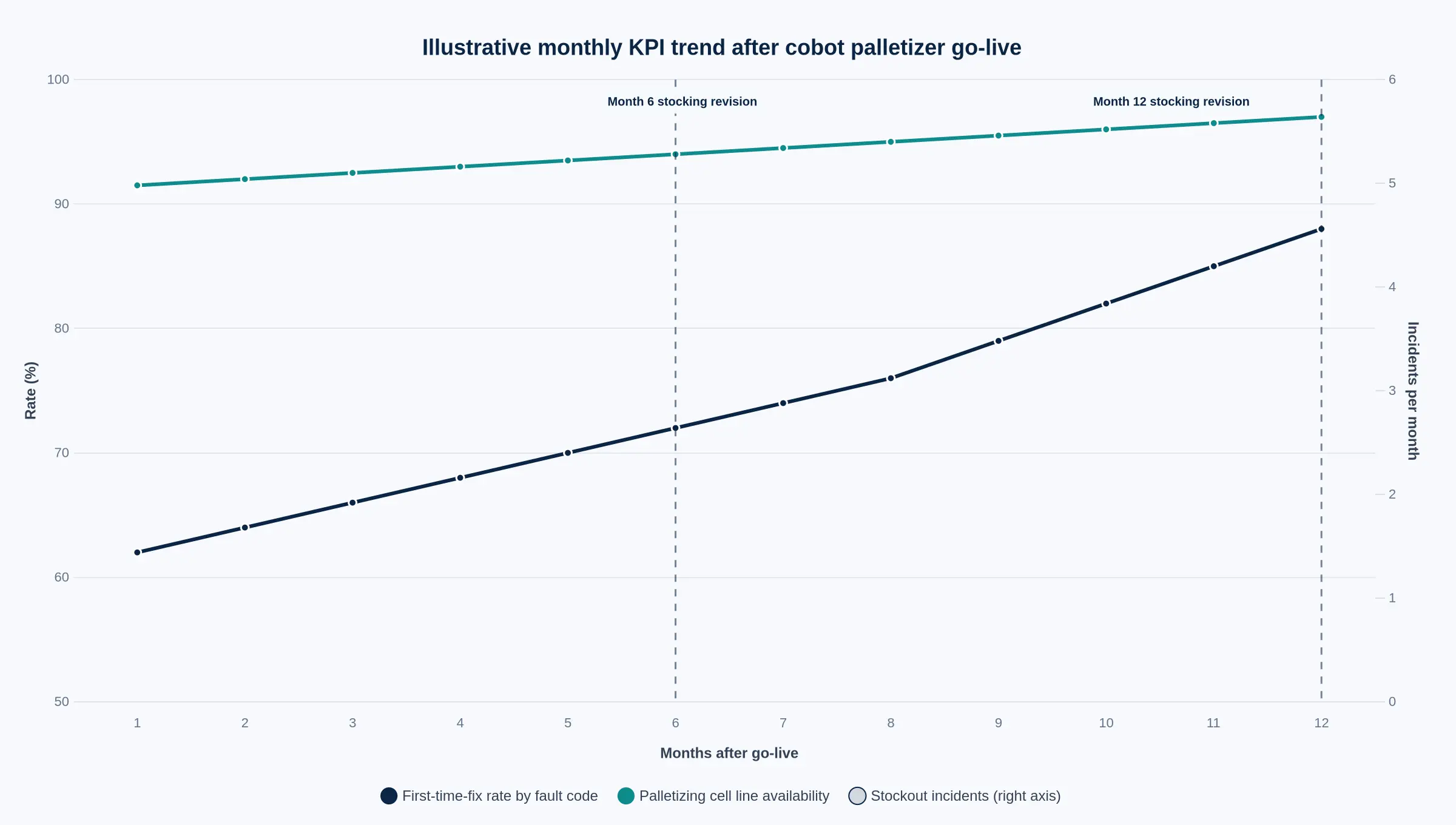
Two rules keep the data honest. Every stoppage gets exactly one root-cause code, chosen jointly by maintenance and production rather than by whoever is on shift when the report is written. And recovery time is measured at the cell, not at the maintenance desk, so that travel and diagnosis time stays visible.
A fixed service review cadence
Run a 45-minute internal review monthly, with the maintenance lead owning the numbers and the production manager challenging the cause codes. Hold a joint service review with the OEM or integrator on a fixed quarterly date, booked for the full year in advance so that peak season does not cancel it.
Keep the joint agenda short and repetitive: the seven indicators against target, the top five fault codes and their first-time-fix performance, parts consumed against plan, open corrective actions from the previous review, and one training gap identified in the field. Plants running conveyor infeed with frequent SKU changes should also separate stoppages caused by conveyor integration and changeover downtime from those caused by the robot itself, otherwise training needs get misdiagnosed as hardware faults.
Escalate by exception. Any A-class stockout, any MTTR event above 8 hours, or any first-time-fix rate below 70% on a top-five code gets a written corrective action with an owner and a date, reviewed at the next joint session.
Revising stock levels at six and twelve months
Initial spares planning is an educated guess built on published failure rates and assumed duty cycles. Replace the guess with evidence in two stages.
- Month 6: re-baseline using six months of consumption. Raise minimum levels for any part with two or more issues, add parts consumed faster than forecast, and remove or downgrade slow movers that have never been touched. Working capital tied up in parts should fall at this point.
- Month 12: re-baseline again against a full year, which captures seasonality, ambient conditions and the real effect of trained operators on wear. At this stage, reconcile consumption against the OEM’s recommended list and negotiate consignment or vendor-managed stock for critical, slow-moving items.
Document each revision and the reasoning behind it, so that the next plant in the region can start from a validated baseline instead of a catalog.
From parts-only supply to a tiered service agreement
Once twelve months of data exist, the conversation with the OEM or integrator should move past purchase orders. A tiered agreement turns reactive buying into predictable support.
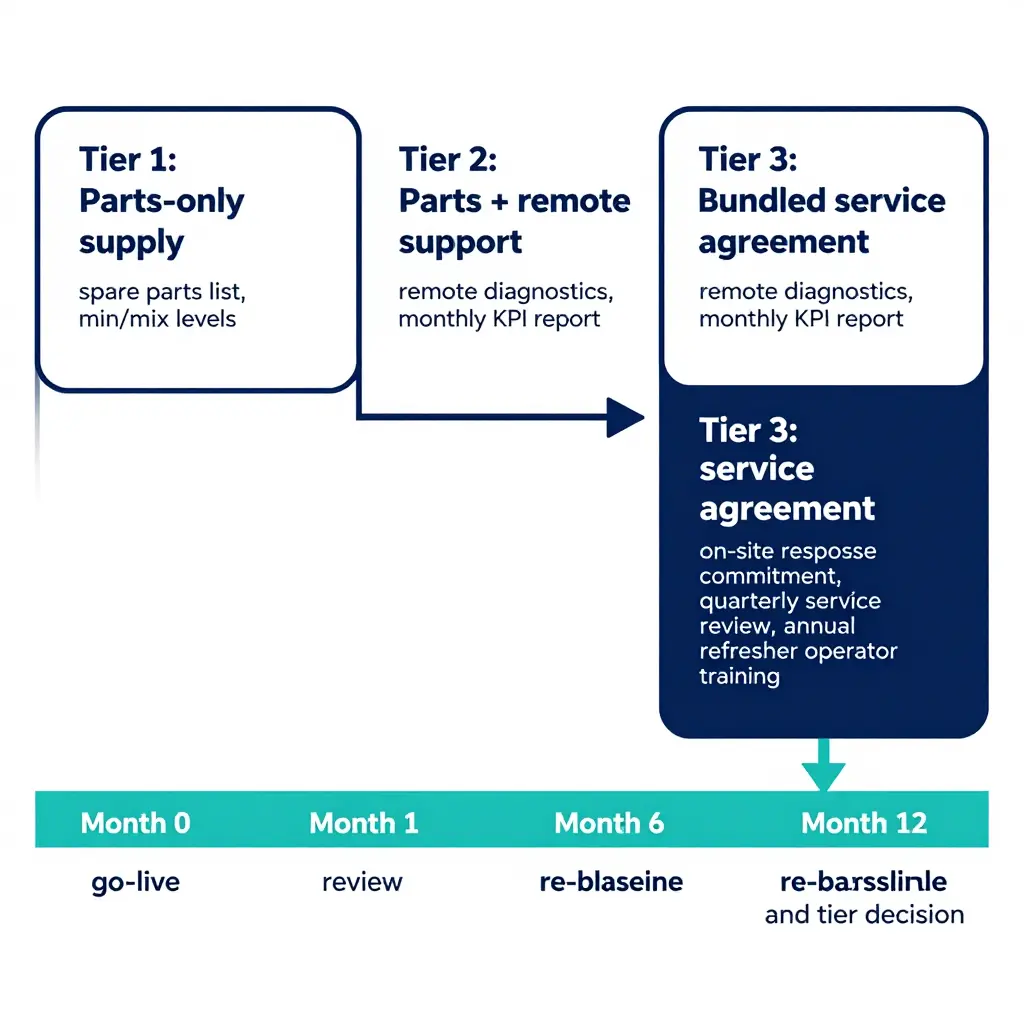
- Tier 1 – parts only: agreed parts list, minimum and maximum levels, defined lead times.
- Tier 2 – parts plus remote diagnostics: secure remote access, log review, firmware guidance, and a monthly KPI pack prepared by the integrator.
- Tier 3 – bundled service agreement: a contractual on-site response time, guaranteed parts availability for A-class items, the quarterly service review, and annual refresher training for operators and maintenance staff, refreshed whenever patterns change.
Tie the tier decision to evidence. If operator-induced stoppages stay above 25% of total stoppages after basic training, the answer is more training, not more spares. If MTTR is dominated by diagnosis rather than repair, remote diagnostics will pay for itself faster than inventory.
Operator Proficiency Ramp-Up Curve by Training Track
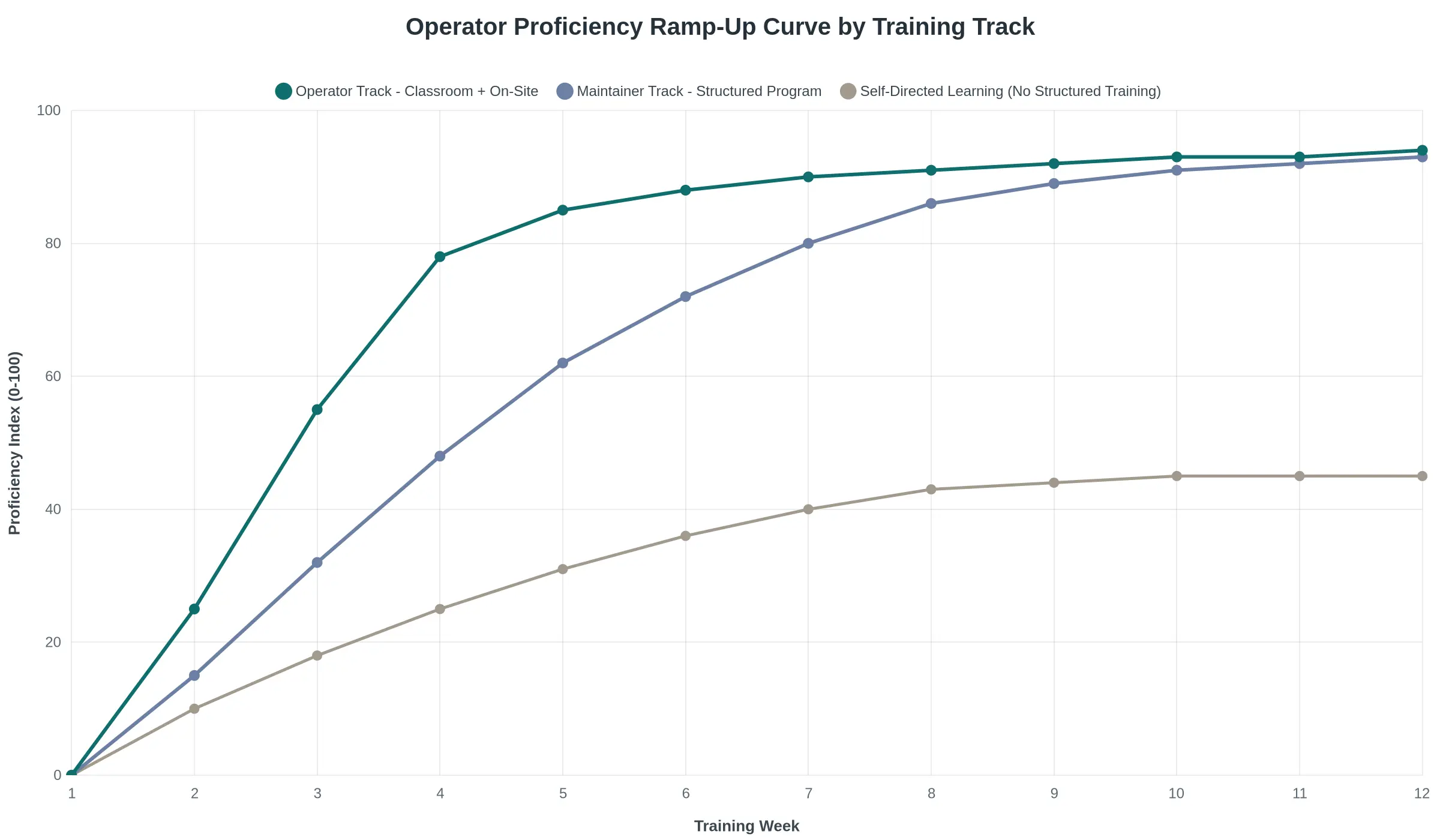
Figure 1. Operator Proficiency Ramp-Up Curve by Training Track. This curve is a planning reference used to size supervision intensity and refresher timing, not a validated performance benchmark. Actual ramp-up varies with crew literacy, language support, pallet pattern complexity and start-up conditions.
How to read the proficiency index
The index is a composite 0-100 score covering five observable behaviors: safe intervention and restart discipline, pattern and layer selection, pallet build quality, exception recovery (wraps, jams, damaged cartons), and autonomous first-line fault handling. A score of 85 is the practical threshold at which a trained operator can run a shift with periodic check-ins instead of continuous supervision. On the operator track below, that point falls between weeks 4 and 8.
| Milestone | Operator track | Maintainer track | Self-directed |
|---|---|---|---|
| Week 2 | 25 | 15 | 10 |
| Week 4 | 78 | 48 | 25 |
| Week 8 | 91 | 86 | 43 |
| Week 12 | 94 | 93 | 45 |
Turning the curve into a staffing plan
- Weeks 1-2 (index 25 by week 2): one trainer or line lead per cell. Expect frequent recoveries and slow pattern changes, and do not staff these weeks as if the line were already productive.
- Weeks 3-4 (25-78): supervision is still active but thinning out. The table above puts the operator track at 78 by week 4, just under the 85 release threshold, so handover of shifts to a plant-based lead is realistic somewhere between weeks 4 and 8, once measured scores pass 85.
- Weeks 5-12 (78-94): gains are incremental and mostly come from exception handling. Supervision shifts from presence to audit: spot checks on pallet integrity and safe stop restarts.
- Maintainer track (48 at week 4, 86 at week 8): preventive maintenance, spare-parts replacement and firmware or recipe updates should stay with the OEM or integrator until roughly week 6, then transition under joint sign-off.
- Self-directed learning (plateaus near 45): unfacilitated learning stalls well below the threshold for unsupervised production, which is why blended classroom-plus-on-site delivery remains the realistic baseline for overseas plants.
Refresher timing that follows the data
Because the operator curve flattens after week 8, refreshers do the most good before the plateau: a two-hour clinic at weeks 5 and 8, then quarterly changeover drills, with the formal annual refresher on top of that. Maintainers hold their knowledge longer when refreshers are tied to real maintenance events rather than to a calendar. Pair each refresher with a changeover drill, since changeover and restart errors are the most common source of lost proficiency after start-up; the same discipline used during conveyor integration and commissioning changeover applies to ongoing operator refreshers.
Practical caveats
Use the curve to plan, then verify with a short skills assessment at weeks 2, 4 and 8. If your crew’s measured scores sit more than 15 points below the reference, revisit language support, documentation and the amount of on-site time before you touch the hardware.
FAQ: Spare Parts Planning and Operator Training for Cobot Palletizer Deployment
1. Which spare parts must be held on site at an overseas plant from day one?
Hold day-one stock for parts that stop the line and sit outside a 48-hour resupply window: vacuum grippers and suction cups, vacuum generators and filters, bellows, timing belts, proximity and photoelectric sensors, safety-scanner brackets, fuses, power supplies and I/O modules. Set minimum levels from an FMECA that ranks failure impact against replenishment lead time, then confirm final quantities with the plant’s own criticality analysis. A spare teach pendant belongs at the regional hub, as the stocking matrix shows, because a missing pendant blocks teaching and diagnosis rather than output.
2. How much initial spare parts budget should be allocated relative to the cobot palletizer’s purchase price?
Budget 3-6% of the delivered price of the cell for critical spares on site in year one, rising to 6-10% once consumables such as cups, filters and gripper pads are included. That is a different basis from the earlier planning band, which is a share of annual operating cost; keep the two separate when you build the budget. Lines dependent on ocean freight or single-source components sit at the top of the range. Treat both figures as planning envelopes rather than targets, and set final numbers from the plant’s own criticality and consumption analysis.
| Resupply profile | Critical spares (year 1) | Including consumables |
|---|---|---|
| Regional supplier, <2-week replenishment | 3-4% of purchase price | 6-8% of purchase price |
| Imported parts, 4-8 week lead time | 4-6% of purchase price | 8-10% of purchase price |
3. How long should operator training take before a shift can run unsupervised?
Plan three to five days of structured operator training, matching the 24.5-hour curriculum: one day on safety functions and cell layout, two days on HMI operation, pattern editing and product changeover, and one to two days on first-line fault diagnosis and recovery. Do not release a shift unsupervised until each operator has logged 40-80 supervised production hours and passed a signed practical assessment covering safe stop, restart and changeover.
4. Who should own the spare parts plan: engineering or procurement?
Split ownership by kind of decision. Engineering holds technical ownership and procurement holds commercial ownership, with one named planning owner, typically the maintenance or reliability lead. Engineering defines criticality, part numbers and approved substitutes; procurement sets stock levels, contracts and lead-time buffers. Neither function changes min-max levels unilaterally, and both sign off quarterly against actual consumption data.
5. How should spare parts planning change when the same plant runs multiple cobot palletizer lines?
Move from line-level to plant-level planning. Pool common components across identical or similar lines, holding one shared spare for every two to three lines, while keeping line-specific tooling and firmware-matched parts separate. Aggregate consumption history before setting min-max levels; multi-line plants typically reduce total stock value by roughly 20-30% against duplicated per-line kits. Confirm the ratio through your own criticality and consumption analysis.
6. How often should operator training be refreshed, and what triggers re-certification?
Refresh operator training annually with a one-to-two-day session covering safety functions, changeover and fault recovery. Trigger full re-certification, not just a refresher, after any software or firmware upgrade, a new tooling or pattern library, an incident or near miss, more than six months away from the cell, or a failed audit finding. Record competencies per operator and tie certification to demonstrated performance rather than to the calendar alone.
Applying these rules to your own plant
Every range above is a starting envelope drawn from typical cobot palletizer deployment conditions. Final quantities, budget percentages, training hours and certification intervals have to come from the plant’s own criticality and consumption analysis, reviewed at least annually and after any line changeover that alters product mix, tooling or throughput targets. Documenting those decisions is what keeps commissioning and changeover downtime predictable as the fleet grows.