Defining the OEM Cobot Palletizer Program and Its Scope Boundary
An OEM cobot palletizer program is a cooperation model in which the palletizer manufacturer supplies the hardware, firmware and standard software it designs and controls in-house, while an OEM or ODM partner takes on the market-specific work: local integration, regional certification, service coverage, spare-parts stocking, or end-of-arm tooling built around local products. The two sides should divide that work rather than duplicate it, and the division needs to exist on paper before the first engineering order is released.
Planning therefore turns on one question: where the boundary sits. Leave partner scope vague and the outcome is easy to predict. Both sides engineer the same subsystem twice, warranty disputes open over which party owns a failed module, and commissioning slips because neither team holds the interface documentation. Conveyor integration and commissioning changeovers follow the same pattern, with unclear handover points showing up later as downtime.
This is written for the technical and procurement staff in fire departments, emergency services and municipal planning teams who specify, review or approve palletizing automation for logistics and equipment-storage facilities. What follows covers how to define the OEM cobot palletizer boundary in writing, which subsystems stay with the manufacturer, how acceptance and warranty terms should be structured, and how training and spare parts get planned across the split.
What In-House Design Covers in a Cobot Palletizer Program
In-house design covers what determines how the machine behaves, how it stops, and whether it repeats the same pattern on the third shift as on the first. None of it is customer-specific tailoring. It is the engineering that makes a palletizer a product instead of a one-off build.
- Mechanism and axis configuration. Mast height, arm geometry and mounting orientation set the working envelope. The payload and reach trade-offs behind those ratios are settled once, not re-derived for every site.
- End-of-arm tooling and product handling. Vacuum, clamp or fork tooling is specified against carton weight, surface and gap tolerance, so the grip is validated before the first case moves.
- Control firmware and motion sequencing. Palletizing firmware governs trajectory blending and case placement order, and it ships as one version-controlled release.
- Safety architecture and stop categories. Stop category assignments, safeguarding zones and restart logic are engineered to a defined standard, then verified.
- Structural design verification. Frame and column loading is calculated and analysed, so the machine holds position under full-load acceleration.
- Pattern-generation software. The pattern engine turns layer definitions into motion commands. The same stacking logic runs on every unit shipped.
- Guided factory acceptance testing. A documented test protocol exercises cycle time, repeatability and fault recovery before release.
- Released technical documentation set. Drawings, bills of materials, firmware baselines and validation records are issued as a controlled package.
These items stay with the manufacturer because every deployment shares them. Engineering them once spreads the cost across the installed base; re-engineering the same functions market by market fragments spares, training and support.
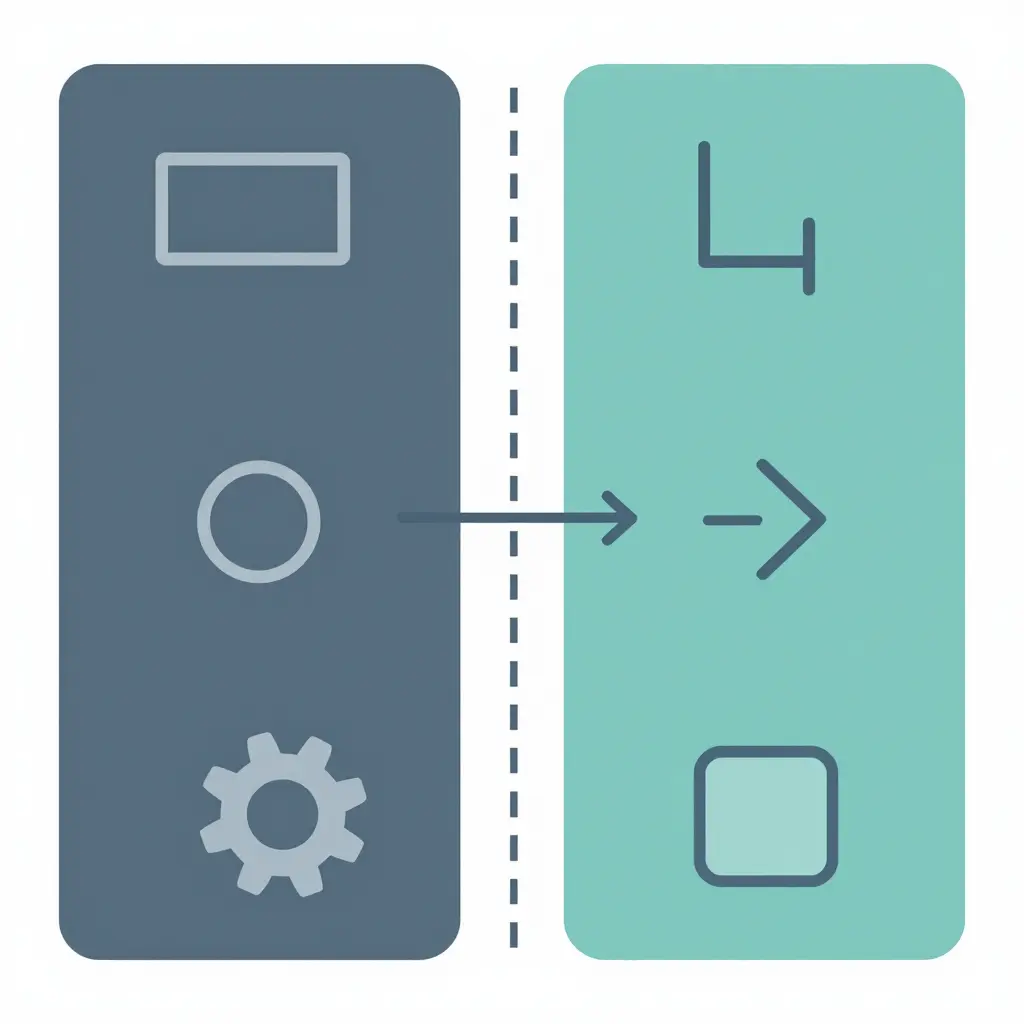
Everything left of the dashed line is machine design, everything right of it is partner scope, and the one arrow crossing the line marks the formal handover point.
Where In-House Design Ends: Handover Criteria
The boundary between an in-house team and an integration partner is set by finished, documented outputs. A verbal understanding on a Friday afternoon does not move scope; a released and recorded deliverable does. On OEM cobot palletizer programs that rule protects both sides when timelines compress before a station goes live.
The handover criteria are concrete and checkable:
- Design freeze – the machine, gripper and tooling are frozen at a numbered revision, with the frozen model and bill of materials archived.
- Validated cycle time and pattern library – measured throughput at the agreed payload, plus the approved pallet patterns and stacking logic used to reach it.
- Released interface definitions – signal-level specifications for conveyors, pallet dispensers and line control handshakes, agreed in writing. The guide to cobot palletizer integration with conveyors shows how those interfaces get commissioned, so both teams can test against the same list.
- Safety validation records – risk assessment, guarding and stop-response test results signed off against the intended layout.
- Full documentation pack – assembly drawings, wiring schematics, parameter lists and maintenance procedures covering routine service tasks.
Once those outputs are released, site execution belongs to the partner. Any later machine-level change, whether a new gripper or an altered conveyor interface, goes back through in-house design review before anyone applies it. Buyers who answer to a formal approval process should make this OEM palletizer documentation set a contractual deliverable, so acceptance rests on measurable criteria rather than assurances.
The matrix below does that splitting for a typical cobot palletizer program: what the machine manufacturer owns in-house, what falls inside partner scope, and what both sides sign at handover.
Responsibility Matrix for an OEM Cobot Palletizer Program
| Program Phase | In-House Scope (Machine Manufacturer) | Partner Scope (OEM/ODM) | Shared Deliverable at Handover |
|---|---|---|---|
| Requirements definition | Payload, reach, and cycle-time envelope | Target-market use cases and customer wish list | Signed requirements spec with acceptance criteria |
| Layout and throughput planning | Cell footprint and robot simulation | Site dimensions, aisle widths, and traffic flow | Frozen CAD layout plus throughput model |
| Mechanical and structural design | Frame, base, and pedestal engineering | Local steel grades, anchor details, seismic norms | As-built structural drawing set |
| End-of-arm tooling | Gripper concept and vacuum/grip selection | Case range samples and product fragility data | Validated tooling kit and changeover jig |
| Control software and pallet patterns | Motion stack and pattern library | Regional pallet standards and label rules | Pattern library plus version-locked config |
| Safety architecture and validation | Risk assessment and safety PLC logic | Local guarding norms and inspection access | Signed safety validation report |
| Conveyor and handshake integration | Handshake protocol and sensor logic | Conveyor supply, line speed, and PLC brand | End-to-end line test log |
| Civil and guarding works | Anchor load calculations and fixing specs | Foundations, fencing, and floor preparation | Site readiness checklist |
| Commissioning and changeover validation | Robot-side tuning and cycle verification | Product mix trials and shift staffing | Commissioning sign-off with cycle data |
| Operator and maintenance training | Maintenance procedures and spares training | Local-language delivery and shift scheduling | Training matrix with attendance records |
| Spare-parts planning | Critical spares list and lead times | Warehouse location and stocking levels | Agreed stock list with reorder points |
| Warranty administration | Robot and controller warranty terms | Field service response and labor coverage | Single warranty escalation path |
| Branding and certification for the target market | Nameplate, manual, and CE/UL documentation | Local certification, language, and labeling | Certificate dossier and branded manual set |
Use the table as a negotiation instrument. Partner scope shifts with payload, throughput targets and local market conditions, so rows will move. The naming should not: every shared deliverable needs an owner on each side, and the handover-critical rows, conveyor and changeover integration above all, are where accountability goes missing when no one signs.
What Partner Scope Typically Owns
Partner scope is not a loose list of favors traded between two companies. It is defined by three properties: local presence, local regulatory knowledge, and a continuing service obligation. A responsibility belongs in the partner column when it depends on being physically on site, on reading the codes and labor practices of one market, or on a response commitment that outlasts handover. What it never includes is anything that would alter the released machine design.
- Site survey and floor-space confirmation, including slab conditions, aisle widths and approach clearances, verified before the layout is frozen.
- Supply of infeed and outfeed conveyors and pallet handling equipment matched to local line speeds and load profiles.
- Guarding, fencing and civil works executed to the drawings supplied by the OEM.
- Compliance with local electrical and safety codes, including permits and inspection scheduling.
- Installation labor and subcontractor coordination, with rigging and lift planning managed on site.
- Commissioning windows arranged around live production schedules, with conveyor integration and changeover timing planned so ramp-up does not stall the line.
- Local-language documentation and operator training delivered at handover.
- Regional spare-parts stocking aligned to the agreed critical-part lists.
- First-line service response, including diagnostics escalation to OEM engineering.
- Market-specific certification files and declarations required for the destination country.
The boundary has a hard edge on the other side too. Machine safety architecture, control firmware, cycle logic and safety-rated function configuration stay out of partner scope. They were validated as part of the released design, and a local modification, however well intentioned, voids that validation and leaves the safety claim without a traceable basis.
Indicative Scope Allocation in an OEM Cobot Palletizer Program
You cannot negotiate a boundary without a rough sense of what sits on each side of it. The doughnut chart below splits typical program effort five ways, from in-house machine design and manufacturing through to warranty and service administration. Read it as orientation, not a budget forecast. Most of the effort stays with the manufacturer; partner integration and installation is the next largest block, followed by shared commissioning and changeover validation. That is why the handover details around commissioning and changeover downtime are worth settling early instead of in the last week before sign-off.
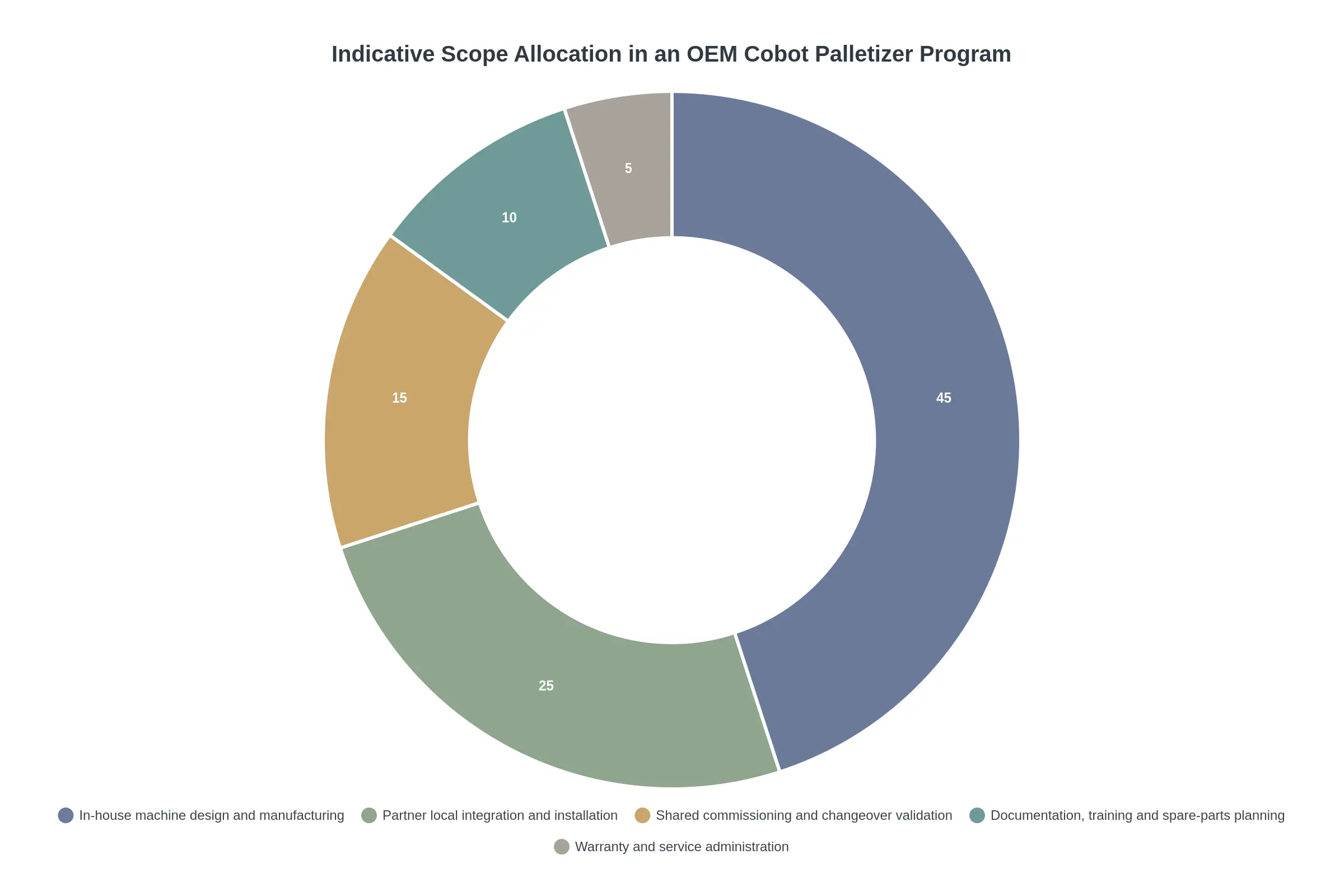
Figure: Indicative percentage shares of total program effort across the OEM-partner boundary.
Note: The values shown are indicative planning figures intended for scoping discussions only and should be replaced with project-specific estimates before any budget or schedule commitment.
Integration and Commissioning: The Contested Middle
Scope ambiguity costs most in integration and commissioning. An argument over drawings burns engineering hours; an argument over who runs the test burns schedule. Four boundaries are worth settling in writing before the first cable is pulled.
Handshake signals. Who owns the interface test between the palletizer and the conveyor or pallet-handling equipment? Signal lists, timing tolerances and fault codes have to be agreed, and one party has to be accountable for proving the handshake works. Planning the cobot palletizer integration path early keeps that test from turning into a joint investigation.
Changeover validation. Who defines the accepted pattern set, and who signs off that a changeover meets it? The partner knows the site’s case mix; the manufacturer knows the control limits. Without a named pattern list and a measurement method, changeover downtime targets cannot be verified.
Downtime windows. Who authorizes line access for commissioning and re-testing? Production managers own the calendar, so site scheduling stays with the partner, while the manufacturer supplies the test procedure and the acceptance criteria.
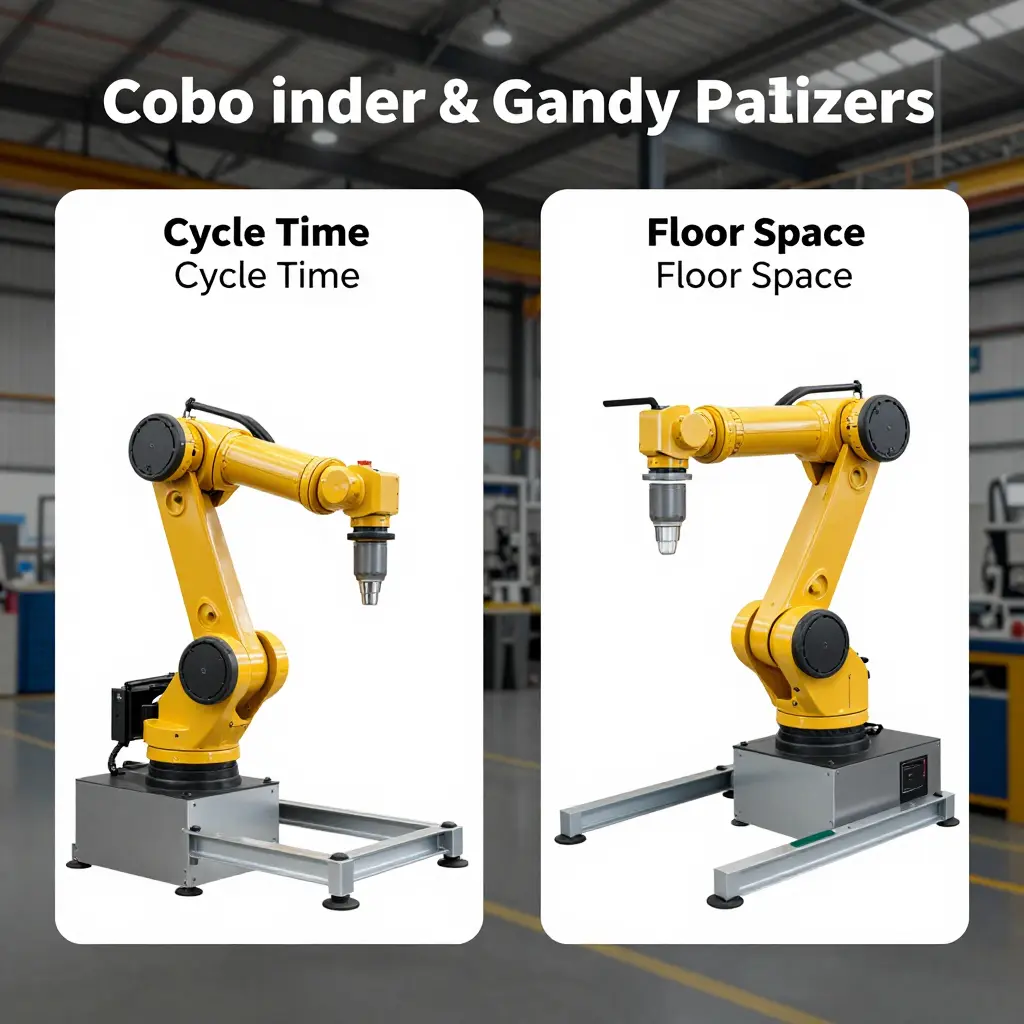
Floor space and layout assumptions. Reach envelopes, aisle widths and pallet-dispenser placement are often assumed rather than measured. Weighing cycle time and footprint trade-offs before layout freeze prevents conveyor re-routing later.
Machine-level control logic stays with the manufacturer; line-level sequencing and site scheduling stay with the partner. The most useful control on the whole boundary is a written interface test plan that both parties sign.
Training, Spare Parts and Service Responsibilities
Training splits into two tracks. The manufacturer owns machine-operating training: teach-pendant navigation, pallet pattern selection, recovery from faults, safe restart after an e-stop. The partner owns site procedure and shift management: how the facility sequences pallet flow, who signs off a pattern change, how handovers are logged between crews. Operator training on the hardware without matching shift-handover training is a common cause of inconsistent throughput across rosters, which is why the split matters in facilities running two or three shifts.
Spare-parts planning follows a similar line. Manufacturers hold long-lead components – servo motors, controller modules, gearboxes – and commit to stocking depth. Partners hold consumables and wear parts: suction cups, vacuum filters, belts, gripper pads, safety-scanner covers. Ask for the wear-parts list with expected replacement intervals in writing.
Service follows a first-line/second-line model. The partner handles first-line response: on-site diagnosis, wear-part swaps, cleaning, pattern re-teaching, within a defined window and with a named engineer. Escalation to the manufacturer applies when faults trace to firmware, controller hardware or recurring axis errors. The escalation rules should state the trigger, the time limit for the partner to attempt resolution, and who owns the ticket afterwards.
Emergency-services and municipal operators usually want documented response times and named contacts, so put both in the cooperation agreement. This guide to cobot palletizer service and training scope gives a worked model.

Figure: Five fixed program gates, left to right – design freeze, interface definition release, factory acceptance test, site integration, site acceptance. The outlined middle gates mark the handover band where manufacturer scope and partner scope overlap.
Commercial Terms, IP and Export Support
Ownership of designs and license rights. IP ownership should be allocated deliverable by deliverable rather than in a single sentence. The manufacturer retains the machine design (mechanical drawings, structural calculations, safety architecture), the firmware and the pattern-generation software; the partner retains the site-specific deliverables it produces. Any license granted to the partner should state whether it is exclusive or non-exclusive, plus territory, term, sublicensing rights, royalty basis, escrow and source-code access, and how jointly developed improvements are handled.
Branding and ODM labeling. In ODM cooperation, nameplates, logo placement, serial-number ranges, certification marks and manual languages belong in a dedicated annex. Both parties approve artwork before production and confirm that neither brand appears on products outside the program scope.
Firmware modification and warranty division. Firmware modification rights have to be defined in advance: who may change code, which tools and credentials are used, how versions are logged, and who signs off releases. Any field firmware change needs a rollback procedure agreed by both parties, with verified backup and restore steps before deployment; this guide to the three rollback checks before a firmware change goes live sets out the minimum evidence. Warranty responsibility follows the same boundary. Machine-level defects rest with the machine supplier; installation-level defects such as anchoring, cabling, alignment, commissioning parameters and site power quality rest with the installer, documented at handover.
Export support and customs. For an OEM cobot palletizer shipped across borders, the export support clause should name the party preparing invoices, packing lists, certificates of origin and the proposed HS classification, and the party handling dual-use screening, destination-market conformity marking, translated manuals and importer-of-record duties. Classification disputes and compliance failures need an agreed cost allocation.
Effort Split by Subsystem: The Boundary Is Per-Subsystem
A palletizer program has five boundaries rather than one. The chart below breaks design and delivery effort down by subsystem and shows how much stays with standard in-house scope versus how much becomes partner-specific adaptation, expressed as a share of total effort within each subsystem.
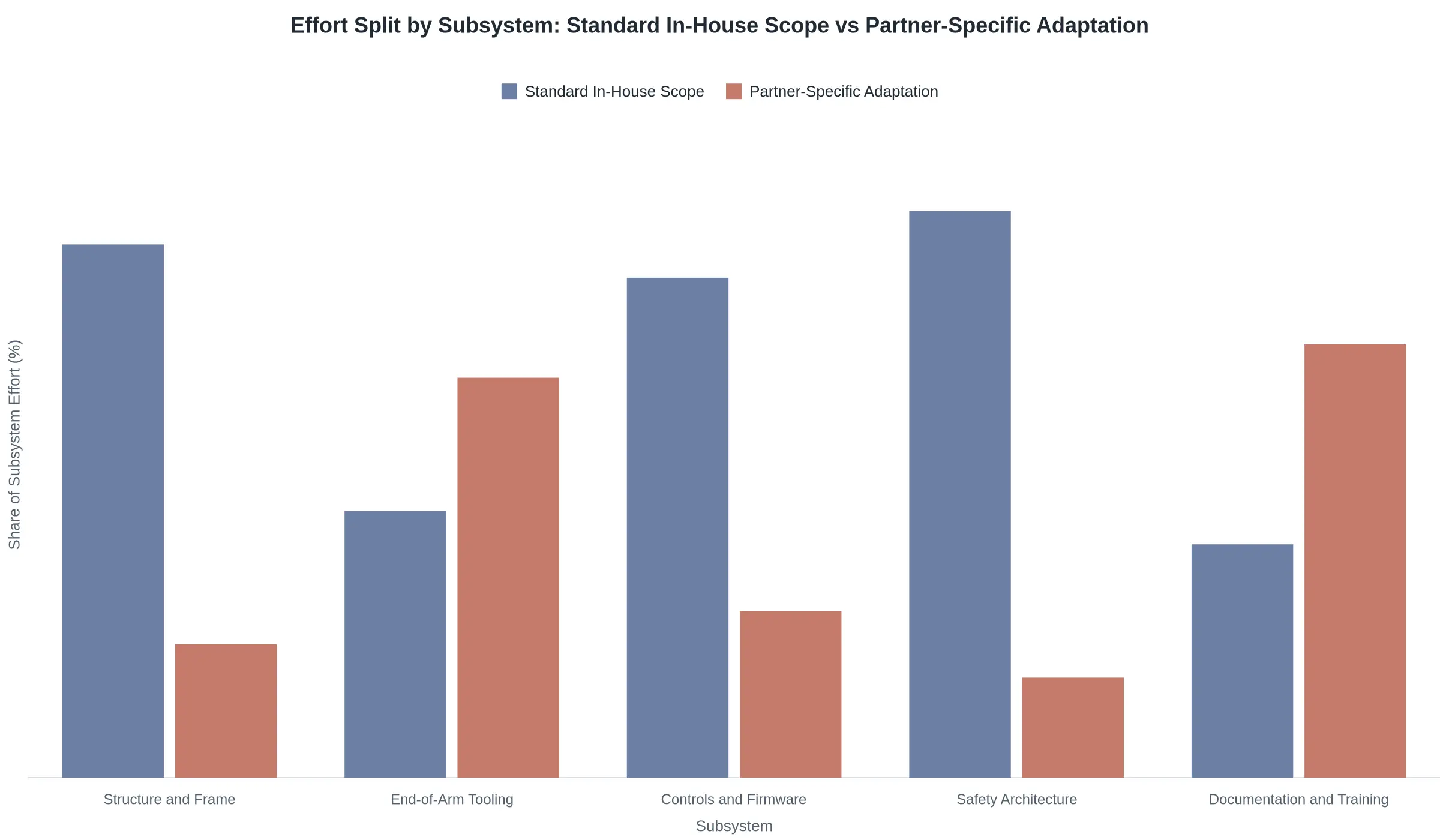
Subsystem-level splits vary with product mix and market requirements and should be confirmed during program scoping.
What the Bars Are Telling You
Structure and frame, controls and firmware, and safety architecture lean in-house at roughly 80, 75 and 85 percent. They set how the machine behaves, how large a working envelope it covers and how its safety case is built, and they are not worth renegotiating in a partner’s workshop.
End-of-arm tooling, and the documentation and training package, flip the other way at about 60 and 65 percent partner-specific. Gripper design follows the cartons, trays and bags a site actually handles. Training material, language and operator certification follow local labor rules and shift patterns, and in a rollout that second item is often the longest tail; it pays to scope deployment, training and parts planning before the purchase order is signed.
Do not average the five bars into one number for the program board. The average is 63 percent in-house, and it tells you nothing about where the integration risk sits.
Frequently Asked Questions
Can a partner modify the cobot palletizer’s safety architecture?
No. The safety architecture is frozen at design freeze and stays under OEM control. Partners may not change safety-rated logic, speed limits, force thresholds or stop categories. Any request enters the written escalation rule, where OEM safety engineers assess it against the certified risk assessment.
Who owns the palletizing pattern library and who may add new patterns?
The OEM owns the palletizing pattern library: pattern geometry, stacking order and release notes. Partners may propose patterns; the OEM validates each against payload and reach limits. Partner-built patterns need a documented partner scope clause and enter the shared version record.
How is the boundary documented so that both parties accept it?
The boundary is documented in a scope-boundary matrix that names each deliverable, its owner and its acceptance criterion. Interface definitions record mechanical, electrical and data handoffs with tolerances. Both parties sign at design freeze, and the signed copy enters the project record. Items not listed stay with in-house design or follow the escalation rule.
What happens when a site’s conveyor layout differs from the released interface definition?
A layout that differs from the released interface definition triggers a deviation request. The partner adapts inbound conveyor geometry, height and handshake signals to the defined interface point, following the conveyor integration and commissioning guidance. Boundary-crossing changes return to the OEM through the escalation rule. Each deviation is logged with drawings and a signed record.
Which party carries warranty responsibility after handover?
After handover, the OEM warrants the robot arm, controller, safety firmware and pattern library against design and manufacturing defects. The partner warrants integration work: conveyor interfaces, guarding, cabling and site programming. Boundary-crossing disputes follow the escalation rule and are settled from the handover record.
A Boundary That Can Be Audited
In-house design does not end when the layout looks right in a meeting room. It ends at released, documented outputs: approved drawings, safety validation records, firmware baselines and pattern-generation logic signed off at a defined version. Short of that, the boundary is still a draft.
Partner scope begins where the work becomes local by necessity, where site presence, local compliance and local service are required. Site integration, permitting coordination and first-line response cannot be managed from a distance. They belong to the partner who can stand on the floor.
Every shared phase needs a named owner and a signed record. Without both, shared work drifts, and the drift surfaces as a dispute once the line is running.
Machine-level safety, firmware and pattern-generation logic remain with the manufacturer. Site integration, local code compliance and first-line service remain with the partner. An OEM cobot palletizer program is strongest when that division is written down before installation begins instead of negotiated afterwards. Reviewers in fire departments, emergency services and municipal planning functions can carry the responsibility matrix and handover criteria into procurement review as a working checklist, reading the documents rather than the assurances. The machine-level safety reasoning behind that split is set out in this look at safe, flexible end-of-line palletizing design.