Why Pallet Variation Breaks Palletizer Assumptions
A cobot palletizer setup is only as reliable as the pallet it receives. Programming assumes a repeatable deck: consistent board thickness, board spacing and entry geometry. When pallet types change between deliveries, those assumptions fail without an alarm, and commissioning time goes on retests rather than throughput.
Deck gaps and fork entry clearance cause most of that rework. A gap wider than the case footprint lets cases tip as they are released; an opening tighter than the forklift’s tine and spec blocks pickup at the zone. Both are dimensional variables rather than handling variables, which is why they surface late and cost schedule time.
Mixed pallet supply across a high-mix, low-volume plant means one validated pallet type is not enough. Each type has to be measured, specified and validated against mixed-SKU pallet patterns, which is the work ZBOSN does as an in-house designer and manufacturer of cobot palletizers.
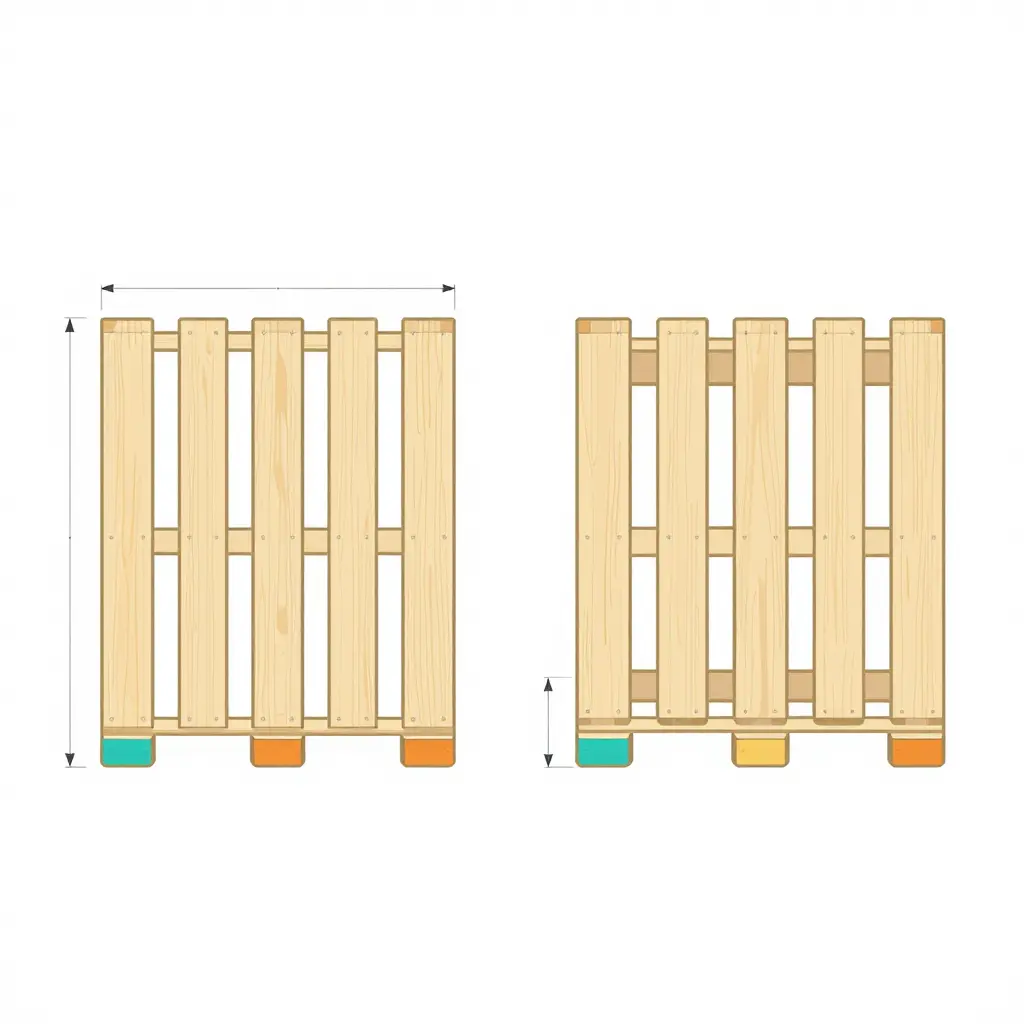
Three sets of numbers decide whether the cell runs clean or fights the pallet all shift: how far apart the top deck boards sit, how far apart the bottom deck boards sit, and how tall and how deep the fork entry opening is at the base. The same three drive gripper clearance, conveyor transfer height, and how cleanly a forklift can lift a finished load out of the cell (see our notes on palletizer layout for forklift access and pickup zones).
Deck Gaps: The Variable That Decides Your Cobot Palletizer Setup
Deck gaps are the open space between adjacent deck boards on the top and bottom of a pallet. They look cosmetic. They are not. Every case a cobot places either sits on boards or bridges over air, and which one happens changes the whole cobot palletizer setup.
How wide gaps cause settling and layer collapse
A case footprint wider than the local board spacing will bridge. Under the gripper’s release impulse and the weight of the layer above, that bridge deflects. Corrugated cases creep; bags slump; shrink-wrapped trays sag. The result is a case that shrinks in height by a few millimetres per layer and shifts laterally. Two or three layers later the stack is leaning, and the pattern that worked in simulation no longer fits the pallet. That is the usual reason a validated palletizing automation cell drifts out of tolerance a few weeks into production.
Why gap tolerance differs by pallet type
| Pallet type | Deck gap behaviour | What to confirm |
|---|---|---|
| Stringer | Top deck boards typically 25-40 mm apart; bottom deck has wide openings, so the unit load is carried mainly on stringers and end boards | Where the stringers actually sit relative to the case footprint |
| Block | Near-continuous perimeter support, gaps usually under 40 mm, four-way entry | Consistency of the top deck plane across suppliers and batches |
| Plastic | Molded, uniform gaps, often 20-35 mm, dimensionally repeatable but lower friction on some deck styles | Slip behaviour during release, not just compression |
Stringer pallets are the difficult case because the top deck is not the structural surface – the stringers are. Block pallets forgive soft footprints because support is continuous. Plastic pallets are dimensionally predictable but slick, so layer support is fine while lateral stability is not.
The check order an integrator should follow
- Measure deck gaps on the actual pallet supply, not the drawing. Sample several pallets and record the maximum gap.
- Map the smallest case footprint in the SKU range against that gap, in both X and Y.
- Assess stiffness of the weakest case – board grade, fill level, and whether it is a bag or carton.
- Verify support at the worst-case footprint: which boards touch, which gaps bridge, how far the overhang extends.
- Run a loaded stack test at full height and hold it, then inspect for deflection and creep.
- Only then freeze the pattern.
Before pattern programming is frozen, sign off a written support map: worst-case SKU, pallet source, gap measurement, permitted bridge span, and the correction method if a footprint fails – slip sheet, plywood topper, tighter pattern, or a pallet spec change. Without that record, pattern revisions get blamed on the robot. Where the mix changes often, the pattern setup guide for mixed-SKU pallet patterns covers how to keep those maps current.
Pallet types and the setup variables they impose on a cobot palletizer
The differences that matter at setup, by pallet family:
| Pallet type | Typical top deck gap | Typical fork entry clearance | Setup implication for cobot palletizers |
|---|---|---|---|
| Standard stringer pallets | Wide gaps between deckboards, often 25-40 mm | Low, stringer depth limits entry height | Vacuum cups can bridge gaps poorly, so favor clamp or wide-cup grippers |
| Block pallets | Narrower, more regular deck gaps | Higher, four-way entry on most units | More forgiving deck surface, but watch cup placement near block corners |
| Plastic pooled pallets | Small, consistent gaps with closed or perforated decks | Moderate and highly repeatable | Predictable sensing and pickup, though slick surfaces need grip checks |
| Euro-style pallets | Tight deckboard spacing with edge cutouts | Lower entry height, four-way but shallow | Tight cup spacing and pattern offsets sized to the smaller footprint |
| Half pallets | Compact deck with closely spaced boards | Low and narrow, tighter fork tolerance | Reduced stack footprint shifts reach, cycle time and load stability limits |
| Custom or damaged inbound pallets | Inconsistent, sometimes broken or missing boards | Variable and often compromised | Expect per-pallet sensing, lower stack heights and manual exception handling |
Confirm the actual deck gaps, fork entry clearance and load ratings against a sample of your own pallet inventory, and review forklift access and pallet pickup zone layout before finalising cell dimensions.
Fork Entry Clearance and Pallet Pickup Zone Planning
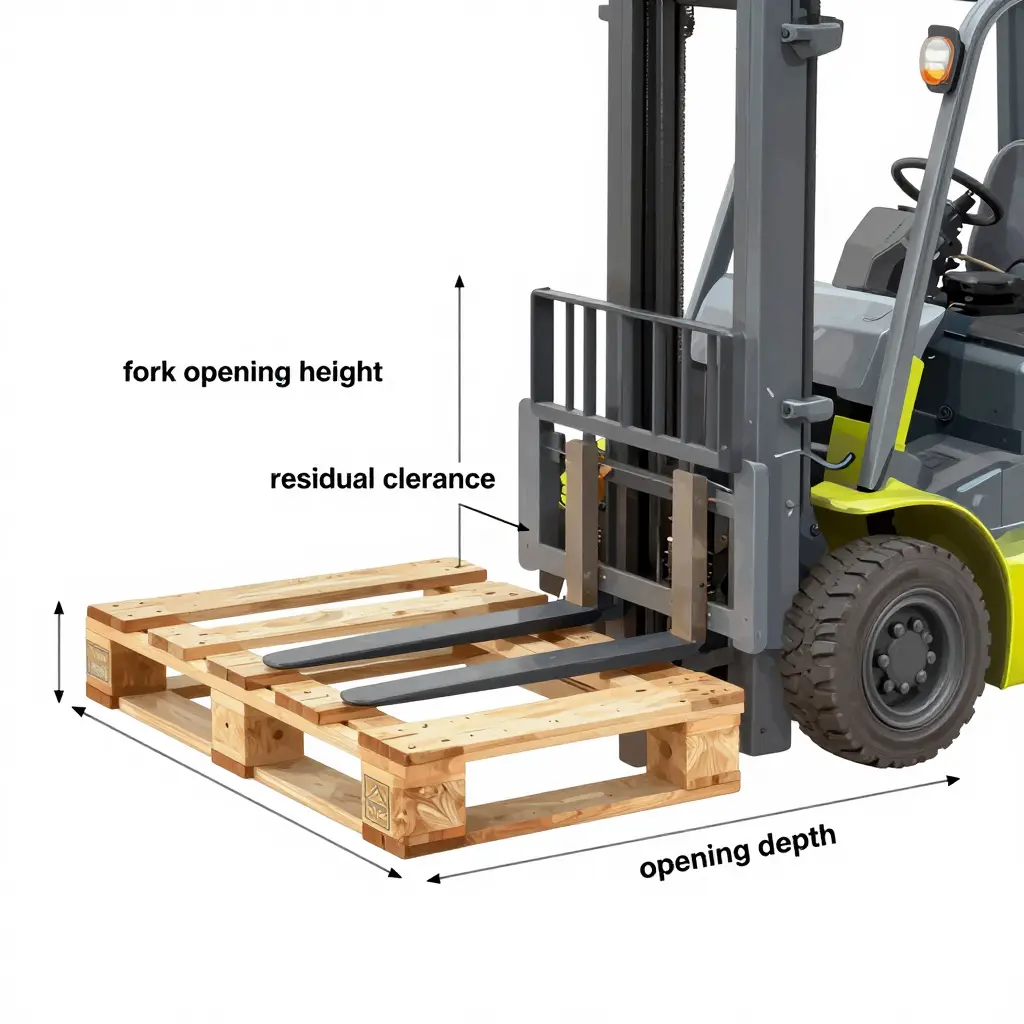
Fork entry clearance is the usable gap a forklift tine travels into before it contacts load-bearing wood, and it has two dimensions you cannot separate: fork opening height (the vertical gap between the top of the bottom deckboard and the underside of the deck above it) and opening depth (how far back from the pallet edge that gap runs before the stringer, block or crossboard blocks the tine). Height tells you whether the tine slides in at all; depth tells you whether it reaches the load centre. Get depth wrong and the tine stops short, its tips bulldoze the lower carton row and the top of the stack shifts before the pallet has even left the floor.
Why residual clearance, not nominal clearance, decides retrieval
The number on the pallet spec sheet is measured empty and unloaded. What the forklift actually meets is:
residual clearance = nominal opening height – tine thickness – deck deflection
A 100 mm nominal opening with 45 mm tines looks generous until a 900 kg load bows the top deckboards down 8-10 mm and the block corners settle into the floor. Add a pallet support surface that is not flat – a floor joint, a worn outrigger, a pickup zone straddling two slab pours – and effective height drops again. In practice, once residual clearance falls below about 15-20 mm, drivers start tilting the mast to force entry, which is exactly how a full pallet gets dragged and the stack above it disturbed.
| Pallet (illustrative) | Nominal entry height (mm) | Tine thickness (mm) | Deck deflection under load (mm) | Residual clearance (mm) | Verdict |
|---|---|---|---|---|---|
| Plastic block, new | 120 | 45 | 3 | 72 | Comfortable |
| Wood block, seasoned | 100 | 45 | 8 | 47 | Fine |
| Wood stringer, mixed age | 90 | 50 | 12 | 28 | Watch wear |
| Rough-sawn stringer | 95 | 50 | 22 | 23 | Marginal – re-specify |
Treat these as a format for your own numbers, not as your numbers. Measure your pallets, loaded, on your floor.
How clearance fixes pallet pickup zone location
The pallet pickup zone should be laid out from the fork entry face outward, not from the cell footprint inward. Three consequences follow:
- The completed pallet must land with its entry face square to the aisle so the truck enters straight. An angled approach consumes effective opening height, because the tines present a thicker cross-section to the gap.
- The zone needs enough length in front of the entry face for the mast, overhead guard and full tine insertion before the load centre clears the deckboards – short zones force partial entry, which is a stack-disturbance problem, not just a slow one.
- The support surface across the whole zone must be at one elevation and flat within a few millimetres; a 10 mm lip at the boundary is enough to lift the truck and change the fork angle.
Then set the distance from the cobot palletizer cell: the pallet handling envelope, the guard perimeter and the walkway must not accidentally overlap the approach lane, which is where most retrofits lose a pallet position. A useful cross-check is our guide to cobot palletizer layout for forklift access, pallet pickup zones and operator walkways.
One more variable plant managers tend to miss: if the cell is bolted to the slab rather than carried on a self-standing frame, anchor drilling, shimming and grout can shift the floor plane at the pickup zone edge – so pickup zone tolerance follows directly from the base mounting decision, as covered in floor anchoring versus self-standing frames for cobot palletizers.
Verification points before you sign off
- Measure loaded, not empty. Place a full production pallet in the pickup zone and check fork opening height at three points across the entry face.
- Use the real truck. Confirm tine thickness and taper on every forklift that will service the zone, including wear plates and any rented units.
- Check dwell. Re-measure after 24-48 hours of load, or after a full shift of compression cycles, and record the drop.
- Confirm opening depth against tine length and load centre – a deep opening on one face does not guarantee four-way entry.
- Level-check the zone. Survey flatness and step height at the zone boundary where the truck rolls in.
- Paint the entry face. Mark the pickup zone so the pallet’s fork entry side faces the approach lane every time, and confirm the cell’s pattern program drops pallets that way.
- Walk the envelope. Verify mast tilt, overhead guard and driver sightlines with the pallet in its final position, with the cobot at the load station.
Do this once, at commissioning, with the pallets and trucks you actually run – and re-verify whenever a pallet supplier changes.
Fork Entry Clearance by Pallet Type: Where Retrieval Margin Disappears
An empty pallet tells you almost nothing. What matters for a cobot cell is what is left of the opening after the load is stacked and the pallet has settled under compression, because that residual gap is what a forklift driver actually works with at 3 a.m. on a full shift.
The chart below gives indicative fork entry clearance figures for six common pallet families, empty versus loaded. Treat the numbers as a starting point for the conversation, not a specification.
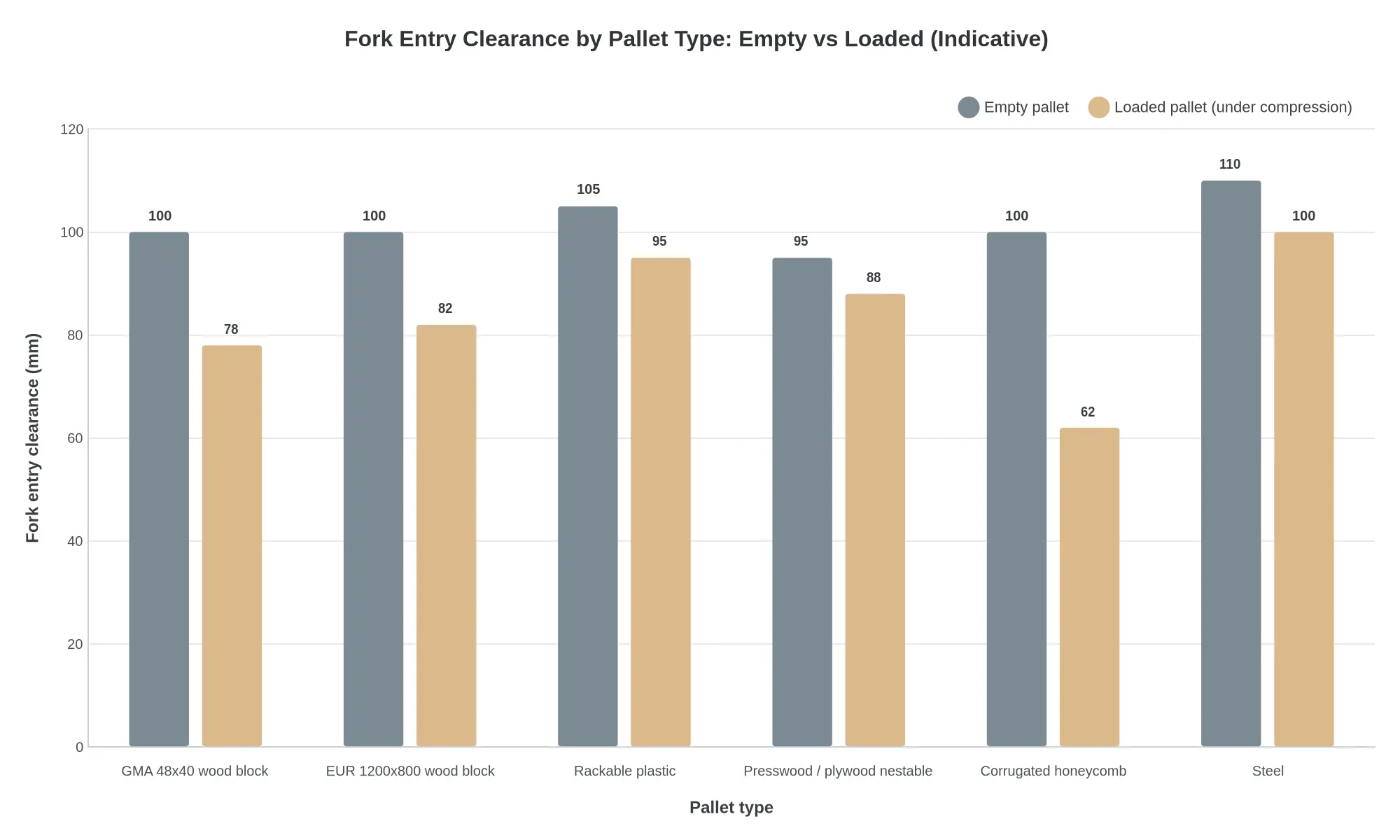
Figure 1: Fork entry clearance by pallet type, empty versus loaded under compression, in millimetres – indicative ranges only, so replace these figures with measured values from your own pallet supply before fixing a retrieval height or fork pocket geometry.
Reading the Gap, Not the Bar
The drop between the two series matters more than the height of any single bar.
- Corrugated honeycomb loses the most, roughly 38 mm once loaded. Deck boards deflect and the pallet beds down under a stacked load, so the fork opening that looked generous on the delivery note is the tightest one in the chart.
- Wood block pallets (GMA and EUR) sit in the middle: about 22 mm and 18 mm of loss respectively, mostly from deck deflection plus the way stringers and blocks take the load.
- Presswood and plywood nestables hold up better than expected at around 7 mm of loss, largely because the deck is a single dense panel rather than spaced boards.
- Plastic and steel barely move, but they start with the most margin – which is why plants fighting a marginal dock apron often migrate to them even at several times the price of a wood pallet.
Turning This Into a Cell Decision
If your tallest pallet stack plus the residual opening still clears the fork carriage with something like 40-50 mm to spare, that pallet is compatible with a forklift pickup zone a cobot also serves. If a pallet type cannot hold its opening under compression, no amount of pattern programming rescues it – the constraint lives in the pallet, not the robot.
Measure three things on a sample of your own pallets before you sign off: opening height empty, opening height with a representative load after a 24-hour settle, and opening height on a pallet that has been through ten return cycles. The difference between the first and the third is the number that predicts field complaints.
Pallet Validation Checklist for Cobot Palletizer Sign-Off
Work through this list in order, on the real floor, with real pallets and real product. It mirrors the sequence an integrator follows before handing the cell over; skipping a step is how a clean FAT turns into a week of nuisance stops.
- Audit every pallet in the incoming stack for cracks, missing boards, and protruding nails.
- Reject pallets with warped decks, delamination, or heavy moisture before they reach the infeed.
- Measure deck gaps and board spacing against the values your gripper was programmed for.
- Confirm no deck gap exceeds the smallest case footprint in the range, or the vacuum cup footprint the gripper depends on.
- Check fork entry clearance on all four sides against wrap, straps, and product overhang.
- Test-entry a loaded pallet with the actual forklift at the actual stack height.
- Verify layer support so bottom cartons sit on solid deck rather than spanning a void.
- Run a full pallet build and watch for deck flex, sag, or pattern drift under rated payload.
- Confirm the pallet pickup zone is marked, squared to the aisle, and reachable at maximum stack height.
- Repeat the full set for each pallet type and each supplier before changeover sign-off.
Log the numbers and photograph borderline pallets – those records are what settle arguments later. When you are ready to formalize the thresholds, use these pilot run acceptance criteria to turn the measurements into pass/fail limits. It is also worth rehearsing the misalignment recovery and restart routines so a rejected pallet becomes a controlled stop instead of a dropped case.
Handling Multiple Pallet Types on One Line
On a high-mix, low-volume line, pallet variety is not the problem. Poorly managed pallet variety is. A cobot palletizer setup that treats each new pallet as a fresh engineering project will quietly consume more budget than the hardware ever did. The fix is architectural, not heroic: make pallet types data, not code.
Store parameters as switchable recipes, not programs
Every variable that changes when a different pallet arrives should live in a recipe, not in the motion program: deck gap and fork entry clearance, overall pallet height, pattern origin offsets, pick and place heights, conveyor handoff positions, and stack magazine coordinates. Operators then select a recipe at changeover instead of calling an engineer.
A rebuilt program drifts. Small edits accumulate, version history becomes unreadable, and the third shift runs a variant nobody validated. A recipe table stays auditable, and each pallet type is proven once.
Validate every type offline before it reaches the floor
Run each pallet type through offline simulation with its worst-case stack height and a fully loaded pattern. Check vertical reach at the top layer, fork entry clearance after real-world settling, corner overhang, and collisions with the pallet dispenser. Simulating all types up front is cheaper than discovering the shortest entry clearance variant during a Friday afternoon changeover.
How changeover scales with the number of types
Switch time per change stays roughly flat, because calling a recipe is nearly instant. What grows is engineering and validation effort, plus the risk carried by rarely used types.
| Pallet types in rotation | Switch time per change | Recurring engineering effort | Main risk |
|---|---|---|---|
| 1-2 | Minimal | Low | Operator overconfidence |
| 3-5 | Minimal | Moderate | Untested pattern edits |
| 6-10 | Minimal | High | Stale recipes for seasonal pallets |
| 10+ | Minimal | Very high | Recipe drift, weak audit trail |
Changeover time is rarely the bottleneck. Engineering bandwidth is. If your line shares a cell with adjacent production areas, the same recipe discipline applies when sharing one cobot palletizer across multiple production lines.
The real cost of letting non-standard pallets in
Every unplanned pallet type is a small project: measure deck gaps, confirm fork entry clearance, re-simulate, re-validate, retrain operators, extend fault recovery routines. That cost lands in engineering hours and unplanned downtime, not on the pallet invoice. Rejecting or quarantining non-conforming pallets at the dock is almost always cheaper than absorbing them into the cell. Standardise your inbound pallet list, document it as an acceptance criterion, and treat deviations as a supplier conversation. Whether the flexibility pays back at your volumes usually depends on how many pallet types you actually run – see our breakdown of cobot palletizer ROI on mid-volume lines.
FAQ: Pallet Geometry and Setup
How are deck gaps measured on an existing pallet?
Measure deck gaps with a tape or caliper from the inner edge of one deckboard to the inner edge of the next, at three points per opening. Record the smallest and largest values: the widest gap is what a case has to bridge, so it governs the support check, and the narrowest tells you the best support you can count on.
What minimum fork entry clearance should a cobot palletizer cell plan for?
Plan for a nominal opening of at least 100 mm, measured from the top of the bottom deckboard to the underside of the top deck, then subtract tine thickness and the deck deflection you expect under load. Keep 15-20 mm in reserve after that subtraction, keep the opening free of stretch wrap, labels and overhang, and confirm the figure against your fork dimensions and the pallet maker’s tolerance range.
Do plastic pallets need different setup parameters from wood?
Yes. Plastic pallets hold their opening height far better than wood – the chart above shows a few millimetres of loss against 18-22 mm for wood block – but their decks are slick and they creep under sustained load, so slip checks, cup friction and stack height limits need more attention than deck support. Wood is easier to grip and cheaper per unit, but it loses opening height under load and varies between suppliers.
What should you do when inbound pallets arrive damaged?
Reject or quarantine damaged pallets at the receiving dock before they reach the cell. Log broken deckboards, missing blocks, and crushed corners, then tighten supplier acceptance criteria. Compromised pallets cause misalignment faults and dropped cases during cobot palletizer setup.
Can one cobot palletizer be validated for several pallet types at once?
Yes. Validation can cover several pallet types in one campaign when each type gets its own pattern program, deck gaps record, and clearance check. Run the full acceptance test on the worst case – heaviest and tallest – to expose reach and cycle-time limits.
ZBOSN is an in-house manufacturer of cobot palletizers, offering mechanical integration and overseas project support.