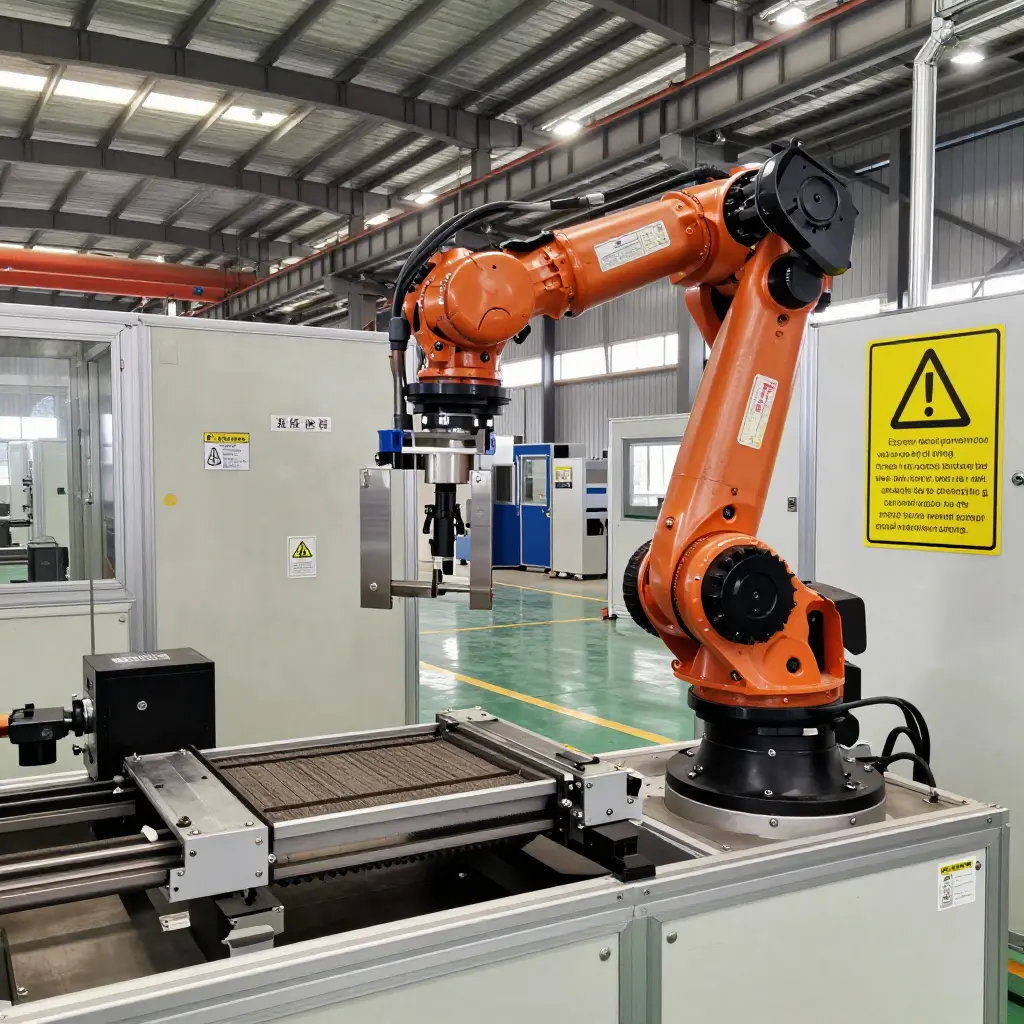
Three workstreams that decide export readiness
A cobot palletizer cell is easy to crate and hard to land. Three things decide whether it starts producing at the destination or sits idle while somebody improvises a fix: power supply, guarding and safety compliance, and the handover document package. Each one can be closed at the factory. Correcting any of them on site costs far more.
Power supply compatibility
Destination voltage, frequency, phase configuration and earthing practice rarely match the plant where the cell was built and tested. Before design freeze, check transformer taps, breaker sizing, control-circuit supply and the loads on the gripper and handling actuators against the site’s actual electrical schedule. Fixing a supply mismatch on the bench costs an afternoon; fixing it on site costs weeks of production.
Guarding and safety compliance
Fence heights, interlock logic, local guarding standards and risk-assessment paperwork differ by market, so a cell that passes at home may not pass at the border. Build to the stricter of the two regimes and write down the reasoning, with photographs of the as-built perimeter. Safety is the one workstream where “we’ll adjust it later” is not a plan.
Handover document package
Drawings, spare-parts lists, firmware versions, pattern files, risk assessments and acceptance records travel with the machine, translated where the destination requires it. A thin package turns a two-day commissioning visit into an archaeology project. Assemble and index it before shipment, not during the site visit.
The sections below take the three in turn. First the electrical and air side that power compatibility rests on – start with our guide to cell utilities planning for cobot palletizer projects.
Power supply settings to freeze before export
Each row below names a concrete item for an engineer to confirm and record on the configuration sheet, not a general rule of thumb. Sign and date the completed table, and attach it to the build file before crating.
| Destination market | Typical plant supply | Voltage/phase setting to lock at the factory | Dedicated breaker and disconnect | Documents to attach to the shipping pack |
|---|---|---|---|---|
| North America | 480 V / 3-phase / 60 Hz, with 208 V wye or 240 V delta panels in older plants | Control transformer primary taps set to the confirmed plant voltage (480 V, 240 V, or 208 V); servo amplifier and drive configuration parameter set to match; 120 V control circuit and 60 Hz brake timing verified | Dedicated branch breaker sized to the cell nameplate FLA with a lockable disconnect at the cell boundary; UL 508A listed panel; NEMA 12 or 4X enclosure; hardwired or NEMA locking plug standard | UL or CSA listing certificate, NFPA 79 compliance statement, as-built wiring diagram, breaker schedule, nameplate FLA table |
| European Union | 400 V / 3-phase / 50 Hz, 230 V single-phase control | Transformer taps at 400 V, 50 Hz motor and brake parameters, 24 V DC control supply, CE marked drives and contactors | Motor-rated breaker with lockable main disconnect per EN 60204-1; IEC 60309 CEE blue or red industrial plug at the specified current rating | CE declaration of conformity, EN ISO 10218-1/2 and EN 60204-1 references, risk assessment summary, wiring diagram and labels in the local language |
| United Kingdom | 415 V / 3-phase / 50 Hz, 230 V single-phase | Transformer taps at 415 V, 50 Hz frequency parameters, neutral and earthing arrangement confirmed for the site | Lockable isolator per BS 7671 with RCBO protection; BS 1363 or IEC 60309 commando plug; panel labelled to BS 7671 requirements | UKCA marking and declaration of conformity, BS 7671 statement, earth continuity and insulation resistance test results |
| Australia and New Zealand | 415 V / 3-phase / 50 Hz in Australia, 400 V in New Zealand | Transformer taps matched to 415 V or 400 V as confirmed in writing, 50 Hz parameters, AS/NZS 3000 wiring practice including MEN earthing | Lockable isolator with RCD protection, AS/NZS 61439 compliant assembly, IEC 60309 plug sized to the circuit | RCM marking, AS/NZS 4024.1 and AS/NZS 3000 conformity statement, electrical safety certificate, test sheets |
| Japan | 200 V / 3-phase, with the frequency split at the plant: 50 Hz in the east, 60 Hz in the west; some plants run 400 V high voltage | Taps at 200 V or 400 V and the frequency parameter set explicitly, since voltage alone is not a valid setting; inverter and servo frequency constant confirmed per site | Dedicated breaker with lockable disconnect, typically hardwired rather than plugged, PSE compliant components | PSE conformity documentation under the Electrical Appliance and Material Safety Act, JIS wiring diagram, written frequency confirmation from the plant |
| Middle East / GCC | 400 V or 415 V / 3-phase / 50 Hz, occasionally 380 V, 230 V single-phase | Transformer taps at the confirmed voltage, 50 Hz parameters, and component derating documented for 45 to 50 C ambient inside the panel | Lockable disconnect with IEC 60309 industrial plug, breaker and panel derated for ambient, IP54 enclosure as a minimum for dusty plants | IEC based conformity statement, local authority or SASO and GSO approvals where required, bilingual Arabic and English labels, ambient rating statement |
Voltage, frequency, control transformer taps, breaker ratings and plug standards are fixed at the build site and validated on a bench test that mimics the customer’s supply. A cell configured for 400 V / 50 Hz will not simply work on a 480 V / 60 Hz service, or on a 200 V Japanese line with the wrong frequency constant. Change any of it after crating and the job becomes a field modification: new taps, a different breaker, a re-terminated disconnect, updated drawings, a fresh verification record – all performed on site under time pressure, often without the original test rig. Settle these items in the same review cycle as utilities planning for power and air, and the freeze date stays honest and commissioning week stays short.
Guarding and safety compliance to close before shipment
Guarding is the one part of a palletizer package that cannot be finished on site without cost. Every fence panel, interlock and relay should be built, wired, tested and marked while the cell is still in the factory: fixing gaps after arrival means new fabrication, new paperwork and a stalled install.
Safety risk assessment
The safety risk assessment is the document everything else hangs from, so confirm it is signed off and revision-controlled before the crate closes. A cobot palletizer guarding package is normally verified against ISO 10218-1 (the robot itself), ISO 10218-2 (the integrated cell) and, where the market still applies it, ISO/TS 15066 for power-and-force and speed-and-separation limits. Check the hazard list against the layout, gripper and load weights actually shipped; our guide to the cell safety risk assessment covers how the two documents fit together.
Physical guarding and marking delivered with the cell
Check the guarded opening height and the interlocked access points that actually left the factory, not the ones on the drawing. Any hand-loading station needs muting or restart logic tested against a real light curtain or safety mat, with the restart behaviour recorded and repeatable rather than improvised by the operator.
Ask for the safety relay and e-stop circuit documentation as a delivered item: wiring diagrams, terminal references, relay model numbers, and the reset routine for each access point. Confirm machine conformity as well – the CE or equivalent marking, declaration and standards list must be affixed at the factory, not added later by the buyer.
Residual risks and the user measures that manage them (training, PPE, restricted zones, load limits) belong in the handover pack as written instructions, never passed along verbally during commissioning. If it is not on paper, it is a shipping hold.
| Item to close before shipment | Evidence to hold |
|---|---|
| Risk assessment | Signed, revision-controlled report covering ISO 10218-1/2 and ISO/TS 15066 limits |
| Guarding | Panel layout, guarded opening height, interlocked gates |
| Hand-loading logic | Muting and restart test record |
| Electrical safety | Safety relay and e-stop circuit diagrams, relay part numbers |
| Marking | CE or equivalent conformity marking and declaration affixed at factory |
| Residual risks | Written user measures in the handover pack |
The guarded envelope, drawn simply
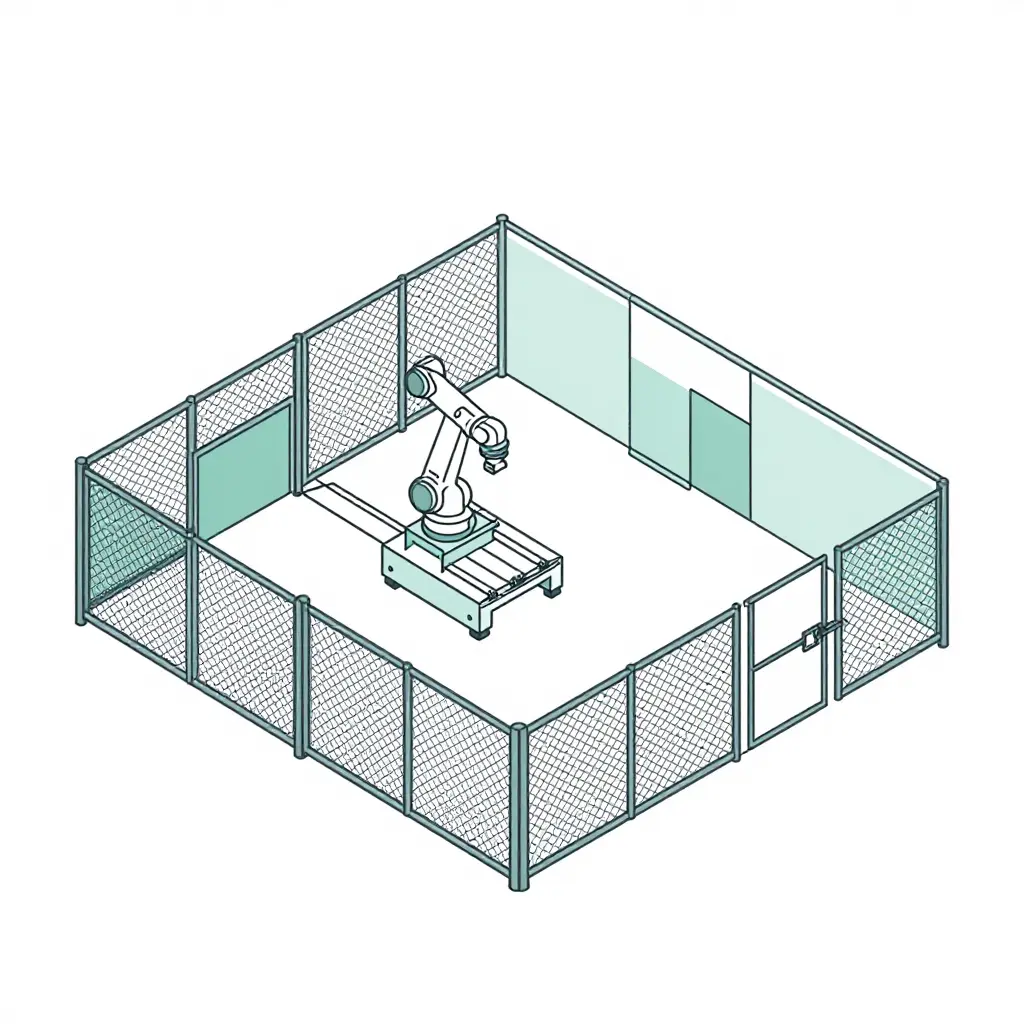
The outer rectangle is the fence line: the physical boundary of the safeguarded space that has to be risk-assessed. The wide gap on one long side is the pallet pickup opening, where a forklift takes a finished load away and drops an empty pallet in. The recessed side opposite it is the operator loading side, kept short so a person can feed cases and step back without ever crossing the robot’s reach. On the remaining wall, the small block on a hinge is the access door. It is drawn with its interlock as a separate element because its position decides whether maintenance and fault recovery can happen without a full line stop.
Those four shapes – perimeter, pickup gap, loading recess, guarded door – are the geometry signed off in the risk assessment, and later the geometry an overseas buyer’s site team measures against their own forklift turning circle. Keep this drawing with the shipping documents; it settles most layout disputes before the crate is opened.
Handover documents the buyer should receive with the cell
The package travels with the cell and gets referenced during commissioning on site. Treat these cobot palletizer handover documents as part of the deliverable itself, and confirm the export documentation is complete before the container is sealed.
- Declaration of conformity – confirms the marking holds for the fully assembled cell, so the local safety inspector signs off without retesting the integration.
- Safety risk assessment file – records every hazard the integrator identified and the guarding response behind it, which gives your team a defensible baseline when layouts or line feeds change later.
- Electrical schematics and I/O list – let your electricians trace a fault to a terminal instead of guessing, and show which spare PLC points are free for a future conveyor or scanner.
- Cell layout and anchoring drawings – define anchor positions, floor load assumptions and clearance envelopes, so the rigging crew drills once and drills correctly.
- Pallet pattern library and program backup – restores production patterns after a controller swap, and lets you build new SKU patterns offline instead of on the running line.
- Factory acceptance test report – captures the cycle time, payload and pattern results proven at the factory; that becomes the reference for re-verification on site.
- Firmware and software baseline record – documents the exact controller and cobot versions shipped, so you know what a rollback returns to when a later update misbehaves – read these rollback checks after a firmware upgrade failure before touching anything.
- Spare parts and wear item list – names the vacuum cups, belts and gripper pads that wear out first, with part numbers you can order against immediately.
- Operator and maintenance training records – show who was trained, on which shift and how deeply, which feeds straight into your deployment training and parts planning so coverage survives holidays and turnover.
Weeks needed to close each pre-shipment workstream
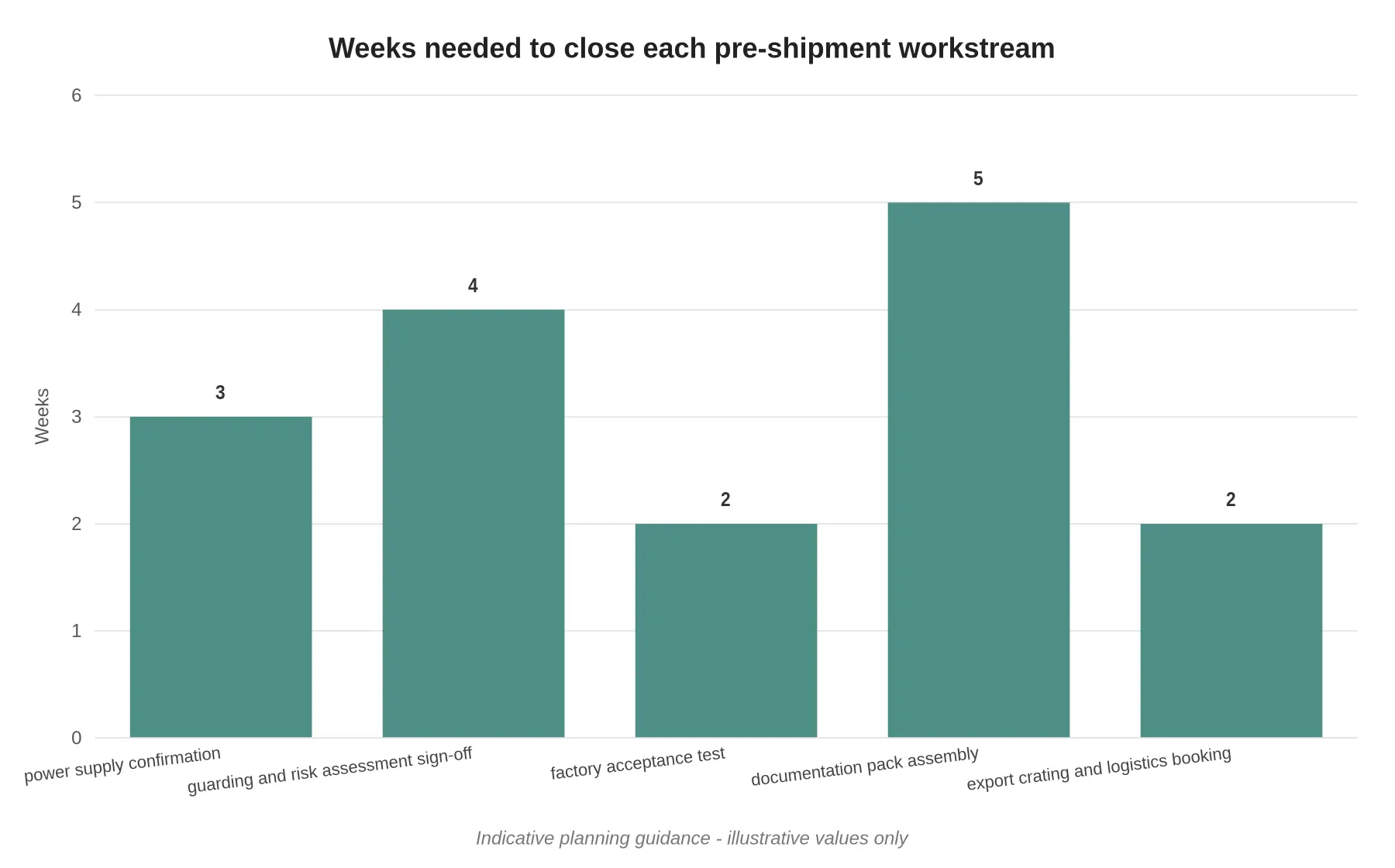
Indicative planning guidance – illustrative values only, not a quotation of schedule.
Documentation pack assembly sits at the top of this list, longer than the factory acceptance test and longer than crating and logistics booking. That ranking is deliberate: a handover pack is not something you write in the last 48 hours before a lorry arrives. It needs as-built drawings, electrical schematics that match what was actually wired, risk assessment outputs, the declaration of conformity, spare parts lists, and a maintenance schedule checked against the real machine.
Where the weeks go
| Workstream | Indicative weeks | Typical trigger |
|---|---|---|
| Power supply confirmation | 3 | Cell layout frozen, utility data issued |
| Guarding and risk assessment sign-off | 4 | Layout and safeguarding concept agreed |
| Factory acceptance test | 2 | Build complete, pattern programs loaded |
| Documentation pack assembly | 5 | Design freeze, drawing revisions closed |
| Export crating and logistics booking | 2 | FAT signed off, shipment window agreed |
The sequencing follows from those numbers. Start the document pack when guarding and risk assessment work starts, not when the crate is being built, so the paperwork grows alongside the machine instead of being reconstructed from memory. The two overlap deliberately: the risk assessment feeds the safety section of the handover file, and the CE or compliance documentation depends on those outputs.
Treat the figures as a scheduling template and adjust for your own review cycles, translation needs and third-party sign-off. For the full sequence from design freeze to FAT to on-site handover, see our guide to the cobot palletizer project timeline.
Put the document pack on the workstream list with a named owner and a start date, exactly like the power supply and the guarding. If it only appears at crating time, it will be the reason the shipment slips.
Factory acceptance test and crating checks before the cell ships
Before anything is wrapped, the cell runs a pre-shipment verification on the builder’s floor with the same robot, gripper, conveyor interface and PLC that will travel. The test confirms cycle time at the rated pattern mix, not just at the friendliest SKU, so the quoted throughput still holds when case sizes and pallet patterns vary. Operators walk a pattern changeover with a stopwatch running, then trigger a simulated e-stop and a guard-door stop to prove the safety circuit drops power and the cell halts in a known state. A dropped-case scenario tests fault recovery: the operator clears the jam, re-homes, and resumes without re-teaching the pattern. Utility checks close the run, confirming the cell starts cleanly at the configured voltage and that air pressure and flow at the gripper meet the specification. Because acceptance criteria are agreed in advance, a structured pilot run doubles as the record that the cell is ready to crate.
Then the physical export checks. Lifting points and the centre of gravity are marked on the frame and on the shipping drawing, so the rigger at the destination picks the same slings the builder used. Anchoring hardware, levelling shims and touch-up materials go into a labelled kit rather than loose in a crate. Guarding panels are wrapped, edge-protected and labelled with their position, because a mismatched fence section costs days on site. Electronics get desiccant, sealed bags and a humidity indicator card, and connector ports are capped. The last step is a photograph set of the configured cell, the wiring, the guarding and the nameplates; that set becomes the reference during unpacking and feeds the wider project timeline from design freeze to handover. Only then is the export crate sealed.
The handover sequence in one glance
Before a cobot palletizer is loaded onto a truck, the cell passes through a fixed chain of checkpoints. Each stage locks in a decision that the next one depends on, and the sealed document pack is the link between the factory’s proof and the site’s reality.

The diagram carries block order and nothing else. Read it left to right:
| # | Stage | What it locks in |
|---|---|---|
| 1 | Factory acceptance test | Cycle time, pattern accuracy and safety functions proven on the customer’s own cases |
| 2 | Document pack sealed | Drawings, BOM, safety validation, firmware versions and spare parts list frozen and signed |
| 3 | Crating and shipment | Shock, humidity and tilt protection matched to the sea or road leg |
| 4 | Site power and guarding verification | Voltage tolerance, earthing, air supply and fence/interlock geometry checked against the sealed pack |
| 5 | Pattern re-verification at start-up | The same patterns, re-taught or re-uploaded, confirmed on site before production release |
Why the sealed pack sits in the middle
Stage 2 is the hinge. Everything to its left is evidence that the machine worked; everything to its right is the argument that it will work again, in a different building, on a different supply. Sealing the pack before crating rather than after arrival gives the site team a fixed reference, so a voltage or guarding mismatch at stage 4 traces back to a documented decision instead of a guess.
Photograph each document as it is sealed and email the set to the site contact the same day. Paperwork that travels in the crate carries the same freight risk as the machine.
Keep the two ends talking
Stages 1 and 5 are the only points where the machine actually runs against product, and they should use the same acceptance criteria. One test script at both ends is the cheapest way to avoid the classic gap where a cell passes FAT on a demo pallet and then stumbles on real cartons. For a stage-by-stage view of how those checkpoints map onto a project calendar, see design freeze, FAT and on-site handover timeline planning.
FAQ: cobot palletizer overseas shipping, power supply, guarding and handover documents
Can a cobot palletizer be re-configured for a different voltage after delivery?
Yes, but it is a hardware project rather than a settings change. The cobot arm itself normally accepts a wide input range through its controller. The cobot palletizer power supply, by contrast, is built around the destination’s nominal voltage and frequency at the time of order, so re-configuration means replacing the transformer or changing taps, re-checking breaker and conductor ratings, and re-validating the safety circuit against the new supply. Settle voltage and frequency during specification and you avoid that cost; retrofitting on site is feasible but adds hardware, labour and a fresh electrical sign-off.
Who is responsible for the safety risk assessment when the cell ships to another country?
The party that puts the cell into service in the destination country carries that duty, which in practice is the end user or the local integrator, because the assessment has to reference local standards and the actual installation conditions. The OEM supplies the guarding layout, risk assessment inputs and conformity documentation; the signed assessment and any guarding modifications belong to the commissioning party. Confirm that split in the contract before shipment. Our notes on cell safety risk assessment scope describe how the division usually works.
Which handover document matters most for local electrical inspection?
The electrical schematic package, including the bill of materials, test certificates and declaration of conformity, is what inspectors ask for first, because it proves the panel as built matches the approved design. Strong handover documents also carry as-built drawings, controller parameter backups and the guarding verification record, which is what lets an inspection close in one visit instead of several.
How long do the factory acceptance test and documentation pack add to the export timeline?
A factory acceptance test takes three to five working days of test time, extending to one or two weeks when the customer witnesses the test and punch-list items need rework; the two weeks on the planning chart cover that window. Documentation runs largely in parallel: about five to ten working days of assembly and translation, spread over the five-week slot because it waits on drawings and risk assessment output, and driven mainly by translating handover documents and issuing the declaration of conformity.
Closing the loop before the cell is crated
Three workstreams close out every palletizer build, in a fixed order. Power supply first: site voltage, frequency, phase count and available fault current matched to the control panel, transformer taps set, disconnect and terminal specs agreed, air pressure and flow documented. Then guarding: fence layout, interlock and light-curtain zones, muting logic, and the safety risk assessment file signed against the final cell footprint. Handover documents last, because they have to describe the machine as built – electrical schematics, bill of materials, FAT results, sequence of operations, fault-recovery routines and the spare parts list. Crating begins only once all three are signed off.
The order pays off downstream. A power mismatch discovered at the plant means a transformer or panel rebuild on site instead of at the factory; a guarding gap found during installation means re-engineering thousands of kilometres from the fabricator. That rework lands directly on commissioning time, and most start-up risk on an overseas install traces back to details that could have been closed before the crate was sealed.
Designing and building the cobot palletizer in house keeps power configuration, guarding package and document set under one roof, so they are confirmed at a single point before shipment rather than negotiated between vendors mid-project. That single-point confirmation is the practical core of cell export readiness, and it moves work out of the field, which changes the cobot palletizer cost structure where hardware and integration costs split. Export support and overseas project services then carry the identical package through to site handover, along the boundary drawn in where in-house design ends and partner scope begins.