What Uptime Really Means in a Cobot Palletizer Cell
Cobot palletizer cell uptime is the share of scheduled production time in which the cell is available, cycling at its rated rate, and completing its pallet patterns with nobody stepping in. Not “power on,” and not “the arm is moving.” A cell that stops every forty cases so someone can nudge a carton or straighten a slipped tier is not up, even though the robot never faults. Measured this way, uptime tracks end-of-line stability: whether the cell can hand off a full, square, wrappable pallet at the rate the line was designed for, shift after shift, while the operator is somewhere else.
Most uptime losses in a palletizing cell do not start at the robot. They start upstream: film tension at the wrapper, flap closure and glue bead placement at the sealer, case squareness after compression, and the pallet itself – warped deck boards, misaligned blocks, moisture-swollen stringers. A cobot asked to stack bulging cartons on a cupped, skewed pallet will fault, retry, or place and slide, and each of those events is charged to scheduled time. In practice most end-of-line instability traces to those two inputs and only a smaller share to the cobot palletizer. That split should decide where engineering hours and capital go. Teams that suspect the robot first buy gripper swaps and pattern tuning while the variation keeps arriving on the conveyor. Auditing sealing consistency and incoming pallet quality before commissioning, then holding tolerances on both, is what protects the uptime number; even well-written fault recovery routines for dropped cases and pallet misalignment only recover the residual.
From Sealed Case to Stopped Cell: How Sealing Defects Become Palletizer Faults
A palletizer does not handle cartons. It handles geometry. Every sealing decision made upstream – glue bead placement, tape tension, fin seal orientation, compression force at the case sealer – commits the case to a shape the robot inherits and cannot negotiate. When sealing drifts, the failure shows up at the tooling rather than at the sealer, which is why sealing quality so often gets read as a palletizer problem.
The seal method sets the surface the gripper has to trust. A glue bead laid slightly off the flap centerline leaves a raised ridge down one case face; a bead that kicks out at the trailing flap end leaves a lump under the tooling. Tape down the center seam under high tension bows the flaps upward on thin board, and a fin seal doubles board thickness along one edge, so one side of the case stands measurably taller than the other. Turn that case ninety degrees in the pattern and the tooling meets a profile it was never taught.
Flap gap and skew work the same way. A gap in the top seam lets the panel deflect and cup under vacuum, breaking the seal before lift; skew rotates the case footprint so the gripper centroid and the carton centroid diverge, and the pick twists. Tape that wraps past the case edge is worse than cosmetic: the overhanging tail bonds to the neighboring case in the layer, drags a second carton on the release, or catches in the gripper throat and rides back up with the tool. Compression closes the set. Under-compressed cases stand proud of nominal height, so each layer stacks higher than the pattern assumes and the error accumulates from layer one to layer eight. Over-compressed cases fail the other way, with flutes crushed and panels dished, and they pancake the moment vacuum pulls or clamp jaws close.
On an inconsistent case surface the gripper stops behaving repeatably and starts negotiating every cycle, which is where the limits described in this comparison of vacuum versus clamp grippers on cobot palletizers turn into visible downtime. From there the chain runs straight through: geometry variance produces pick failures and false no-part alarms; failed and re-picked cases disturb pattern height; height drift and skewed placement destabilize the load, with leaning columns, corners that never interlock, and cases overhanging the deck edge; and one bad layer ends in a restart routine – fault clear, pattern re-teach, layer recount, manual rebuild of the top tier – that consumes the scheduled time the cell was bought to protect.
The order matters when you are troubleshooting, because the fastest repair at the robot is usually not a repair. Measure flap gap, seal placement and case height on the infeed before touching a pick offset.
Carton Sealing Defects and Their Effect on Cobot Palletizer Cell Uptime
Sealing quality rarely stays inside one department: defects created at the case sealer come back as retries, reprogramming and manual pallet rebuilds inside the palletizer cell.
| Sealing defect | Observable symptom at the cell | Primary uptime effect | Countermeasure |
|---|---|---|---|
| Inconsistent glue bead or tape placement | Flaps spring back on infeed; case shifts after gripper release | Pick retries and gripper faults on worst cases | Verify bead width and tape path every changeover; log adhesive temperature and nozzle cleaning |
| Open or lifted flaps | Flap standing proud on case top; height check trips | Case rejects and short stops; manual flap taping at the cell | Add flap-closing guide rail before sealer; check compression rollers and adhesion |
| Case height outside nominal tolerance | Stack height drifts from pattern; top layer sits high or low | Pattern reprogramming time and stack-height faults; occasional pallet rebuild | Tighten case height spec with supplier; add height gate and re-teach offsets |
| Seal skew causing footprint distortion | Corners out of square; footprint shifts against layer pattern | Layer placement errors, pick retries, more manual pallet rebuilds | Square sealer rails to the conveyor; check tape head parallel to case travel |
| Seal contamination from product dust or moisture | Weak or gapped seal; adhesive stringing, tape lifting in humid air | Repeated pick retries and cleaning downtime | Add dust extraction and air knife before sealing; specify moisture-tolerant tape or adhesive |
Treat seal quality as the first control point for cell uptime and audit it alongside palletizer performance data. It is not a downstream packaging detail.
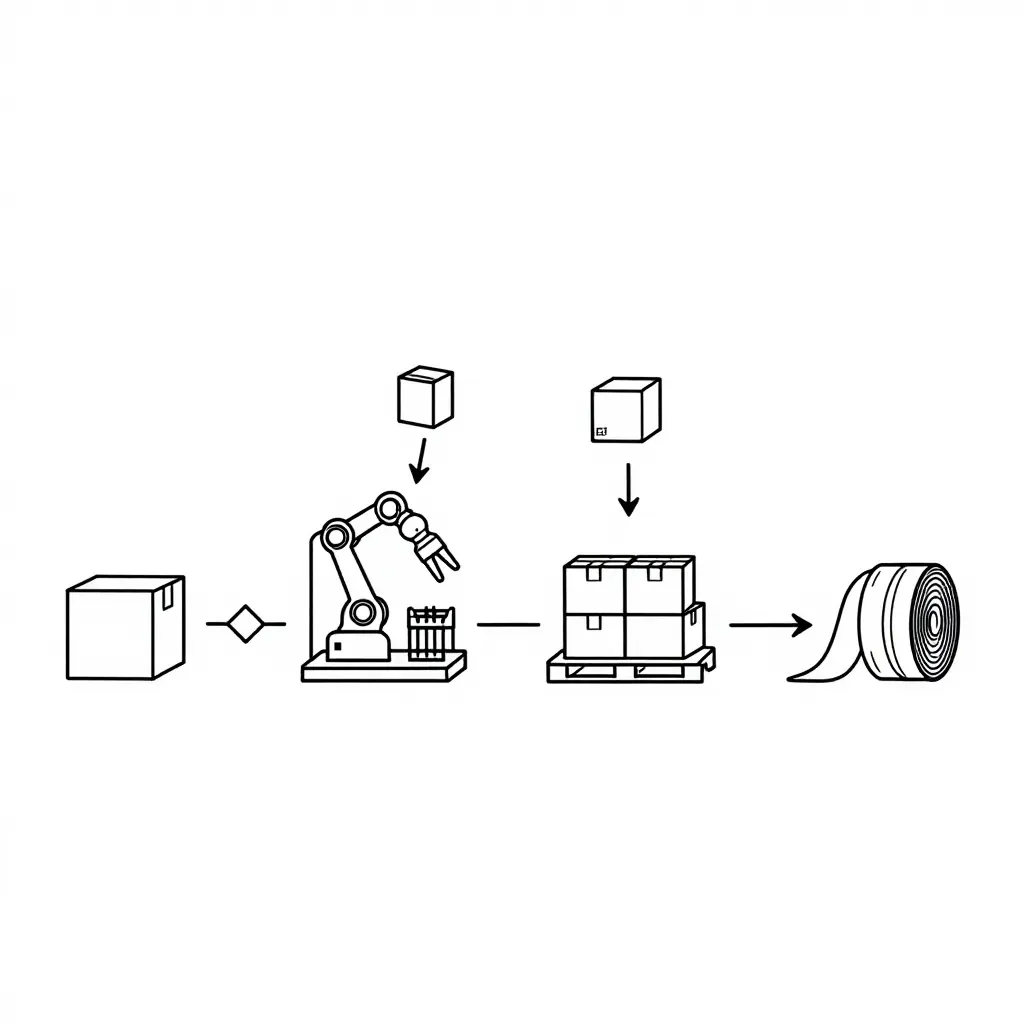
The horizontal chain is material flow; the two symbols above it are the upstream quality inputs. Carton seal consistency and pallet flatness both reach the cell before a single case is placed, which is why they govern stability as much as the robot does. When either input drifts, the arm inherits the error and the fix lands on the palletizer instead of the upstream process. For the mechanical side of that handoff, see vacuum versus clamp grippers on carton and bag handling.
Pallet Quality and Its Effect on Load Stability
A cobot palletizer trusts the pallet. Every drop position is an offset from a reference surface it was taught, usually the top of the deck, and every layer pattern assumes the deck is square, flat, and where the fixture says it is. Wood does not always cooperate. On high-mix, low-volume lines where pallet batches rotate weekly and incoming inspection is a glance at best, pallet variation quietly becomes the largest single source of instability in the cell.
Where wooden pallets break the assumption
- Deck board flatness and warping. A board that bows 6-10 mm across its width moves the true top surface away from the taught reference. The robot places at nominal height, the carton lands 8 mm low into a gap or 8 mm high on a crown, and the layer plane tilts from the first row onward.
- Board spacing and fastener protrusion. Gaps wider than 25-30 mm let carton corners sag between boards. Nails or staples sitting 1-2 mm proud of the deck snag case bottoms and keep them from sliding into the pattern.
- Dimensional tolerance across a batch. Pallets ordered at 1200 x 800 mm often arrive at 1194 x 806 mm or worse. Patterns are programmed to nominal, so 6 mm of length variance per side is enough to push the outer column of cases past the deck edge.
- Moisture content and swelling. Kiln-dried pallets at 12-15% moisture behave predictably. Pallets that sat in a humid or uncovered yard climb past 20%, the boards swell in width and cup, and the deck grows 3-5 mm in each direction.
- Damaged stringers or blocks. A cracked stringer or a missing block turns a flat deck into a rocking surface, and the pallet settles under load after the second or third layer.
- Mixed grades from multiple suppliers. When HT, recycled, and repaired pallets interleave in the same stack, the cell sees a different deck every few pallets with no consistent baseline.
The mechanical consequence inside the cell
Those defects produce four failure modes: placement at the taught Z instead of the actual Z, cases overhanging the deck edge once the pattern no longer fits a non-nominal footprint, layer interlock failure when sagged or shifted cases break the overlap that holds the stack together, and eventually a leaning or collapsed load. Each one stops the cell and brings an operator over to clear a fallen case, re-teach a reference, or restack by hand. The restart and recovery routines cover those situations, but recovery is the expensive fix and incoming pallet control is the cheap one. A simple gauge check – deck flatness within 3 mm, moisture under 18%, footprint within 3 mm of nominal – removes most of the variation before it reaches the gripper.
| Pallet defect | Typical measured value | What the cobot experiences | Failure mode |
|---|---|---|---|
| Warped deck board | 6-10 mm bow | Reference surface no longer at taught Z | Placement height error |
| Fastener protrusion | 1-2 mm proud of deck | Case base catches, will not slide | Misplaced case, pattern shift |
| Footprint variance | 6 mm per side | Pattern no longer fits deck | Overhanging cases |
| Moisture swelling | above 20% MC | Deck grows 3-5 mm per side | Edge overhang, soft deck |
| Cracked stringer | Visible split | Deck rocks under load | Layer interlock failure |
| Mixed grades | Multiple suppliers | Different deck each pallet | Inconsistent placement |
For lines running frequent changeovers, the practical answer is a pallet quality spec written into the purchase order and a 30-second gauge check at goods-in, not a more tolerant robot program.
Where Uptime Goes: Illustrative Downtime Minutes per 1,000 Pallets by Cause
Before anyone starts tuning patterns or swapping grippers, it is worth seeing where the minutes go. The two tallest bars are input problems the cell inherits rather than creates, so a good share of what gets recorded as robot downtime is carton and pallet variation arriving at the infeed.
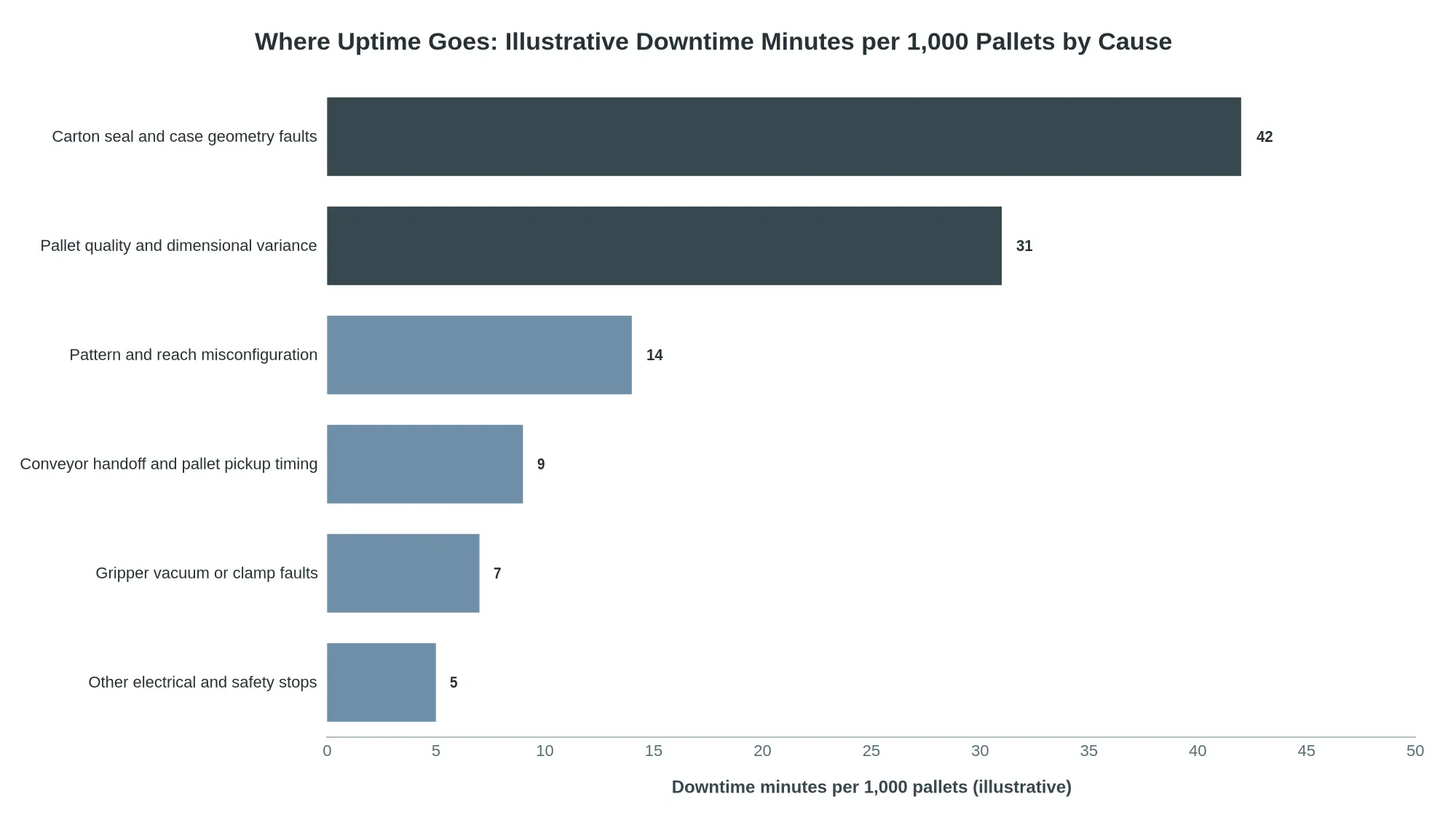
Illustrative planning ratios for discussion only, not measured benchmarks from a specific site.
Carton seal and case geometry at 42 minutes plus pallet quality at 31 come to 73 of the 108 minutes charted, about two thirds of the total. The fault recovery routines for dropped cases and misaligned pallets recover time after a load has failed; they cannot stop the failure. That is why the input side deserves the first engineering hours, ahead of any adjustment to the robot itself.
Infeed Verification Checklist Before the Cell Runs
Run this sequence at shift start and again at every pallet-batch change, so the cell never starts on unverified material.
- Confirm seal integrity and flap closure on a sample of cases.
- Measure case height against the nominal tolerance band.
- Check case footprint squareness at all four corners.
- Confirm pallet deck flatness and absence of protruding fasteners.
- Verify pallet dimensions match the programmed pattern envelope.
- Confirm pallet grade matches the purchasing specification.
- Confirm stacking height limit against cell vertical reach and stack height limits.
Each item produces a number you can compare against the spec, which is the difference between an inspected pallet and an assumed one.
Write It Down: Converting Field Observations into Specifications and Drift Monitoring
A pilot run tells you where a palletizing cell struggles: a taped flap that lifts and catches the gripper, a deck board sitting 6 mm proud, a case that bulges after a week in a warm warehouse. None of that should survive as tribal knowledge. If it lives only in a technician’s memory, it gets rediscovered every peak season with a stopped line attached. At handover, turn what you observed into two documents that outlive the project, a purchasing specification and a process specification, plus one log that shows whether the limits are still being met.
Define carton seal and case geometry with the packaging supplier
Seal quality is a machine input, not a cosmetic detail. Write measurable limits into the packaging specification and agree them with the supplier who actually runs the case erector or sealer: tape placement and centering, flap gap, seal length, and the dimensional deviation of a filled case. Include bulge and squareness, because a case that is 4 mm fat at the panel corners changes how a vacuum gripper seats and how tightly cases nest on the pallet.
Put pallet grade and dimensional tolerance in the pallet purchase contract
Pallets are the least controlled input in most end-of-line cells, and the one that drifts quietly when a buyer chases a cheaper source. Grade, board thickness, moisture content, deck board spacing, fastener flushness, and length, width and squareness tolerance all belong in the purchase contract, alongside a stated inspection method.
| Characteristic | Owning document | Illustrative limit |
|---|---|---|
| Tape placement and centering | Packaging spec | centered on the seam, 25-30 mm lap onto the case ends, no gap |
| Filled case dimensional deviation | Packaging spec | within +/-1.5 mm |
| Case panel bulge | Packaging spec | under 3 mm |
| Pallet top deck flatness | Pallet contract | within 3 mm across deck |
| Pallet length and width | Pallet contract | within +/-3 mm nominal |
| Pallet squareness (diagonal delta) | Pallet contract | within 6 mm |
Treat these as starting values to calibrate against your gripper and pattern, not as universal standards.
Record which inputs correlate with cell stops
Keep a simple drift log at the cell. Every stop or mis-pick gets a timestamp and the incoming conditions at that moment: SKU, seal condition, case bulge measured on a sample, pallet source and lot, pallet flatness. After a few hundred events one or two inputs usually explain most of the interruptions, and those become the characteristics you police.
Review the drift data on a fixed interval
Set the cadence before commissioning, weekly for the first month and monthly after that, and put it in the quality calendar instead of relying on goodwill. The review is also the natural moment to look at the cell itself alongside the incoming material, so pair it with scheduled periodic checks and wear-point inspection, so mechanical wear does not get mistaken for material drift.
The trade-off: tighter incoming tolerances versus packaging cost
Tighter tolerances cost money. Better board grade, higher compression board, more consistent glue lines, sorted pallets: each adds cents per unit, and at a million units a year that is real. The comparison is not tolerance cost against zero, though. It is tolerance cost against stop cost. On a high-mix line, an end-of-line stop is rarely the 40 seconds of the fault itself; it is the pattern restart, the partial pallet decision, the walk back to the cell, and the SKU sequence now out of order. One three-minute interruption per shift, across three shifts, is nine minutes of fault time a day, which on its own will not pay for anything. Twenty minutes of stoppage per shift across three shifts is roughly an hour of line time a day, and at three minutes a stop that works out to six or seven stops a shift. In most high-mix factories, tightening incoming tolerances is cheaper than absorbing repeated stoppages, and far cheaper than upgrading the robot or adding buffer. It is also why a payload and reach plan built around a nominal case size loses its margin of safety the moment real cases run 5 mm larger: the pattern envelope assumes stable geometry.
Set the numbers before design freeze, not after commissioning
Tolerances written after commissioning are always a compromise with whatever the supplier already ships. Set them while the packaging artwork, case size, pallet sourcing and gripper design can still move together, then hold them through acceptance testing. The cell you buy is only as stable as the specification you were willing to sign.
FAQ: Carton Sealing, Pallet Quality and Cobot Palletizer Cell Uptime
How much of cobot palletizer cell downtime is caused by packaging rather than the robot?
In the illustrative split above, carton and pallet inputs account for about two thirds of unplanned downtime, the robot arm and controller for under 5%. The dominant causes are carton sealing defects (open flaps, tape flags, crushed corners) and pallet quality problems (short decks, warped boards, broken stringers). The robot rarely fails outright. It stops because it cannot place a case that never arrived cleanly, or stack on a pallet that is out of tolerance.
What pallet dimensional tolerance should be specified for automated palletizing?
Specify length and width within ±3 mm, overall height within ±3 mm, diagonal skew within 6 mm, and top-deck flatness within 3 mm across the load area. Keep pallets inside those bands and the cell can run its pattern offsets without vision correction.
Can a cobot palletizer compensate for inconsistent carton seal or case heights through programming?
Yes, within limits. Layer-height sensing, automatic pattern offsets and per-layer Z adjustments take out roughly ±10 mm of case height variation and ±15 mm of position drift on a vacuum gripper. Beyond that, bulged cases and raised tape flaps cause vacuum leaks and gripper collisions, so fix the sealer and flap control first and program second.
How should cell uptime be measured and reported?
Uptime is scheduled production time minus unplanned stops, divided by scheduled production time, with planned changeovers and breaks excluded. Log every stop against three buckets – robot, carton sealing, pallet quality – and report weekly availability alongside MTBF and MTTR. Separate stop codes for sealing and pallet quality are the fastest way to show where cobot palletizer cell uptime is actually lost.
Where the Uptime Work Actually Belongs
End-of-line stability is decided before a case reaches the robot. Seal consistency and pallet quality set the practical ceiling on uptime, so improvement work belongs in infeed inspection and supplier specifications rather than in robot programming.
Three things carry most of that work:
- Verified incoming quality – measure seal integrity and pallet flatness on arrival, before a jam forces the question.
- Tolerances in the specifications – seal strength, board squareness and deck condition go into the purchase document, so the supplier carries ownership.
- A fixed review cadence – track fault codes and mispick causes on schedule, and let the trend, not the loudest complaint, set the next priority.
ZBOSN designs and manufactures its cobot palletizers in-house and supports mechanical integration and overseas project services.
When the cell is ready to prove itself, well-defined acceptance criteria for pilot runs turn sign-off into a repeatable test instead of one unusually good shift. After that, uptime is less a project milestone than a routine: the same inspection, the same specifications and the same review, run shift after shift.