
Maintenance intervals on a cobot palletizer are set by duty, not by the calendar. Cycles per hour, payload, gripper type, and plant environment decide when components actually degrade, so cobot palletizer maintenance is better scheduled against accumulated work than against elapsed weeks. A cell running high cycle rates in a chilled or washdown room reaches the same wear points in months that a light-duty cell reaches in a year. The three-tier framework below turns that into something a shift supervisor can act on: daily checks, staged maintenance intervals, and quarterly and annual service.
Tier 1: daily pre-shift checks, at every shift start. No tools, no disassembly – look and function-test before the first pallet is built. Cups or clamp pads, air pressure at the FRL, hose and cable abrasion at the wrist, pendant alarms, light curtain and scanner status, pallet presence sensing. This tier catches the failures that would stop production in the first hour or put someone at risk.
Tier 2: weekly and monthly inspections, anchored to cycle count. These are logged checks aimed at slow drift rather than hard failures: vacuum decay and cup hardness, fastener torque on end-of-arm tooling, filter condition on the vacuum generator, cleaning of conveyor tracking photo-eyes, brake holding tests on the highest-moment joint, versioned backups of pallet patterns. A shift operator will not spot this kind of degradation; the log will. And because gripper type changes the wear profile, vacuum and clamp machines should not share one interval table.
Tier 3: quarterly and annual service. Quarterly: safety functions validated end to end, backlash and repeatability checked at the wrist, gripper wear parts inspected or rebuilt, cable routing reviewed for fatigue. Annual: full mechanical inspection, joint and reducer assessment, controller cooling and filter replacement, and an audit of the interval record against actual throughput. Cumulative structural and drive-train wear shows up here, and this is where next year’s baseline gets reset.
Write intervals from recorded conditions, not from a template. Log cycles per hour, average and peak payload, gripper configuration, ambient temperature, and washdown exposure for each cell, then scale the tiers to match. Any change in SKU mix, pattern complexity, or end-of-arm tooling is grounds to re-derive the schedule rather than inherit the previous one.
Daily Pre-Shift Check List for a Cobot Palletizer
Run these daily checks at the start of every shift on the cobot palletizer, and record each result on the shift log before the cell is released to production.
- Gripper vacuum level – read vacuum gauge or sensor at idle and with a test carton held; pass at rated vacuum (e.g. -60 kPa) and no decay over 10 s, fail on drift or slow build.
- Vacuum cup lip condition – visually inspect and wipe each cup lip for cracks, flattening, cuts, or debris; pass if lip is continuous and compliant, fail on any tear or permanent set.
- Gripper/clamp jaw pads – check pad wear depth and fastener tightness; pass if wear is within the marked limit and no movement under hand load, fail if pad is worn through or loose.
- Cable dress pack abrasion – inspect harness, conduit, and strain relief along the full arm travel; pass with no exposed conductor, scuff-through, or kink, fail on any abrasion through the outer jacket.
- Teach pendant fault log review – open the event/alarm history and clear the buffer only after review; pass with no active or repeated faults, fail if any recurring axis, vacuum, or safety fault is present.
- Light curtain and safety scanner response – perform a manual interruption test of each zone; pass if the robot stops and a reset is required, fail if the cell continues or the reset is bypassed.
- Pallet magazine / dispenser – confirm pallet stack height, squareness, and magazine guide alignment; pass if the dispenser cycles to the home position without jamming, fail on misaligned or skewed stacks.
- Infeed conveyor sensors – trigger each photo-eye and check gap/position setpoints against the HMI; pass if every sensor reads and clears in sequence, fail on any intermittent or blocked signal.
- Base anchoring bolt torque marks – check the index paint lines on anchor bolts (see base mounting and floor anchoring practice); pass if all marks are aligned, fail on any rotated mark or cracked grout.
- Cell guarding and interlock doors – test each door interlock and verify guard fixings; pass if opening any door drops the safety circuit, fail on a defeated or slow interlock.
- E-stop and reset circuit – press each E-stop and confirm the drive disable and fault message; pass if all stations stop and latch, fail on any non-latching button.
- Air supply pressure and filter bowl – read the regulator gauge and drain the bowl; pass at rated supply pressure with no water or oil carryover, fail on low pressure or visible contamination.
- Pattern program and pallet count – verify the active recipe matches the scheduled SKU and the pallet counter is zeroed; pass if recipe and count match the work order, fail on any mismatch.
If a check fails: log the fault, escalate to the shift supervisor or maintenance lead, and do not run the cell until the item is cleared.
Table: Cobot Palletizer Maintenance Interval Matrix – what each tier covers, who owns it, and how the failure announces itself if the tier gets skipped. Stocking depth for these parts is covered in the spare-parts planning guide.
| Interval Tier | Components Covered | Typical Task | Failure Symptom If Skipped | Owner (Operator / Technician / Integrator) |
|---|---|---|---|---|
| Daily check | Vacuum cups, gripper pads, safety devices, pallet magazine | Wipe cups, cup-pull test, light curtain and e-stop function check, confirm pallet stack present | Dropped cartons, nuisance stops, empty pallet alarms | Operator |
| Weekly inspection | Cable dress pack, cable chain, belt conveyor, mounting bolts | Visual chafe and kink scan, belt tracking check, bolt witness-mark check | Intermittent joint faults, belt drift, frame vibration | Operator with Technician |
| Monthly inspection | Joint gearboxes, roller conveyor drives, pallet dispenser, force-torque limits | Leak and weep check, chain and roller wear check, dispenser cycle test, force-limit verification with test mass | Gearbox whine, roller slip, double-dispense, over-force faults | Technician |
| Quarterly service | Joint gearboxes, cable dress pack, conveyor drives, safety devices | Grease per axis schedule, dress pack bend-radius audit, drive current trending, safety function validation | Position drift, cable fatigue fracture, motor overload trips, unverified safety state | Technician with Integrator |
| Annual service | All wear items, frame anchoring, pallet magazine, gearbox lubrication | Lubricant change to joint specification, dress pack replacement, anchor re-torque, safety recertification, magazine rebuild | Sudden axis seizure, anchor loosening, missed pallet picks, audit non-conformance | Integrator with Technician |
Common Wear Points and Failure Signatures
Most unplanned cobot palletizer stops start small – a cup that takes longer to pull vacuum, a pad that measures a little thin, a fault that only appears at one wrist angle. So a working cobot palletizer maintenance program trends symptoms instead of collecting pass/fail ticks, and keeps coming back to the same wear points.
Vacuum cup lips. Ozone, flex fatigue, and washdown chemistry harden the elastomer until it cracks at the sealing lip. Before the crack, the cup needs more vacuum or more time to hold the same carton, because the seal is leaking. Check weekly for crazing, flat spots, and embedded debris, leak-test at rated vacuum, and compare durometer against a new cup. Once leakage trends upward, replace the set rather than the worst cup.
Gripper foam and clamp pads. Clamp force, heat, and product dust cause compression set, so foam loses rebound and pads glaze or flatten. Pad thickness drops, and the cell needs more air pressure or motor torque to hold the same load, until cartons slip under acceleration. Measure with calipers at pad centre and edge, log clamp pressure, and watch for glazing. How much faster this happens depends on the end effector: see this guide to vacuum versus clamp grippers on cobot palletizers.
Cable dress pack at the wrist. Repeated wrist rotation fatigues conductor strands, abrades shielding, and stretches cable ties. The first sign is usually an intermittent encoder, valve, or sensor fault at particular wrist angles, plus rising resistance on a continuity check. Cycle the full range of motion looking for sheath wear, bend-radius violations, and loose ties; run continuity while the wrist moves, and put a thermal camera on connectors that run warm.
Joint gearbox backlash. Degraded lubricant, worn tooth flanks, and lost bearing preload all end up as lost motion. Commanded and actual position diverge more on reversal, torque climbs, and the joint starts to growl. Baseline backlash with a dial indicator under loaded and unloaded conditions, joint by joint, and trend lubricant condition from oil analysis or grease samples.
Tool flange fasteners. Vibration and cyclic bending relax preload, the threads fret, the joint shifts slightly. Torque falls below the specified value, witness marks rotate, flange runout grows. Re-check with a calibrated torque wrench, inspect marks and threads, measure runout. Keep certified fasteners and wear parts on the shelf through a disciplined spare parts stocking plan so a small finding does not become a long downtime event.
Conveyor belt tracking drift. Belt elongation, pulley misalignment, idler drag, and debris buildup push the belt sideways. Belt edge distance to the frame changes, drive current climbs, and product arrives skewed at the transfer. Measure edge position at head and tail pulleys, check pulley square and belt tension, inspect idlers for drag, and trend motor current after cleaning.
Trend every measurement against the commissioning baseline. A pad that is 1 mm thinner, or a wrist cable that only fails at 170 degrees of rotation, already tells you which spare to stage.
Indicative Wear-Part Replacement Frequency on a Two-Shift Cobot Palletizer
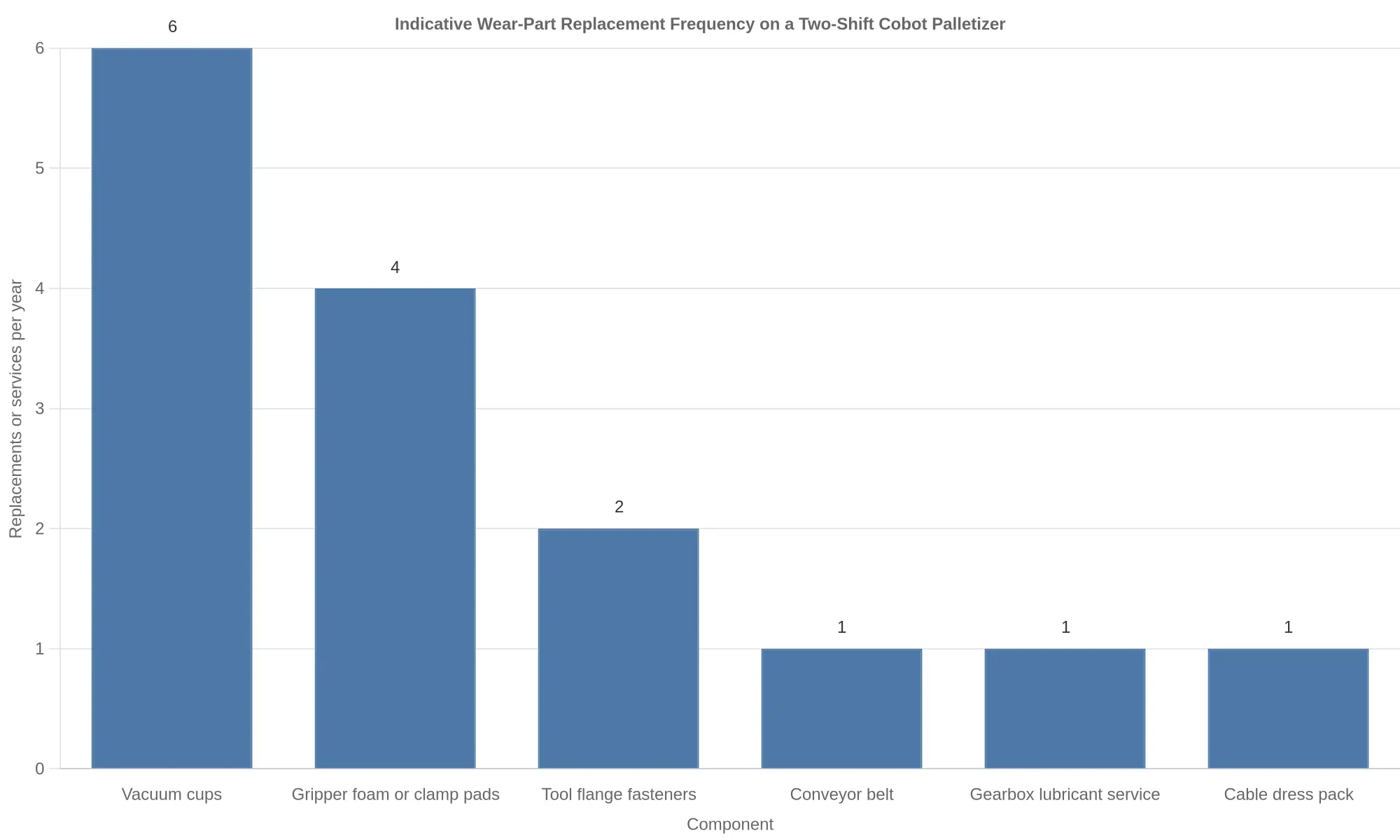
Figure 1. Indicative annual wear-part replacement and service counts for a cobot palletizer running two shifts.
Caption: Indicative only, based on a mid-duty two-shift cell handling cartons and cases in an ambient plant. Every count shifts with actual cycles per hour, product mix, and environment – abrasive dust, washdown, cold storage, and high-speed vacuum gripping all move these numbers, so use the chart to size a first spares kit, not to set the schedule.
Replace the estimates with your own counters after the first quarter. Stocking depth and lead times are covered in this guide to cobot palletizer deployment training and parts planning.
Adapting Intervals to Washdown, Cold Storage, and High-Mix Duty
Baseline maintenance intervals are normally written for a dry, temperature-stable cell running a narrow carton range. Change any one of those three assumptions and the wear rates behind the schedule change with it. The environment multiplies sealing and corrosion degradation; SKU mix multiplies gripper and pattern-related wear. The practical method is to keep the task list fixed and re-scale the frequencies.
Washdown and food-grade duty
Hygienic cleaning attacks the cell from two directions. Water, foam, and caustic chemistry find any unsealed path into the arm connector bays, tool flange, and vacuum generator, so moisture ingress usually shows up first as intermittent I/O faults and drifting vacuum readings rather than a hard failure. Read the IP rating against the actual cleaning method: IP65 covers dust and low-pressure water jets, not the high-pressure, high-temperature washdown that IP69K covers. Detergent contact also degrades elastomer suction cups, and a residual moisture film on carton surfaces cuts the friction and vacuum margin cup adhesion depends on, so correctly sized cups begin to slip on cartons they previously held. Stainless hardware and IP-rated components need their own inspection line: fastener torque on 316 brackets, gasket compression at covers, cable gland tightness, pitting around weld seams. Enclosure and material limits are covered in this guide to cobot palletizers in washdown food and beverage plants.
Revised interval: cup and pad inspection moves from monthly to weekly; seal, gland, and stainless fastener checks move from monthly to per-shift, once per washdown cycle.
Cold storage and condensation risk
At freezer temperatures, standard NLGI 2 grease channels instead of flowing, which raises joint torque and accelerates gearbox and bearing wear; the lubricant type and the relubrication frequency both have to change, not just the quantity. Condensation is the second mechanism and often the more damaging one: a cell that cycles between cold storage and an ambient staging area wets its internal surfaces on every warm-up. Ice builds on gripper venturi exhausts, vacuum lines, linear rails, and photoeyes, and the failure mode is a slow loss of vacuum response or a false no-carton signal rather than anything visible. Meltwater also washes rail and guide lubrication away. Low-temperature limits and mitigation options are set out in this review of cold storage and low-temperature duty limits.
Revised interval: relubrication moves from quarterly to monthly with cold-rated grease; gripper and rail de-icing inspection moves from weekly to per-shift at the start of each cold cycle.
High-mix, low-volume and frequent pattern changes
When pallet patterns change per order rather than per week, the gripper meets a wide spread of carton geometry: different edge stiffness, tape and film surfaces, bags as well as cartons. Cups and foam pads wear faster because contact pressure and shear load vary between products, and a cup compliant enough for a film-wrapped case is overloaded by a rigid die-cut carton. Frequent changeovers also multiply the pattern verifications and offset checks performed each week.
Revised interval: vacuum cup and pad inspection moves from monthly to weekly; pattern offsets are verified at each changeover instead of on a weekly schedule.
Interval revision summary
| Duty condition | Dominant wear driver | Baseline interval | Revised interval |
|---|---|---|---|
| Washdown / food-grade | Moisture ingress, elastomer degradation, adhesion loss | Cups monthly, seals monthly | Cups weekly, seals and glands per-shift |
| Cold storage | Grease channeling, condensation, ice on gripper and rails | Relube quarterly, de-ice weekly | Relube monthly (cold-rated), de-ice per-shift |
| High-mix low-volume | Variable carton geometry, changeover frequency | Cups monthly, offset check weekly | Cups weekly, offset check per changeover |
Record these revisions as a documented change to the task list. The re-scaled frequencies belong in the maintenance schedule, so every cobot palletizer maintenance task reflects the duty the cell actually runs rather than the ambient-cell assumptions printed at commissioning.
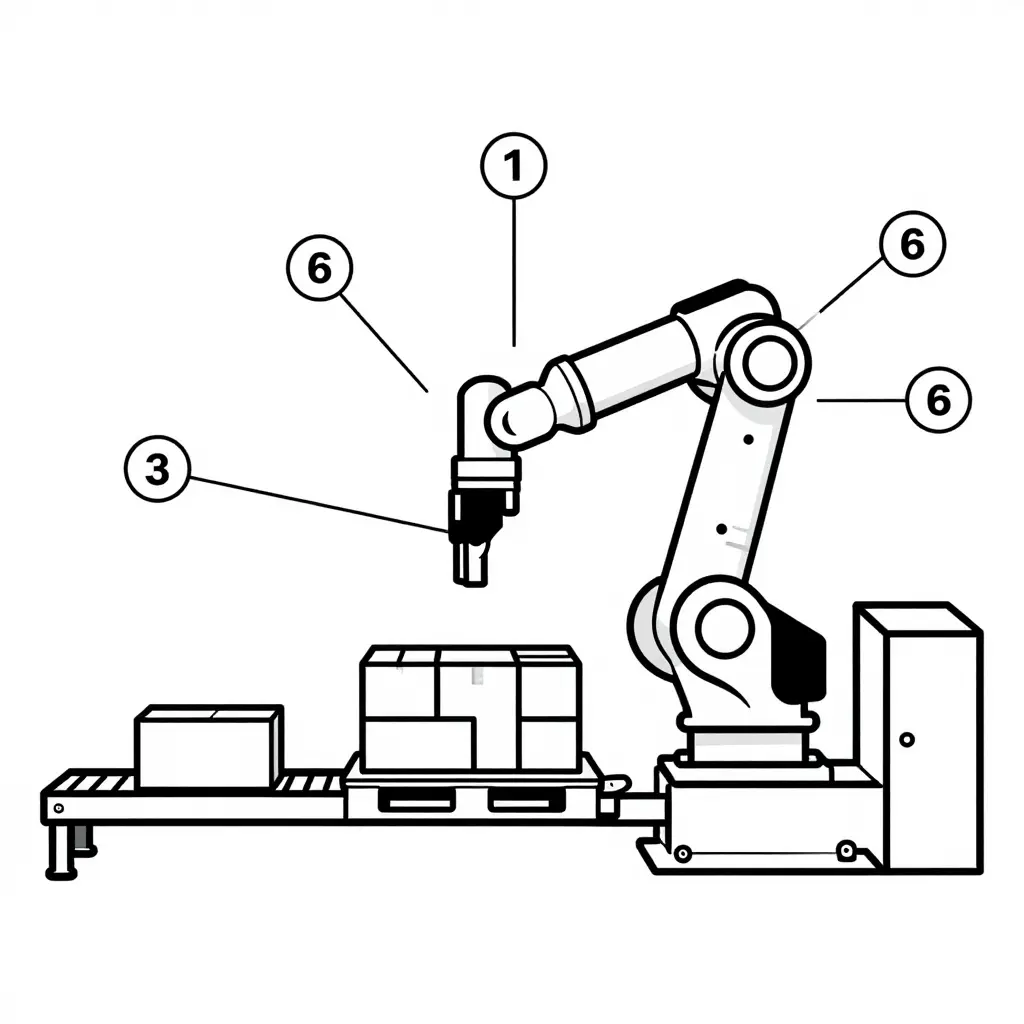
Figure: Two-dimensional wear-point map of a cobot palletizer cell. Numbered callouts mark the six locations that drive most unplanned stoppages: 1 cup lips, 2 gripper pads, 3 wrist cable dress pack, 4 joint gearboxes, 5 tool flange fasteners, 6 base anchor bolts. Use it as a walk-the-cell checklist graphic – each number maps to an inspection step in the tables above.
Converting Daily Checks into Predictive Signals
A daily checklist proves the cell ran today. A trend line tells you when it will stop. Moving from reactive repair to predictive cobot palletizer maintenance is a data discipline more than a hardware problem: pick five signals, log them the same way every shift, and compare them to a fixed reference rather than to yesterday’s number. Five signals cover most of the failure modes that actually take a palletizer down.
Vacuum decay test time. On vacuum grippers, cap the cup, pull vacuum, and time how long the circuit holds. Log seconds-to-decay at a fixed vacuum level. A decay time that creeps upward points to a leak path at the cup lip, the filter, or a fatigued hose, and it is the earliest warning that a carton or bag will eventually drop mid-stack.
Cycle-time drift against the commissioned baseline. Trend measured cycle time per pallet pattern against the figure recorded at handover. A few percent of drift is usually pattern or conveyor timing; a steady climb is usually friction, gripper slip, or a joint working harder than it should. If the baseline was never tied to documented criteria, rebuild it from the acceptance criteria defined during the pilot run first, so later comparisons mean something.
Joint current and torque trend logging. Log peak and average motor current per axis per shift. Rising current on one axis with a flat payload is the cleanest early indicator of lubrication breakdown, belt tension loss, or bearing distress, and no visual inspection will find it.
Gearbox backlash measurement. Take a repeatable backlash reading at each wrist and shoulder axis on a fixed interval. Backlash growth degrades pattern accuracy and eats positioning tolerance long before anything sounds wrong.
Vibration and audible change at the wrist. Train operators to report a new tick, whine, or shudder at the tool flange, then confirm it with a simple vibration reading. These are among the highest-value wear points to track, precisely because the change stays subjective until someone writes it down.
A Three-Level Escalation Scheme
Keep the daily check as the first level: operators log the five signals, and routine preventive maintenance tasks (cup swap, filter clean, lubrication check) stay inside the shift. Escalate to Level 2, a maintenance technician, when a signal crosses a documented limit and holds for two consecutive readings rather than one. Level 3, integrator support, comes in when the technician’s intervention fails to bring the signal back inside band after a defined window, or when two or more signals move together, which usually points to a mechanical or program-level root cause instead of a component swap.
The percentages below are starting thresholds for a new cell. Replace them with limits derived from your own baseline data as it accumulates.
| Signal | Level 1 – daily check | Escalate to technician (Level 2) | Escalate to integrator (Level 3) |
|---|---|---|---|
| Vacuum decay time | Log seconds-to-decay | 20 percent above baseline on two shifts | Still elevated after cup and filter replacement |
| Cycle-time drift | Record per pattern | 5 percent above baseline sustained | Drift continues after mechanical check and re-teach |
| Joint current | Log peak and average | 15 percent rise on one axis | Rise persists after lubrication and tension check |
| Gearbox backlash | Measure monthly | Any growth beyond documented tolerance | Backlash beyond tolerance after adjustment |
| Vibration / audible | Operator report | Confirmed on two consecutive checks | Confirmed source inside arm or gearbox |
Fault Log and Firmware Review
Every escalation should carry the fault log with it. Export the controller log at the moment of escalation, not after the next reboot, and read it alongside the firmware version history: unexplained axis faults after an update are a different problem from faults on unchanged firmware. Run the three rollback checks before and after any firmware upgrade, so a version change never gets confused with mechanical wear. Done consistently, that habit keeps integrator time off the wrong layer of the stack.
FAQ: Cobot Palletizer Maintenance Intervals
How often should daily checks be performed on a multi-shift cobot palletizer?
Run daily checks once at the start of every shift, not once per 24 hours. A three-shift cell gets three inspections, each covering gripper vacuum level, hose condition, teach-point drift, and safety scanner status. Log results by shift, so a degrading trend surfaces before it becomes an unplanned stop.
Can maintenance intervals be extended after the first year of stable operation?
Yes, but only after twelve months of logged data show zero wear-related downtime and stable vacuum performance. Move in increments – stretch a 500-hour joint inspection to 750 hours and watch it for two quarters before going further. Base every extension on measured condition, not on calendar convenience.
How do you tell a worn vacuum cup from a vacuum generator fault?
Clamp the cup against a flat plate and read the gauge. A cup that reaches target vacuum but decays fast is worn; one that never reaches target points to the generator, the filter, or the supply line. Check the lip for cracks, hardening, and permanent set, replace a single cup, and retest. If vacuum recovers with the new cup, the generator is fine.
Which wear points cause the most unplanned downtime?
Vacuum cups, hose and fittings, and the cable carrier at the wrist usually account for the bulk of unplanned stops. Cup lips degrade fastest on abrasive corrugated and bagged product, hoses crack at tight bend radii, and carrier chains fatigue from repeated wrist rotation. Track these three wear points on fixed replacement intervals and keep spares on the shelf.
What maintenance documentation should an integrator hand over at commissioning?
The handover package contains the as-built maintenance schedule with task intervals, a spare parts list with OEM part numbers, lubrication and torque specifications, gripper and vacuum diagrams, and the fault-code reference. It also includes a signed maintenance log template and written wear-part replacement procedures. Verify the package against the cell’s actual configuration before signing acceptance.
For the complete parts and training handover scope, see our deployment training and parts planning guide.