Manual Palletizing vs a Cobot Palletizer: The Real Trade-Off
Manual palletizing almost always wins on capital cost. It loses on shift coverage, labor stability and the knowledge that leaves with the crew, and it starts losing as soon as volume and SKU mix settle into a predictable band. Nearly everything below follows from that one trade.
Manual palletizing runs on a schedule rather than a program: throughput is whatever the people on that shift can sustain, and the pallet pattern lives in an operator’s head or on a taped-up sheet by the cell. Nothing is fixed, so nothing has to be bought, programmed or validated. It also scales down to zero volume without penalty, which is why it has lasted this long.
A cobot palletizer invests the other way round. It is a fixed-output cell running a defined pattern program, so cycle time and stack quality come from the installation instead of the roster. You pay once for the capability, then again only when the pattern set, carton range or line speed changes.
The trade-off bites hardest where shift labor is hardest to hold. Two or three crews mean two or three training curves and quality baselines, and every departure resets what the plant knows. Palletizing automation moves that knowledge into a program that does not resign, does not rotate out at peak season and needs no shadow cover for absences.
At low volume the deciding factor is predictability, not cost. Once daily case counts and SKU families stop swinging week to week, the question changes from what the cell costs to what an unstable crew costs, and that is when a mid-volume ROI model gets built before anyone commits capital.
What Manual Palletizing Actually Costs on a Shift Basis
Most plants can quote a wage rate for a palletizer operator. Fewer can quote the hourly burden behind it, which is where the real number sits:
- Scheduled headcount per shift sets the shift labor hours the line must fund before a case moves.
- Absenteeism and peak overtime both add paid hours that never appear on the staffing plan, and overtime pushes the effective hourly rate above the posted wage.
- Onboarding consumes training hours each time an experienced operator leaves.
- Ergonomic risk accumulates as recordable incidents and lost days.
- Pace drops through the last hours of a shift, so cases per hour fall exactly when the shift needs to close out.
- Supervisors spend their own hours redistributing staff between stations.
- Where one operator is the only one trained on a given pallet pattern, a single absence stalls the cell.
- Breaks and shift handovers idle the line for the length of each transfer.
Cost these drivers per shift before you price any automation against them. That per-shift baseline is what a cobot palletizer ROI case on mid-volume lines gets measured against.
Manual Palletizing vs Cobot Palletizer Side by Side
| Criteria | Manual Palletizing | Cobot Palletizer |
|---|---|---|
| Output consistency across a shift | Rate drifts with fatigue; last hour typically slower than first. | Cycle time holds steady; rate set by gripper and pattern. |
| Shift coverage model | Two or three operator shifts, with relief staff covering breaks. | Same cell runs every shift; attended for infeed and pallet exchange. |
| Sensitivity to turnover and cross-training | Each new hire needs weeks; build quality varies by operator. | Headcount changes don’t alter rate; training shifts to maintenance and setup. |
| Changeover to a new pallet pattern | Operator reads a pattern sheet and adapts in minutes. | Pattern program edit or offline simulation, then a verification run. |
| Floor space required | Operator zone plus pallet staging; footprint stays flexible. | Fixed cell footprint, plus fence or safety-scanner clearance envelope. |
| Upfront capital vs recurring cost | Low capex; recurring labor cost scales directly with volume. | Higher capex; recurring cost mostly maintenance, spares and power. |
| Ergonomic and safety exposure | Repetitive lift and reach exposure; musculoskeletal disorder risk rises at high case rates. | Risk shifts to pinch points, cell access and pallet exchange zones. |
| Ramp-up time for new staff | Days to baseline rate; weeks on mixed SKUs. | Commissioning takes weeks; operating tasks take hours, not weeks. |
| Best-fit demand profile | Low volume, seasonal peaks, or many SKUs with infrequent runs. | Steady mid-volume, repeatable patterns, limited gripper changes per shift. |
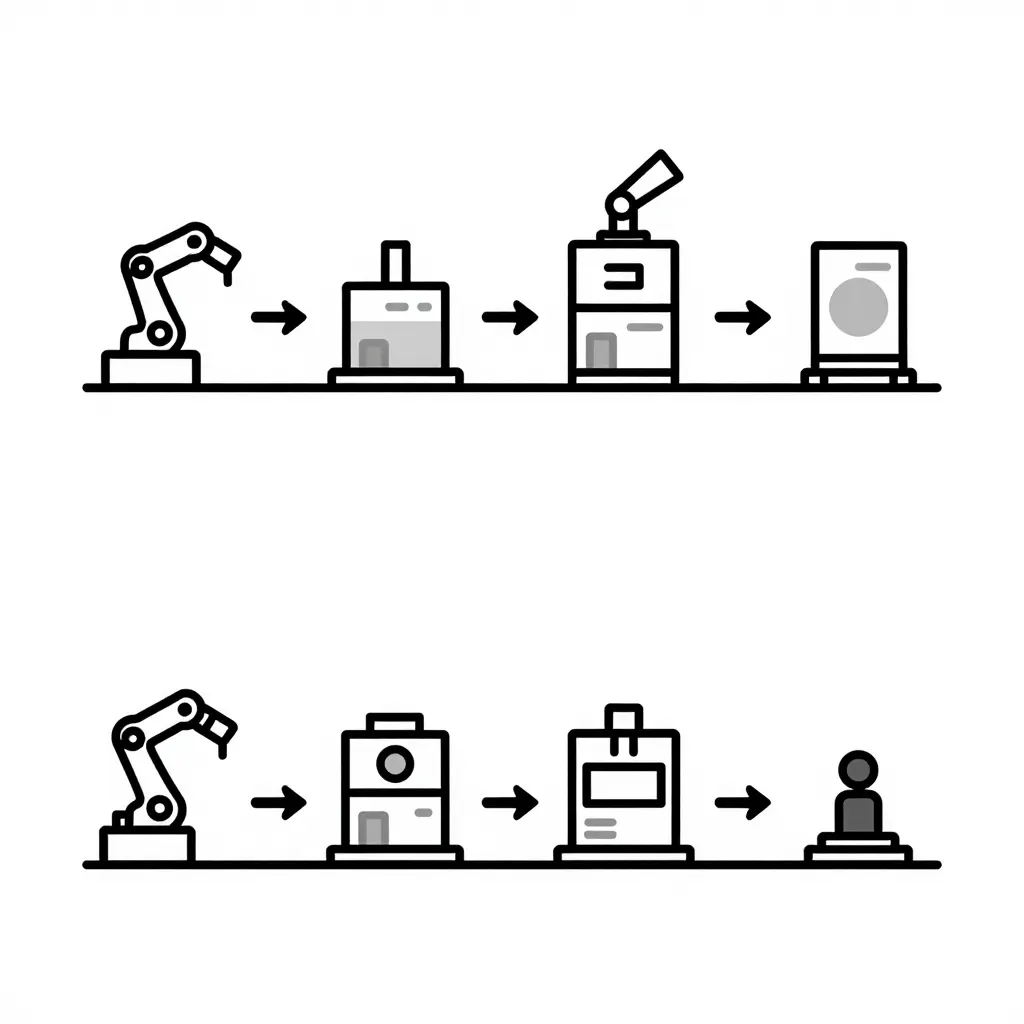
Two parallel bands, read left to right across the same four shift blocks: the manual crew keeps reshuffling, the cobot cell keeps running.
Where the Cobot Palletizer Cell Starts to Make Sense
No single pallet count flips the decision. The cell makes sense when sustained throughput and pattern reuse line up at the same time. Six questions, in order:
-
Required sustained pallets per shift. Not the peak hour, not the best day of the quarter. Take the average across a normal shift and ask whether the cell can hold that rate for hours rather than minutes. A line that needs one burst of pallets a day rarely justifies the hardware.
-
Number of shifts per day that must be covered. This is where the economics usually break in favor of the cell. One shift of palletizing is a staffing problem; two or three is a coverage problem, and coverage gets expensive when it depends on finding people who will do the same repetitive lifting all night.
-
Number of active SKUs and pallet patterns. Count the distinct patterns you run in a season, not the product codes. High-mix, low-volume lines often carry fewer real patterns than the product list suggests, which is good news for automation.
-
Stability of demand over a production season. A pattern reused for months amortizes. One that changes weekly with seasonal pack sizes and promotional cases does not, because every change eats into the saving.
-
Available floor space at the end of the line. The cell needs room for the robot base, robot envelope, pallet pickup access and a buffer position. Measure before anything goes onto a layout drawing.
-
At least one person available for replenishment and pallet exchange. The cell automates stacking. It does not automate the flow of empty pallets and slip sheets, or the removal of finished loads. Someone has to own that loop every shift.
The Plain Version of the Threshold
At the low end of the band, manual palletizing stays cheaper, and single-shift work rarely clears it. A crew of two doing a couple of pallets an hour, one shift a day, is displacing a fraction of one operator. That is not enough to repay a cell, and you have added maintenance, programming and a safety review to a job that was already working.
The cell earns its place when two conditions hold at once: coverage across multiple shifts, and stable pattern reuse amortized over a long production run. If you can staff the line for eight hours but not for the third shift, that staffing gap is worth more than the throughput number. If a dozen programs cover 80% of your volume because the patterns hold steady, setup effort stops being an obstacle.
This is why integrators talk about thresholds in pairs, sustained throughput and pattern reuse, rather than one universal number. Thirty pallets a shift across four repeating patterns is a far better candidate than sixty pallets across forty patterns with seasonal churn. On mid-volume lines the pattern side usually decides it, and how payback works on mid-volume lines runs those numbers.
Mapping Volume to the Cell
Once you clear the threshold, sizing comes next. Pallets per shift and cases per minute are different units, and swapping one for the other is where capacity plans go wrong.
| Question | What It Tells You |
|---|---|
| Sustained pallets per shift | Whether the case rate justifies the robot at all |
| Cases per pallet | Cycle time budget per cycle, and reach requirements |
| Shifts to cover | Whether labor savings can pay back the capital |
| Repeating patterns in a season | Whether programming effort amortizes |
| Pallet exchange time | Whether one person can keep the cell fed |
If the volume looks marginal, recheck the case rate assumptions before abandoning the project. The difference between comfortable and marginal is often arithmetic done in the wrong units, which is where throughput planning in cases versus pallets starts.
A Habit Worth Building
Write the six answers down before you request a quote: sustained pallets per shift, shifts to cover, active patterns, seasonal stability, floor space, and one named person for replenishment. A vendor who asks for those six numbers is asking the right questions. A quote built without them is a guess in a proposal template.
Cost per Pallet vs Sustained Volume: Manual vs Cobot Palletizing
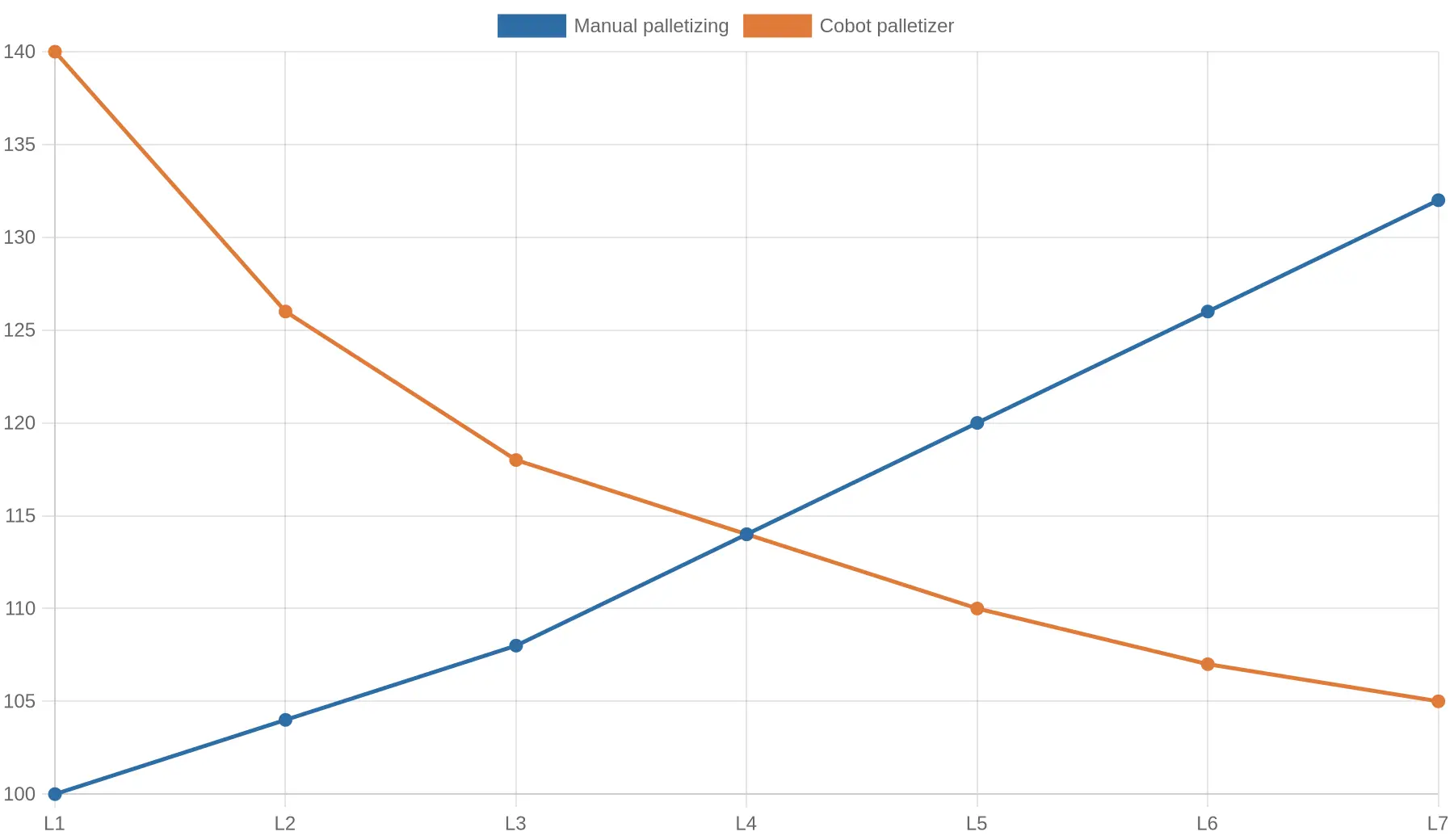
The crossover marks where a cobot palletizer cell begins to beat manual palletizing on cost per pallet as sustained volume rises.
At relative volume L1 to L3 the manual crew still wins, because the cell is carrying fixed cost it has not yet diluted. The manual line keeps climbing quietly on wage rate, peak overtime and the replacement cost of a trained operator who leaves every season or two. The cobot line falls, since the same cell cost spreads over more pallets. Where the two lines meet is break-even, and every pallet to the right of that point is cheaper on the robot. So the practical question is not “is automation cheaper” but “how often do we actually land to the right of that dot”, which is worth testing against the real cost model behind mid-volume ROI before committing capital.
Turnover and the Knowledge That Leaves With It
On paper, manual palletizing looks cheap because the only visible line item is wages. The rest of the cost sits in people’s heads.
An operator who has stacked cartons for six years knows which tall case needs a slight overhang to lock the tier, that the last two layers have to be mirrored, and that the bundle on the bottom will sag by Thursday. None of that is in the work instruction. It leaves at 5 p.m. on the day they quit. That is what turnover costs in a manual cell: not the vacancy, the reset.
Each departure restarts the ramp. A new operator needs weeks to reach nominal rate, and rework climbs in the meantime: crushed corners, leaning stacks, pallets rejected at the stretch wrapper. Across shifts and seasons, that stops being an HR metric and turns into exposure that shows up in yield and on the overtime line.
A cobot palletizer cell moves the knowledge itself. The pallet pattern lives in a stored program rather than someone’s memory, and output does not depend on who is on the shift. The same recipe produces the same stack at 2 a.m. on a Sunday as on a Tuesday morning with the most experienced hand on the floor. Patterns are built and proven in software before the cell ever runs, through offline pattern programming and simulation, so the knowledge is documented by design. When the person who built the pattern leaves, the program stays.
What is left for the operator is narrower: replenishment, pallet exchange and pattern selection. Those take hours or days to teach rather than years, which also simplifies training and ramp-up planning for new hires and keeps shift coverage manageable.
Where that knowledge physically sits, in a person or in a program, belongs on the same comparison sheet as cycle time, labor rate, volume and mix.
The test to keep applying: does the cell reduce the number of things that break when one person leaves?
FAQ: Cobot Palletizer vs Manual Palletizing
At what sustained pallet volume does a cobot palletizer cell start to pay back compared with manual palletizing?
Payback generally starts at roughly 15 pallet loads per eight-hour shift, and the usable band runs up to about 40 depending on labor rates, case weight and gripper scope. Below that, manual palletizing stays cheaper because cell cost is dominated by integration and hardware scope rather than the arm itself.
How does a cobot palletizer handle high-mix, low-volume runs with frequent pallet pattern changes?
Pattern changes become a recipe selection rather than a re-teach, because tier logic is stored per SKU. Setup for mixed-SKU pallet patterns relies on validated program libraries and offline simulation, so a new carton size is verified before the line stops.
How many operators are still needed once a cobot palletizer cell is running?
One operator is normally enough, and that person is usually shared with upstream case packing or labeling. The cell handles pick and place automatically; the operator covers replenishment, pallet exchange, label checks and periodic pattern confirmation.
Does the cell reduce staffing risk when turnover is high?
Yes. Palletizing knowledge moves from individual operators into stored programs, so turnover no longer resets pattern quality or throughput, and a new hire trains on safety and replenishment in hours instead of learning stack sequences over weeks.
What floor space and infrastructure should be confirmed before committing to palletizing automation?
Confirm footprint, forklift pickup clearance, floor flatness, and power and air drops before committing. These items drive anchoring, guarding and reach feasibility, and missing them late forces layout rework. ZBOSN designs and manufactures cobot palletizers in-house and supports mechanical integration and overseas project services.