Cobot Palletizer Cost Structure: Two Blocks, Not One Robot Price
Budget a standard end-of-line palletizing cell as two separate blocks: hardware and integration. The cobot palletizer cost structure splits along that line, and each block has its own scope, risks and quoting logic.
Block 1: Hardware
The hardware block covers every physical item delivered to the plant floor: the collaborative arm, the gripper (vacuum, clamp or hybrid tooling matched to carton or bag geometry), the pallet dispenser, the infeed conveyor interface, and the safety devices (safety-rated scanners, light curtains, interlock gates and e-stop hardware). Vendors usually quote this block with reasonable transparency because it is built from catalog components with published payload, reach and repeatability specifications.
Block 2: Integration
The integration block covers the engineering labor and site-specific work that turns hardware into a working cell. It includes layout, reach and payload verification, and cycle-time modeling for every SKU and pallet pattern. It also covers mechanical adaptation (pedestal or base frame, guarding, gripper tooling, conveyor extensions), controls programming (robot programs, PLC handshakes, pattern recipes, barcode or MES interfaces), safety validation (risk assessment, stopping-distance measurement, standards documentation), and commissioning (FAT/SAT, throughput verification against the design rate, changeover trials, operator training).
Why the Share Matters More Than the Arm Price
The hardware versus integration share determines the real project budget far more than the raw robot price. Two projects can specify the same arm at the same list price and end up with very different total costs, because integration scope – pattern count, conveyor complexity, safety architecture and site conditions – drives the rest. A buyer who benchmarks only the arm price is comparing roughly a fifth to a quarter of the spend.
That share is not fixed. A single-SKU cell feeding one conveyor with a pre-engineered guard package leans toward hardware. A high-mix line with dozens of pallet patterns, multi-conveyor infeed and line-side retrofits shifts the balance toward integration. Any quotation that applies one integration ratio across different scopes is an estimate, not a budget. For scope-specific examples, see how integration with conveyors affects commissioning and changeover downtime.
Start with the cell scope, then compare hardware and integration as separate line items in the same spreadsheet.
Scope Boundary: What the Standard Cell Includes and Excludes
A standard end-of-line palletizing cell needs a boundary on the drawing before anyone assigns a cost line. Without one, the same conveyor metre gets quoted twice by two suppliers and disappears from a third. The boundary below is the working definition used here to split hardware from integration consistently across quotes, purchase orders and change orders.
Inside the boundary (supplied and integrated as standard):
- Infeed handoff point – the last upstream photo-eye or transfer plate where the conveyor releases the case. The cell owns everything downstream, including the infeed accumulation buffer.
- Product orientation and pattern forming – turn and lane guides, case rotation, pattern logic, layer definitions and the recipe library, all driven from the cell controller.
- Pallet dispensing and discharge – empty pallet magazine or dispenser, pallet-present sensing, pallet lift or turntable, and the powered outfeed stub to the forklift or AMR pickup point.
- Guarding and safety-rated devices – perimeter fence, light curtains, area scanners, interlocked access gates, safety-rated PLC or relay logic, e-stops, muting where specified, and the risk assessment plus validation records.
- Cell controller and line interface – PLC or IPC, HMI, pattern and SKU recipes, diagnostics, and the fieldbus or discrete I/O layer that exposes cell status to the line.
- Handshake to upstream equipment – the named signal set exchanged across the boundary (palletize permit, case ready, cell full, fault, reset). Document the conveyor interface scope and handoff sequence on the boundary drawing so no one assumes ownership twice.
Outside the boundary, by default:
- Upstream conveyor extension – any accumulation, merge or transport conveyor upstream of the handoff point, and its supports and controls.
- Building works – foundations, floor slab reinforcement, pits, cable trenches, compressed air drops, lighting and HVAC.
- Pallet wrapper – stretch wrapper, top-sheet applicator, labelling and any downstream pallet conveyor beyond the pickup point.
- Third-party MES changes – ERP/MES configuration, historian tags, network segmentation and IT security policy changes outside the cell switch.
Everything inside that list is priced as part of the cell. Everything outside it gets its own line item, so a scope review becomes a checklist rather than a negotiation.
Hardware Cost Block Breakdown
In a standard end-of-line cell, hardware usually absorbs 45-60% of the quoted cell price; integration, programming and commissioning take the rest. The shape of the hardware block moves with payload class, reach envelope, cycle-time target and hygiene duty. The list below shows the cobot palletizer hardware cost block as a share of the hardware subtotal rather than in currency, because regional pricing and exchange rates can move absolute figures by 20-30% between builds. Arm sizing alone can shift the block 5-8 points, as the linked breakdown of payload and reach trade-offs when selecting a cobot palletizer explains.
- Collaborative arm and controller – 30-40%. The payload class matters first (10-16 kg at the wrist; 12-20 kg for bagged goods with an eccentric centre of gravity), then reach (1300-1600 mm horizontal usually covers single-pallet patterns from a fixed base) and cycle-time target (8-10 cycles/min at 12 kg often forces the next frame size up). The controller carries safety-rated I/O, so the PL d outputs are already in this line.
- End-of-effector – 8-15%. Vacuum arrays for cartons and cases (4-12 cups, venturi block or electric pump, 50-70 kPa holding) sit at the low end; servo clamp grippers for bags and multi-pack clusters sit at the high end. Tool weight comes out of the arm’s payload one-for-one, so every 2 kg of gripper costs 2 kg of usable capacity.
- Pallet dispenser – 10-18%. The price depends on magazine depth (10-15 pallets), dispense cycle (20-30 s), and whether the unit is pit-mounted, floor-level or built into the conveyor frame.
- Infeed and discharge conveyors – 12-20%. Priced on run length (3-6 m of powered roller per leg), belt class, accumulation logic, and line speed (0.2-0.5 m/s) matched to the upstream case packer or labeller.
- Safety scanners and interlocks – 5-10%. Two Type 3 area scanners (IEC 61496-3) with 4-6 m protective fields, a PL d safety function (ISO 13849-1), door interlocks and a muting arrangement at the pallet exit.
- Guarding structure – 6-12%. 8-15 linear metres of 2.0-2.2 m fence, the choice between polycarbonate and welded mesh, and the number of hinged access gates.
- Cell control cabinet – 8-14%. PLC or industrial PC, 10-15 in HMI, VFDs, 24 V DC distribution, and the EtherNet/IP or PROFINET backbone that ties the line items together.
| Line item | Cost weight | Dominant spec lever |
|---|---|---|
| Arm + controller | 30-40% | payload class, reach, cycle time |
| End-of-effector | 8-15% | gripper type, tool weight |
| Pallet dispenser | 10-18% | magazine depth, dispense cycle |
| Conveyors (in/out) | 12-20% | run length, accumulation, line speed |
| Safety scanners | 5-10% | protective field size, PL rating |
| Guarding | 6-12% | linear metres, panel type |
| Control cabinet | 8-14% | I/O count, network architecture |
IP rating quietly changes the cost of the whole block. IP54 is the baseline. Moving the arm and tooling to IP65 for splash zones adds roughly 8-12% to those two line items. Full IP69K washdown duty, with a stainless frame, sealed tooling and a NEMA 4X cabinet, can add 15-25% to the gripper, conveyor and enclosure lines combined. Gripper architecture is the second big swing factor: the choice between vacuum versus clamp grippers on cobot palletizers is typically worth 3-4 points of hardware weight on its own, before any cycle-time penalty on carton transfer.
The ranges overlap on purpose, because scope boundaries move. When the dispenser, conveyors and guarding come from one OEM as a mechanical package, their content is often quoted inside the integration share rather than the hardware line; that can make the arm look 5-8 points heavier than it is. For a defensible comparison, ask every vendor to quote the same seven line items separately and to state payload class, reach, cycles/min and IP rating against each. The bands above are typical ranges, not additive shares, so they do not sum to 100 at either end.
Hardware Versus Integration Share in a Standard Cobot Palletizer Cell
Budget approval for an end-of-line cell usually happens on one lump-sum number. That number splits into two blocks that behave very differently once SKU mix, line layout and documentation requirements start to move. The arm-side share is largely fixed by the payload and reach trade-offs chosen at specification time.
| Cost category | Typical share of total cell cost (%) | Key specification drivers | Scales with SKU mix? |
|---|---|---|---|
| Collaborative arm | 19 – 25 | Rated payload at working offset, maximum reach versus layer height, cycle time at rated speed, ISO 10218-1 and ISO 10218-2 compliance, mounting orientation and inertia limits | No – fixed by payload and reach, independent of carton variety |
| End-of-effector | 7 – 10 | Vacuum versus clamp versus hybrid gripper, carton weight and surface porosity, bag compliance and sag, tool-changer requirement, vacuum generator and valve count | Partially – a broader carton and bag mix may force a convertible or dual-mode tool |
| Pallet handling equipment | 6 – 9 | Pallet dispenser or magazine capacity, pallet quality and dimensional tolerance, floor-level feed versus powered roller, dispense cycle time versus cell takt, slip-sheet handling | No – driven by pallet volume and pallet standard, not by product mix |
| Conveyor interface | 4 – 6 | Infeed conveyor length and accumulation buffer, line-tracking sensor set, handshake I/O and fieldbus choice, transfer plate and guide rail detail, reject and bypass routing | Partially – more SKUs means more accumulation and more re-circulation logic |
| Safety and guarding | 3 – 5 | Risk assessment outcome, safety-rated speed and separation monitoring, muting and restart logic, physical fence versus virtual safeguarding, gate and interlock count | No – set by cell footprint and access philosophy |
| Mechanical integration and adaptation | 12 – 16 | Base frame and pedestal fabrication, reach extension or riser, floor anchoring and leveling, guarding frame structure, cable routing, existing line cut-in and civil works | Partially – pattern-driven reach envelopes and mixed pallet heights add framing variants |
| Controls and pattern software engineering | 16 – 21 | Pallet pattern editor and recipe library, mixed-SKU stacking rules, PLC and MES interface, barcode and label handshake, changeover logic, data logging and traceability | Yes – each new pattern, layer rule and interlock path is engineering hours |
| Safety validation | 5 – 8 | Risk assessment documentation per ISO 12100, validation test protocol, speed and force verification at pinch points, functional safety checks, sign-off records | Slightly – new tooling or access paths trigger re-validation |
| Commissioning and training | 9 – 13 | On-site days and engineer travel, throughput ramp-up trials, changeover SOP authoring, operator and maintenance training levels, spare parts and documentation package | Yes – wider SKU mix means longer pattern proving and more changeover training |
Caption: Using the midpoint of each range, the five hardware rows (collaborative arm through safety and guarding) total about 47% of cell cost, and the four integration rows (mechanical integration through commissioning and training) total about 50%. The remaining few points are contingency and rounding. The rows are independent ranges, so they do not sum at either bound.
For budget planning, most of the hardware cost is committed once the arm, gripper and pallet feeder are specified. Much of the rest is engineering hours that rise with SKU count, so put contingency and schedule float on the integration line, not the hardware line.
Why the Integration Block Carries 35 to 55 Percent of Total Cell Cost
When a purchase order arrives, the arm, gripper and pallet stand get the most scrutiny. Yet those three items rarely tell you where the rest of the money goes. The integration share usually lands between 35 and 55 percent of total cell cost, and the range reflects the number of interfaces the cell has to satisfy, not padding or margin. A simple single-robot cell sits near the low end; a high-mix line with several conveyor and MES handshakes sits near the top. A useful cobot palletizer cost structure treats integration as an engineering deliverable with its own scope, hours and technical risk, not as a percentage that floats with the robot price.
What the 35 to 55 percent pays for
- Mechanical adaptation and guarding design – base plates, pedestals, conveyor and pallet-stand interfaces, fence layouts, light curtains, and reach-envelope studies that confirm the cell geometry works before steel is cut.
- Controls architecture and PLC/robot handshake – I/O mapping, safety-rated signals, conveyor and case-handling logic, reject and full-pallet interlocks, plus the state machine that lets the cell start, stop and recover without a technician babysitting it.
- Pallet pattern software for mixed SKU – building and validating every pattern, tie and interlock rule the line actually runs, including stack height limits, overhang tolerance, and label-facing orientation.
- Safety validation and documentation – risk assessment, stop-time and separation-distance calculations, validation records, and the drawings and manuals a plant needs for audit and insurance.
- Commissioning – dry runs, cycle-time tuning, throughput proving, and the slow work of matching the cell to real incoming case flow.
- Operator training – recipe changes, pattern selection, fault recovery and daily checks, so the cell keeps running at design rate after the integrator leaves.
| Scope item | Typical share of the integration block | Sensitivity to SKU count |
|---|---|---|
| Mechanical adaptation and guarding | 25-30% | Low to medium |
| Controls and PLC/robot handshake | 22-28% | Medium to high |
| Pallet pattern software configuration | 12-25% | High |
| Safety validation and documentation | 11-14% | Low |
| Commissioning | 8-10% | Medium to high |
| Operator training | 5-7% | Low to medium |
Interfaces Drive Integration Cost, Not Payload or Reach
Integration cost does not track the robot’s payload or working envelope. A 20 kg cobot and a 30 kg cobot with similar reach need almost the same engineering effort when the surrounding line is identical. What drives the number is the count and complexity of the interfaces: how many conveyors feed the cell, how the PLC hands off a case, how many label orientations the vision system or gripper must recognize, and how often the operator changes over.
Integration cost therefore rises with variability. Move from one SKU to forty and the pattern library grows, the handshake logic multiplies, and changeover time becomes a design constraint rather than an afterthought. In high-mix, low-volume plants, the integration share can climb toward the top of the range even when the arm is modest and the cell is compact; the hours move into software, validation and proving runs. Teams planning that kind of line should budget pattern work as engineering time. The linked guide to pallet pattern configuration for mixed-SKU palletizing covers the sequencing and validation steps that keep the scope predictable.
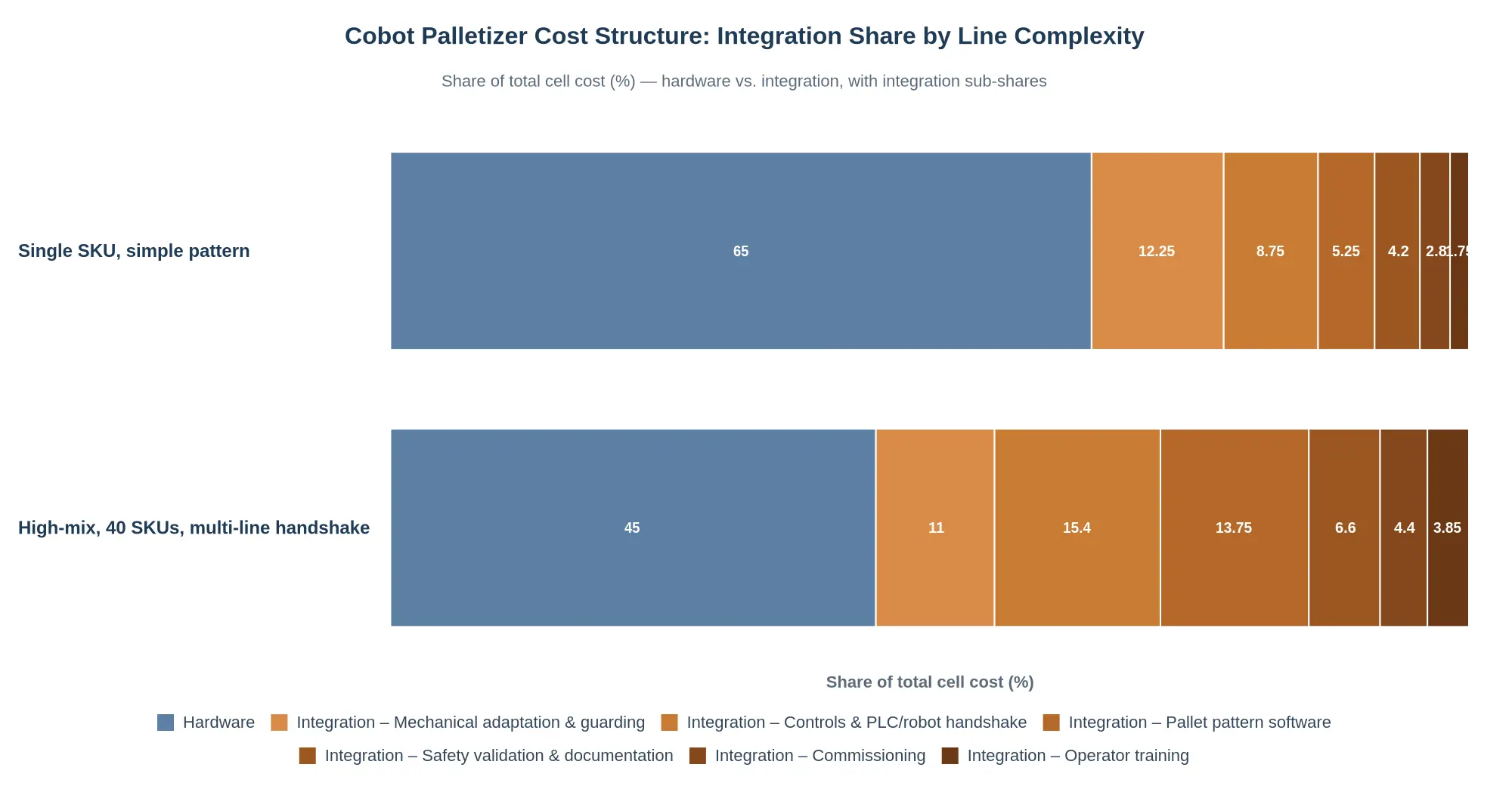
For buyers, the practical step is to ask integrators for integration priced as a broken-out package tied to your SKU count, pattern complexity and handshake requirements. Once those three inputs are explicit, the 35-55 percent range becomes a number you can test, compare and negotiate rather than an unexplained premium.
Reading the Cost Stack at a Glance
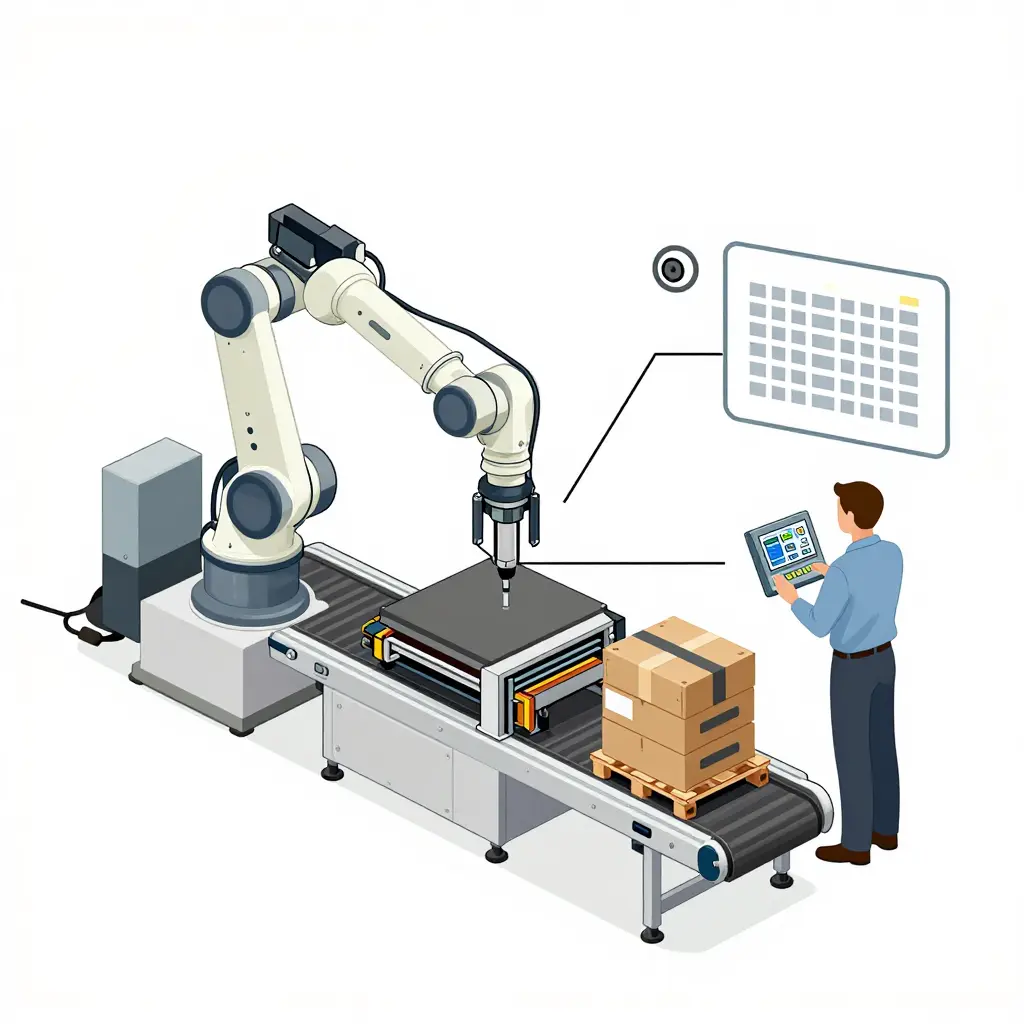
The schematic breaks a standard end-of-line cell into three stacked bands. The widest band is hardware: the cobot arm, gripper, conveyor and safety devices that appear on every quotation. The middle band is mechanical and controls integration: mounting frames, guarding interfaces, PLC and safety logic, conveyor handshakes. The narrow top band covers commissioning and validation, the work that turns installed hardware into a running, pattern-tested cell.
The band heights are proportional. Hardware anchors the stack, but the two upper bands decide whether the cell runs at rate on a mixed-SKU line.
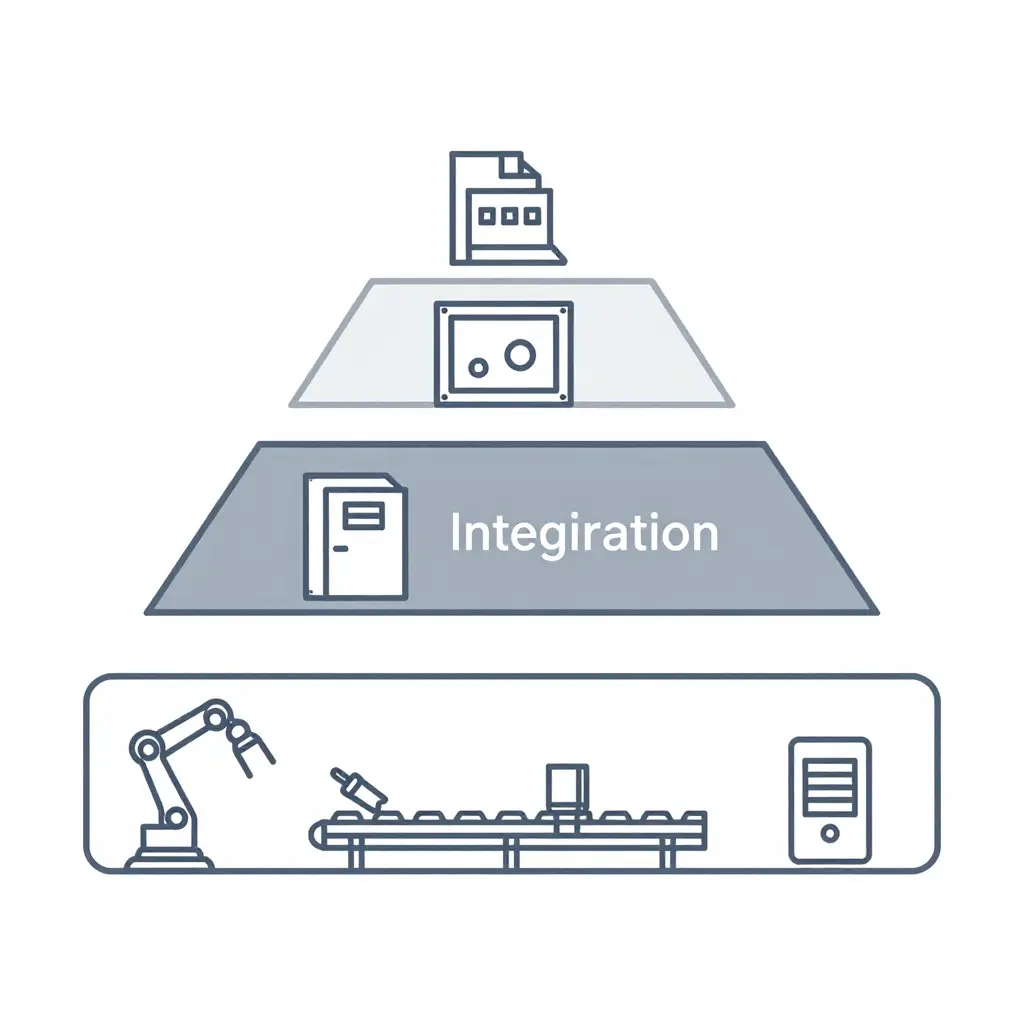
Layered schematic of the cell cost structure – hardware at the base, integration in the middle, commissioning at the top.
Before you benchmark one quote against another, assign every line on it to exactly one of two buckets. No line should float between them.
- Fix the cell boundary. Write down where the palletizer cell begins and ends (infeed handoff point, pallet dispenser, stretch wrapper interface, fence line) and state whether freight, rigging and utilities are inside or outside that line. Every later decision inherits this boundary.
- List all supplied equipment as hardware candidates. Robot arm, gripper, pallet dispenser, conveyors, fencing, safety scanners, controls cabinet and spares. Hardware is anything that arrives as a physical asset and carries a serial number.
- List all labor and engineering hours as integration candidates. Mechanical and electrical build, PLC and robot programming, simulation and reach studies, safety validation, project management and travel. Integration is everything that converts parts into a working cell.
- Split mixed lines. A bundled line such as “guarding supplied and installed” or “conveyor supplied and commissioned” has to be broken into material value and labor value, then routed to the hardware and integration blocks respectively. Do not let one number sit in both.
- Assign software licensing per contract terms. Perpetual robot, vision or pallet-pattern licenses and annual subscriptions usually follow the hardware block when they ship with the machine. Customization, pattern development and host/MES interface work belong to integration.
- Allocate commissioning and training. On-site commissioning, changeover validation, and operator and maintenance training hours go to integration. Review how conveyor integration and commissioning changeover downtime is scoped in comparable quotes so the hours rest on the same floor-time assumptions.
- Validate that the two blocks sum to the quoted total. Total hardware plus total integration must equal the grand total before any discount, tax or freight adjustment. If they do not reconcile, find the orphaned line rather than plugging a balancing figure.
- Flag residual contingency. Any allowance, spare-parts kit or option that cannot be placed confidently stays visible as a separately labeled contingency line and is reported alongside the hardware versus integration share, not absorbed silently into either block.
Consistent allocation makes cross-vendor comparison valid. Only then does the hardware versus integration share describe the cell rather than the quoting habits of the salesperson who wrote it.
Hardware Versus Integration Share by Cell Configuration
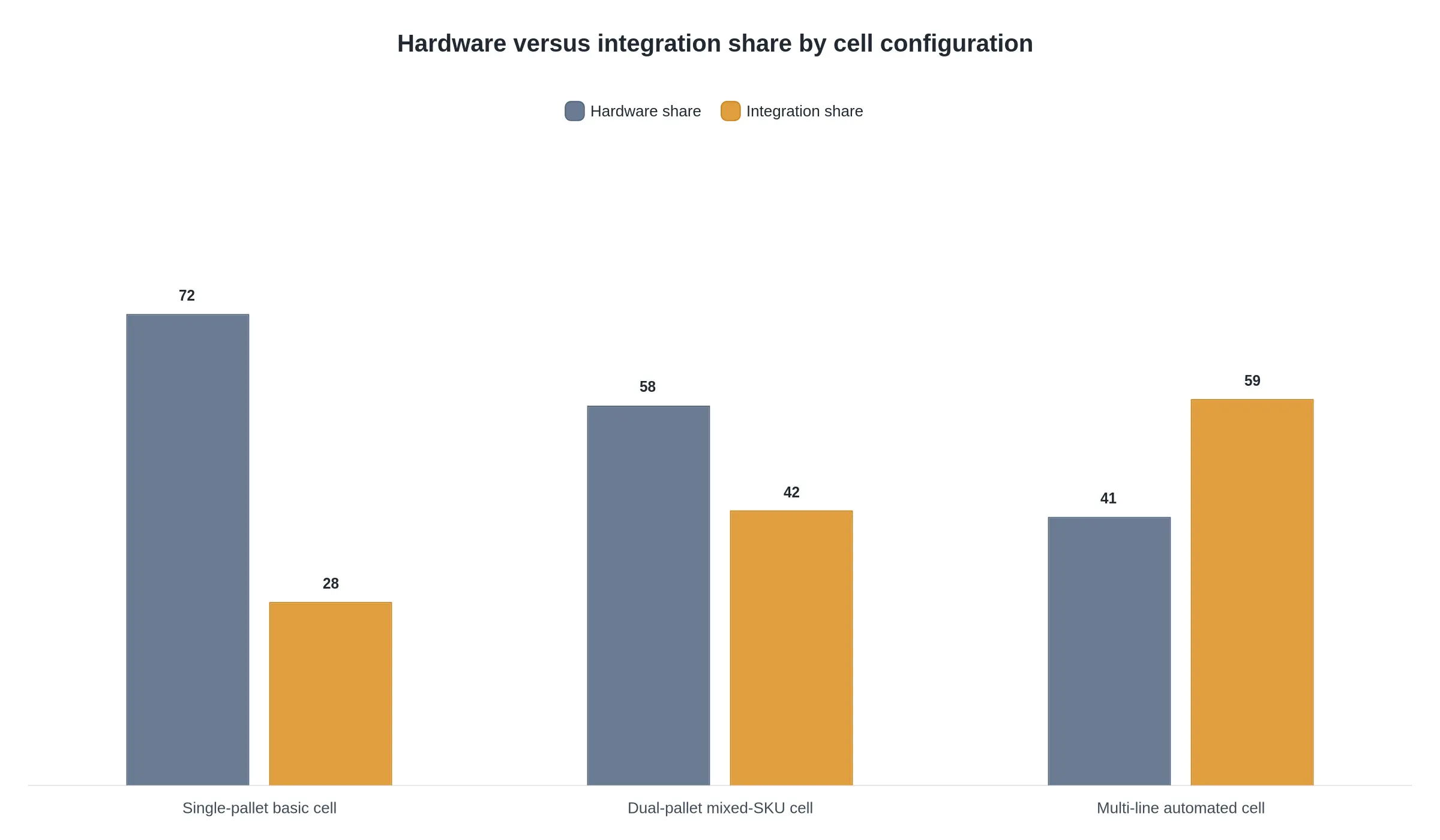
The split is not a fixed ratio; it follows scope. The chart plots two buckets – hardware (robot arm, gripper, pallet dispenser, safety devices, guarding, column and base) and integration (controls engineering, conveyor and pallet-conveyor interfaces, safety validation, programming, pallet-pattern logic, commissioning, documentation, training) – across three configurations of increasing scope.
| Cell configuration | Hardware share | Integration share | What drives the shift |
|---|---|---|---|
| Single-pallet basic cell | 72% | 28% | One infeed, one pallet position, fixed pattern, minimal handshake logic |
| Dual-pallet mixed-SKU cell | 58% | 42% | SKU changeover recipes, dual-position pallet logic, barcode-driven pattern selection |
| Multi-line automated cell | 41% | 59% | Multiple conveyor merges, MES/WMS transactions, line-level interlocks, validation scope |
Why the Hardware Share Falls
Hardware grows almost linearly with scope. A second pallet position adds a conveyor section and a photo-eye array; a third line adds another merge. But the hardware bill does not compound the way engineering hours do. One robot and gripper often serve the larger footprint, so hardware spend rises slowly while total project cost rises quickly. Hardware’s share of the total therefore falls.
Why the Integration Share Rises
Integration is where scope grows fastest. Every additional SKU dimension – carton count, bag type, pattern family, pallet height limit – adds branching logic that a controls engineer has to write, simulate and validate. Every additional conveyor handoff brings a new state machine and a new failure mode to commission. Every line-level interface pulls in plant IT, and with it network segmentation, tag mapping and acceptance testing. That is why conveyor integration and changeover downtime tends to dominate the schedule on multi-line projects more than the mechanical install does.
What This Means for Capital Planning
Do not carry a single-pallet budget ratio over to a mixed-SKU or multi-line scope. Budget integration as the growth term, not the residual. A useful rule of thumb: assume the integration share climbs roughly 15 percentage points for each step in configuration complexity above the basic single-pallet cell, then check that estimate against the number of distinct pallet patterns and external system interfaces your line actually needs. If your pattern library runs into the dozens, or your plant IT team needs a change-control window for every tag, plan on the upper band.
What Shifts the Hardware-to-Integration Ratio
The hardware-to-integration split inside a cobot palletizer cost structure is not a fixed property of the machine. It follows the application specification. Change the SKU mix, the duty rating or the number of upstream machines, and the same nominal 4-axis arm can move from a hardware-heavy budget to an integration-heavy one. The table below gives the direction of each factor’s effect on each block. It describes share of total cell cost at constant cell scope, not absolute spend.
| Factor | Hardware share | Integration share | Specification basis |
|---|---|---|---|
| SKU count and pattern variability | Decreases | Increases | One gripper covers many carton formats; patterns move into recipe and vision logic. At 1-5 SKUs with a frozen pattern, hardware share is highest because pattern logic can be hard-tooled. |
| Required cycle time relative to payload and reach class | Increases | Flat to slight increase | Tightening takt at fixed payload and reach forces a higher payload class, longer reach or a faster model, all hardware items. Added motion and safety-zone tuning add modest integration. Loose takt reverses the effect. |
| Hygiene or washdown duty | Increases strongly | Increases | IP66/IP69K rating, stainless steel, sealed cable runs and food-grade tooling are hardware line items; drainage, cabinet siting, access and validation documentation are integration line items. |
| Ambient temperature range | Increases below 5 C | Increases | Low-temperature lubricants, heaters and rated sensors are hardware; condensation control, cabinet purge and defrost logic are integration. The linked cold storage and low-temperature duty limits give the rating thresholds. |
| Line interface complexity and upstream machine count | Increases marginally | Increases strongly | Each upstream machine adds I/O, safety modules and conveyor sections, but signal mapping, sequencing, fault propagation and staged validation scale faster than the parts list. |
| Pallet and slip-sheet handling requirements | Increases strongly | Increases | Pallet dispensers, slip-sheet magazines and sheet-gripping tooling are discrete hardware; interlock sequencing is the integration counterpart. |
| Standard versus custom end-of-effector | Increases strongly for custom | Increases | Custom EOAT drives design, fabrication and spares cost inside the hardware block, with gripper validation and recipe offsets in the integration block. |
Reading the Table Correctly
Some factors raise both blocks in absolute terms while raising only one in share terms. Washdown is the clearest case: the hygienic build adds real hardware cost and real commissioning work, but it adds hardware faster. For washdown duty, the washdown duty specification guide for food and beverage plants sets out which ratings belong in the RFQ rather than in the change order.
Two factors are usually underestimated at quotation stage. The first is pattern variability: the hours to build and validate a 40-SKU recipe library sit in the integration block, so high-mix lines should expect the split to drift toward 50/50 even with an unchanged robot. The second is upstream machine count: a cell fed by four lines needs interlocked handshakes with each, and that work is schedule-bound rather than part-bound. Neither factor appears on a hardware BOM, which is why bottom-up estimates built only from the robot, gripper and guarding often under-run on mixed-SKU lines.
Where the Money Goes
The doughnut breaks a standard end-of-line cobot palletizer cell into seven cost blocks. This view puts hardware – arm and controller, end-of-effector, pallet handling and conveyor hardware, plus guarding – at roughly 60 percent of cell spend, with engineering, commissioning and contingency taking the remaining 40 percent. The bottom-up table above lands nearer 50/50 because it prices a more heavily integrated cell and excludes contingency. Both are planning views, not measured averages.
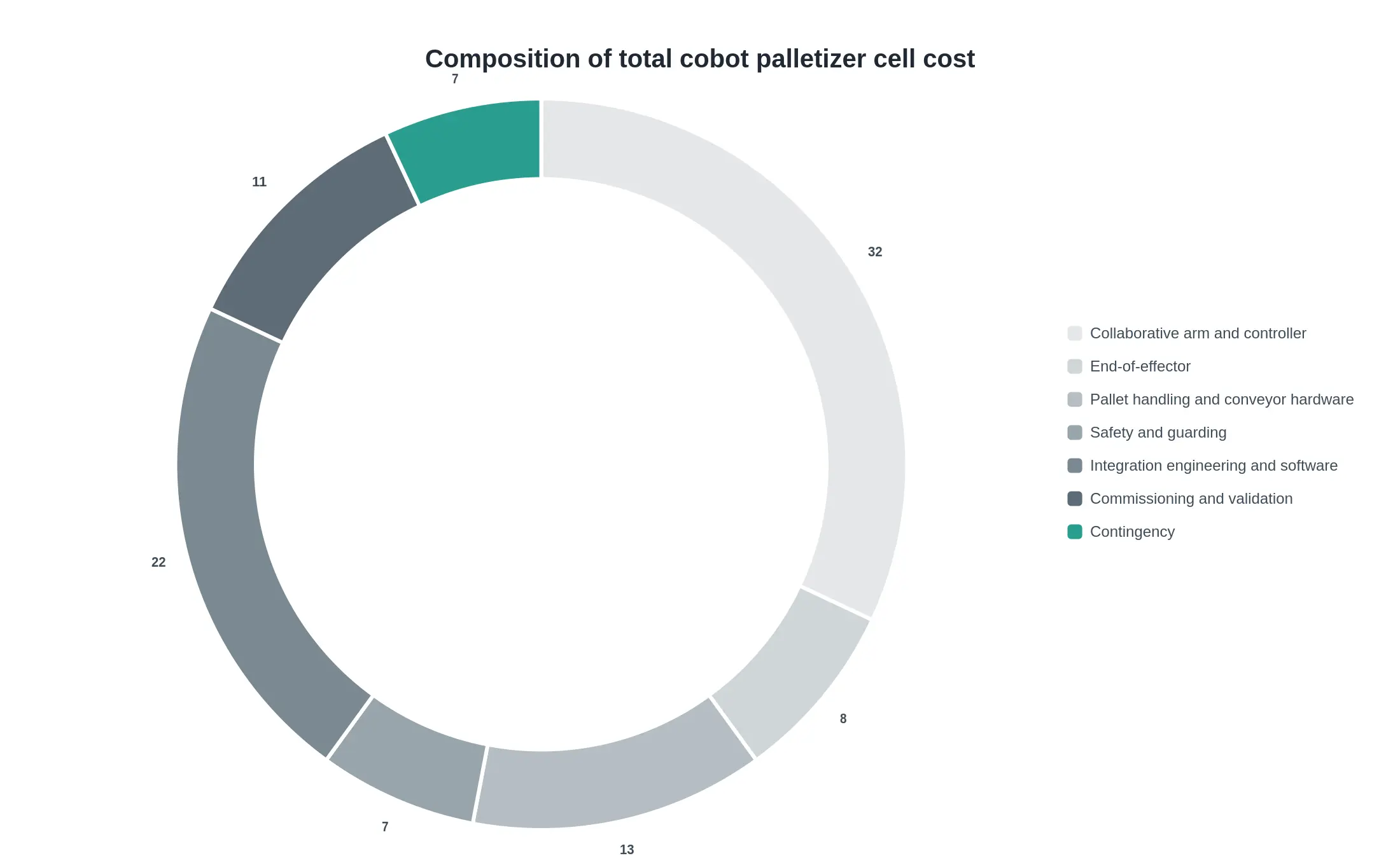
Figure: Share of total installed cell cost by block. Percentages sum to 100%; contingency is carried separately rather than folded into the engineering segments.
Two details matter when building the budget. First, the end-of-effector looks small in percentage terms but carries outsized schedule risk: a late gripper change runs straight into pattern programming and re-validation. Second, integration engineering and software at 22 percent in this chart is not padding; it is the block that turns a catalog arm into a cell that handles your SKU mix. Squeeze that line and the cost usually reappears later as manual re-teaching and changeover friction. For how these blocks pay back across volumes, see the analysis of cobot palletizer ROI on mid-volume lines.
Commissioning and Changeover Support: A Sub-Block of the Integration Share
In most palletizer budgets, commissioning shows up as a footnote: a lump sum, a week on site, a handshake at the end. That is a mistake. Commissioning, validation and changeover support form a distinct sub-block inside the integration share, with their own scope, deliverables and hours. Treat them as a line item and you can audit them. Leave them as a footnote and you will find their true cost in the third month of production, when the line runs at 70 percent of rate and every SKU change eats half a shift.
The integration share of a standard end-of-line cell is the engineering work that turns purchased hardware into a working system. Commissioning is its last, most visible and often most underestimated slice.
Where the Commissioning Hours Go
The hours are not one activity. They break into six work packages, each with its own sign-off evidence. The split below is representative for a single-cell, single-robot palletizer with a conveyor infeed and 20 to 60 active SKUs.
| Work package | Share of commissioning hours | What the hours buy | Sign-off evidence |
|---|---|---|---|
| Mechanical fit-up and alignment | 22% | Conveyor transitions, gripper and tooling mounting, pallet dispenser and stacker interfaces, anchoring, shimming, datum and level checks | Alignment and torque records, as-built drawing markups |
| Controls integration and I/O verification | 26% | Robot-to-PLC handshakes, safety PLC mapping, conveyor interlocks, scanner and vision signals, point-to-point I/O checks, state-machine logic | Signed I/O list, dry-cycle log |
| Pattern library build and verification per SKU | 18% | Layer definitions, gripper offsets, slip sheet and corner board logic, first-article pallet per SKU | Pattern register with revision and validation date per SKU |
| Safety function testing and documentation | 14% | E-stop and reset behaviour, light curtain and muting logic, speed and separation monitoring, validation against the risk assessment | Safety validation report suitable for audit |
| Throughput ramp-up | 12% | Dry cycles to design rate, fault recovery tuning, time studies, accumulation and buffer behaviour | Rate test record at stated SKU mix |
| Operator and maintenance training | 8% | HMI navigation, pattern selection, fault recovery, gripper change, preventive maintenance tasks | Training record with named attendees |
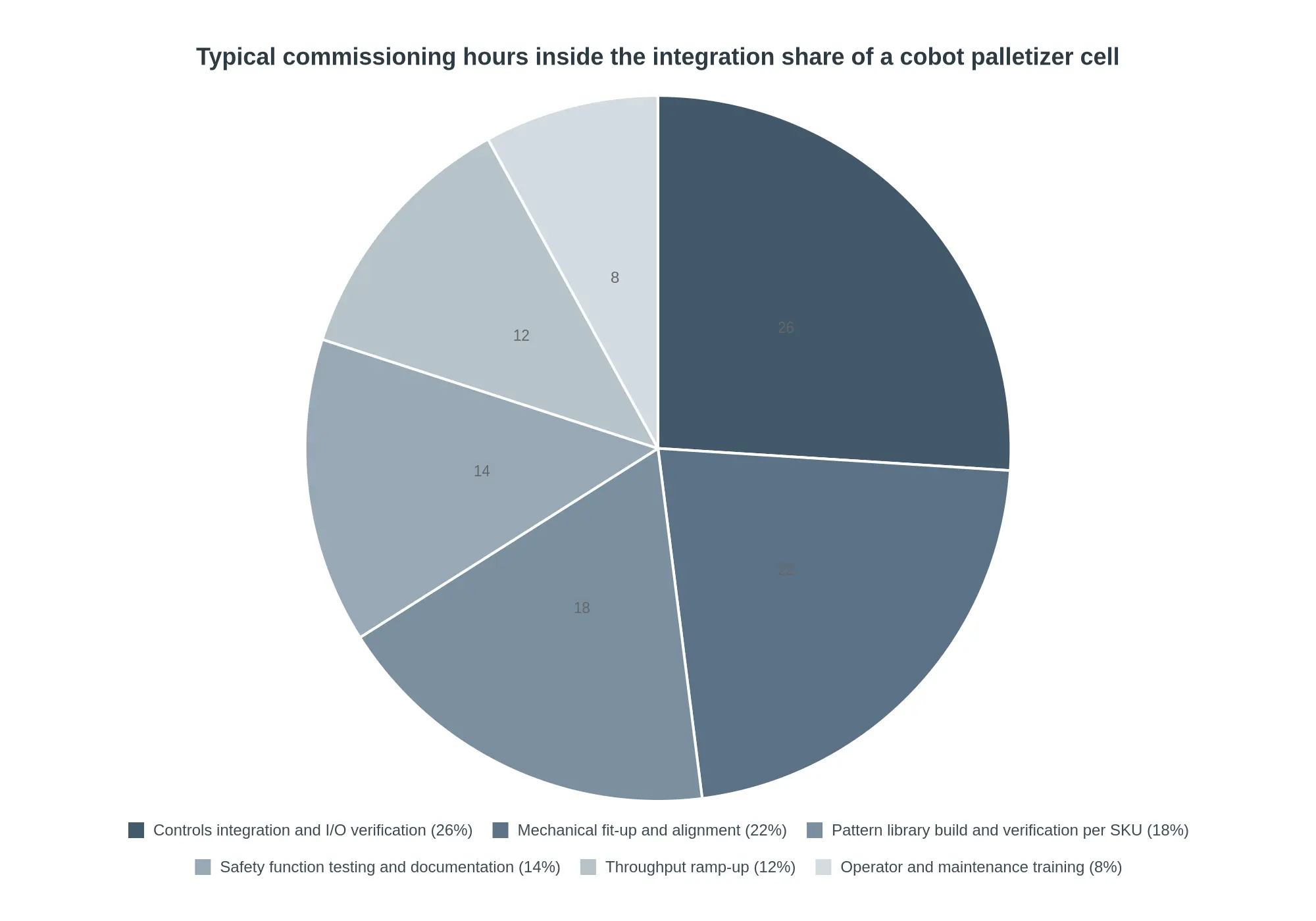
The controls and I/O package is usually the largest single block, and for good reason. A palletizer is a coordination problem: robot, conveyor, dispenser, scanner and safety system all have to agree on where a case is and when it is safe to move. Every unverified signal is a future stop. For a closer look at how conveyor handoffs drive this effort, see conveyor integration, commissioning and changeover downtime.
Changeover-Capable Design Trades Upfront Hours for Recurring Minutes
Pattern libraries and changeover-friendly tooling are not free. They consume integration hours before the first pallet ships: pattern development, gripper offset calibration, recipe structure, HMI screens, and first-article verification for each SKU at roughly 0.5 to 2 engineering hours per pattern once the template is established. A fixed mechanical format with a single pattern costs far less to integrate.
The trade is upfront hours against recurring changeover time. The recurring cost accumulates every shift.
| Design approach | Upfront integration effort | Typical changeover | Best fit |
|---|---|---|---|
| Fixed guides, single pattern, hand-adjusted | Low | 20 to 40 minutes, tools required, skilled operator | One or two high-runner SKUs on long campaigns |
| Quick-release tooling, parametric pattern library, recipe-driven HMI | Higher | 3 to 8 minutes, no tools, any trained operator | High-mix, low-volume lines with daily or shift-level changes |
Run the arithmetic on the recurring side. At three changeovers per shift, two shifts and 250 production days, a line performs 1,500 changeovers a year. A 22-minute reduction per changeover returns 550 hours, roughly 68 eight-hour production shifts. No maintenance budget recovers that from hardware alone. That is why the changeover sub-block belongs in the integration share as planned scope, not as an optional extra bought after the first painful product switch.
Fitting It Into Total Cost of Ownership
Total cost of ownership for a palletizer is hardware plus integration plus the operating pattern the cell imposes for years. A cell that is cheap to integrate but slow to change moves cost from the capital budget into unplanned downtime, scrap at restart and operator frustration. A cell that spends more integration hours on pattern libraries and verified changeover sequences costs more upfront and less at every changeover.
That changes how you read quotes. Ask each integrator to break the integration share into engineering, commissioning and changeover enablement, then ask what changeover time they will commit to in writing, per SKU and with the tooling supplied. An integrator who answers with a number and a validation method has priced the sub-block. One who answers with “a few minutes” has not.
The same logic applies to people. Training hours are not a courtesy; they are how a validated cell becomes a repeatable one. A structured approach to deployment training and parts planning keeps changeover competence on the floor across shifts and staff turnover, which protects the return you paid for during commissioning.
Exit Criteria for the Sub-Block
Close commissioning against deliverables, not against a calendar date:
- Signed point-to-point I/O list, with every device addressed and tested.
- Pattern register listing each SKU, pattern revision, and the date its first-article pallet was approved.
- Safety validation report mapped line by line to the risk assessment.
- Rate test record at the agreed SKU mix, including changeover events inside the test window.
- Training records naming operators and maintenance staff, plus a changeover procedure posted at the cell.
- A measured changeover time, witnessed and documented, for a worst-case SKU transition.
When those six items are contract deliverables, commissioning becomes a defined, priced part of the integration share and a real lever on total cost of ownership.
Frequently Asked Questions on Cobot Palletizer Cost Structure
What is a typical hardware-versus-integration split for a standard cell?
For a simple standard single-robot cell with conveyor infeed and perimeter guarding, hardware typically represents 55 to 60 percent of total cost, and integration, safety engineering and commissioning absorb 40 to 45 percent. Cells with more conveyors, mixed SKUs or MES interfaces move toward 50/50 or higher integration.
Does a cheaper cobot arm always lower total cell cost?
Not necessarily. A lower-cost arm often has less payload, reach or I/O capacity, which can require larger grippers, revised guarding, slower cycle programming and extra validation. Total cell cost often lands in a similar band.
Which integration items are most often underestimated in palletizing budgets?
Risk assessment and validation, end-of-arm tooling design, conveyor and PLC handshaking, safety-rated stop configuration, and operator training. These items carry the largest variance in integration quotes and often drive budget overruns on first builds.
How does SKU variety change the integration share?
High-mix production raises the integration share because every additional pallet pattern, gripper changeover and product recipe consumes engineering and validation time. Low-SKU lines can hold integration below 40 percent; high-mix lines commonly exceed 50 percent.
Conclusion: Normalize the Cell Boundary, Then Compare Quotes
The hardware-versus-integration split shapes the whole business case. Hardware sets a floor on cost; engineering determines how far above that floor the project lands. No quote is meaningful until both are drawn to the same cell boundary. For engineers and operations managers, the sequence is:
- Budget from the cell scope outward. Price the cell itself first: conveyor infeed, robot and pedestal, gripper, pallet dispenser, guarding, safety devices and cell controls. Only then add what sits outside the boundary: upstream case handling, plant network changes, floor preparation, and downstream stretch wrapping or AMR handoff. Budgets built inward from a robot price tend to understate the cell by a wide margin.
- Treat the integration share as a function of interface count and SKU variability. Integration is not a percentage that arrives by default. It scales with the number of physical and logical interfaces (conveyor handshakes, dispenser interlocks, safety PLC links, MES or WMS messaging) and with the number of SKU families and pallet patterns the cell must absorb. A single-pattern, single-interface cell and a twenty-SKU cell with three handshakes are not the same engineering job, even with an identical robot.
- Compare vendor quotes only after both blocks are normalized to the same cell boundary. Line up scope of supply, exclusions and interface responsibility side by side before looking at totals. Most apparent price gaps dissolve into scope differences; the ones that survive are genuine efficiency differences worth paying for.
To verify the split rather than accept it, ask for documents that show how each block was built:
| Document to request | What it verifies |
|---|---|
| Scope-of-supply matrix with cell boundary drawing | Whether conveyor infeed, dispenser, guarding, and controls sit inside or outside the quote |
| Interface list with protocols and handshake definitions | The interface count driving integration hours |
| Pallet pattern and SKU library, plus changeover logic | How much SKU variability is actually priced in |
| Engineering-hours breakdown by task | Whether integration was estimated or merely marked up |
| BOM with make/buy flags | Hardware share and where partner content enters |
| Commissioning and acceptance test plan | Whether startup labor is capped or open-ended |
| Exclusions list and change-order rates | The realistic cost of scope gaps |
Taken together, these documents let a buyer reconstruct the cost structure instead of inheriting it, and they make the hardware and integration segments auditable at the same boundary. From there the next questions are structural rather than commercial: which parts stay in-house and which sit with a partner, and how the resulting cost base behaves at realistic volumes. Those are covered in the analysis of where in-house design ends and partner scope begins and in the modeled ROI of cobot palletizers on mid-volume lines. The sequence stays the same in both: define the cell, count the interfaces, quantify the SKU mix, and only then read the number.