Vacuum Versus Clamp Grippers: the Choice Follows Grip Physics
Vacuum cups and clamp jaws hold a package by different mechanisms, so each tool family has an operating envelope that tuning cannot widen. On a cobot palletizer the decision comes down to grip physics and to what the tool can prove about delivery quality, not to a preference for one family.
Vacuum grippers hold the load with differential pressure. A venturi ejector or rotary-vane generator evacuates a cup array sized to the carton footprint, and holding force equals the pressure differential multiplied by the sealed area. Vacuum decay is the failure signal to watch: when the pressure reading climbs, a seal is leaking, and the controller has to react before the lift completes.
Clamp grippers hold the load by friction. A pneumatic side clamp closes two opposing contact faces on the carton or bag, and the regulated clamp force sets the normal force at that interface. Capacity depends on the friction coefficient and on pad geometry. The force that prevents slip can also deform the package.
That leaves three measurable conditions behind every carton and bag handling limit: seal integrity at the cup lip or pad face, carton stiffness under grip load, and clamp force tolerance between the slip threshold and the crush threshold. All three apply to the whole end-of-arm tool assembly, not just to the gripper body.
A mismatch between tool and package usually shows up at the pallet rather than at the gripper: collapsed cartons, dropped bags, layers that fail handover inspection. Each symptom has a physical cause, and none of them is operator error. Lines that run mixed-SKU pallet patterns put all three limits under test every time the SKU changes.
Vacuum Grippers on Cartons: Contact Area, Leakage and Pump Curves
A vacuum gripper lifts only the area it can seal. Holding force scales with sealed contact area and with the pressure differential across it, so a large flat carton face leaves a comfortable margin and a small or interrupted face loses it fast. The governing ratio is sealed area against carton mass, plus the dynamic term for acceleration and deceleration at the handover point. On a cobot palletizer that term is not small. Engineers comparing payload and reach often find the cup array is the real constraint before the arm is.
Corrugated board is where the calculation gets awkward. Single-wall and recycled-content board is porous by nature: the liners and medium leak, and an edge crush test rating describes stacking strength, not airtightness. A bellows cup compensates for board warp and panel bow, and a foam pad improves seal compliance on rough or slightly domed surfaces, but neither stops leakage through the board itself. Faster cycles make it worse, because every pick starts by evacuating the cup volume and the leakage path behind it.
Film-wrapped and shrink-wrapped cartons change the failure mode. Poly film seals well on a clean, taut surface and poorly on wrinkled, gusseted or powder-dusted wrap, and shrink tunnels leave soft corners that a bellows cup can collapse or bridge. Dust and oil on cup faces act like a release agent. Cup wear is the slower problem: lip hardening, flattening and micro-cracks raise leakage gradually, no alarm catches it, and picks start failing at the end of a shift.
Generator flow therefore has to be matched to the cup array’s total leakage at the duty point, not at free flow, because the rated vacuum figure is not the vacuum available while air is moving. On buffered systems, a vacuum decay test and periodic tank leak checks catch reservoir and valve leakage that a running pump otherwise hides. The practical limit: vacuum suits non-porous, flat, uniform carton faces, and it degrades quickly on dusty or porous board.
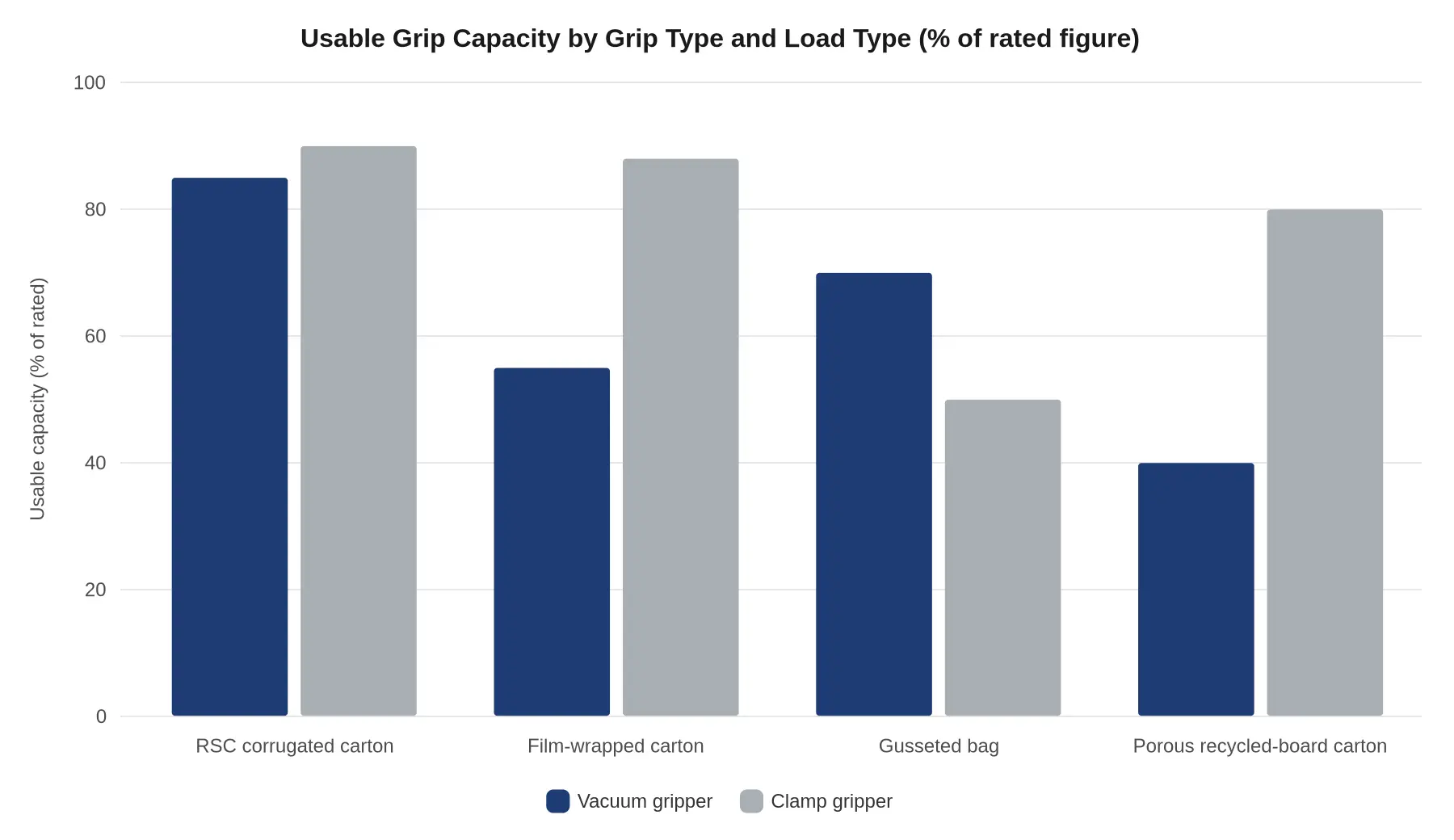
Figure 1: Usable grip capacity by grip type and load type, expressed as a percentage of the rated figure. The values shown are illustrative engineering reference points only and must be replaced with measured data from pump curve verification and clamp force trials before any load handling decision is made.
Clamp Gripper Behaviour on Cartons
A clamp gripper holds a carton by squeezing two opposite side walls, so the load path runs through the board instead of through a sealed air pocket. A proportional regulator or a torque-limited servo jaw sets regulated clamp pressure, and the controller holds the resulting force inside a window rather than at one fixed value. That window is the clamp force tolerance, and it absorbs SKU-to-SKU drift in board grade, fill settlement and dimension. Published force-versus-crush curves show the trade-off: holding force has to clear the slip threshold set by carton mass and surface friction, and stay below the knee where side walls buckle, corners round over or print scuffs. Integrators who read the curve at the worst-case SKU avoid the familiar outcome: a jaw that holds perfectly on kraft board and crushes a coated, varnished case two pallets later.
Clamp jaws therefore carry heavier, denser cartons than vacuum cups of the same face size. Vacuum capacity scales with sealed area and falls away when porous board, dust or print varnish breaks the seal, so a 200 x 300 mm pad needs margin for leakage. A jaw of the same face size develops capacity as friction coefficient multiplied by normal force across the whole contact face, and normal force can be raised until the crush limit arrives. Reported working values run from 0.2 to 0.35 for coated and printed board and 0.4 to 0.6 for uncoated kraft, which is why surface finish often decides the gripping strategy before weight does. Where carton dimensions shift between runs, mixed-SKU pallet pattern setup should fix jaw gap and pressure recipes before commissioning.
Clamp end effector limits to check before a quote:
- Minimum board stiffness to avoid side-wall buckling
- Clamp force versus crush risk at the curve knee
- Friction coefficient on coated and printed board
- Contact-face area versus carton height coverage
- Gap tolerance for dimension variation across mixed SKU runs
- Cycle-time cost of opening and closing clamp jaws
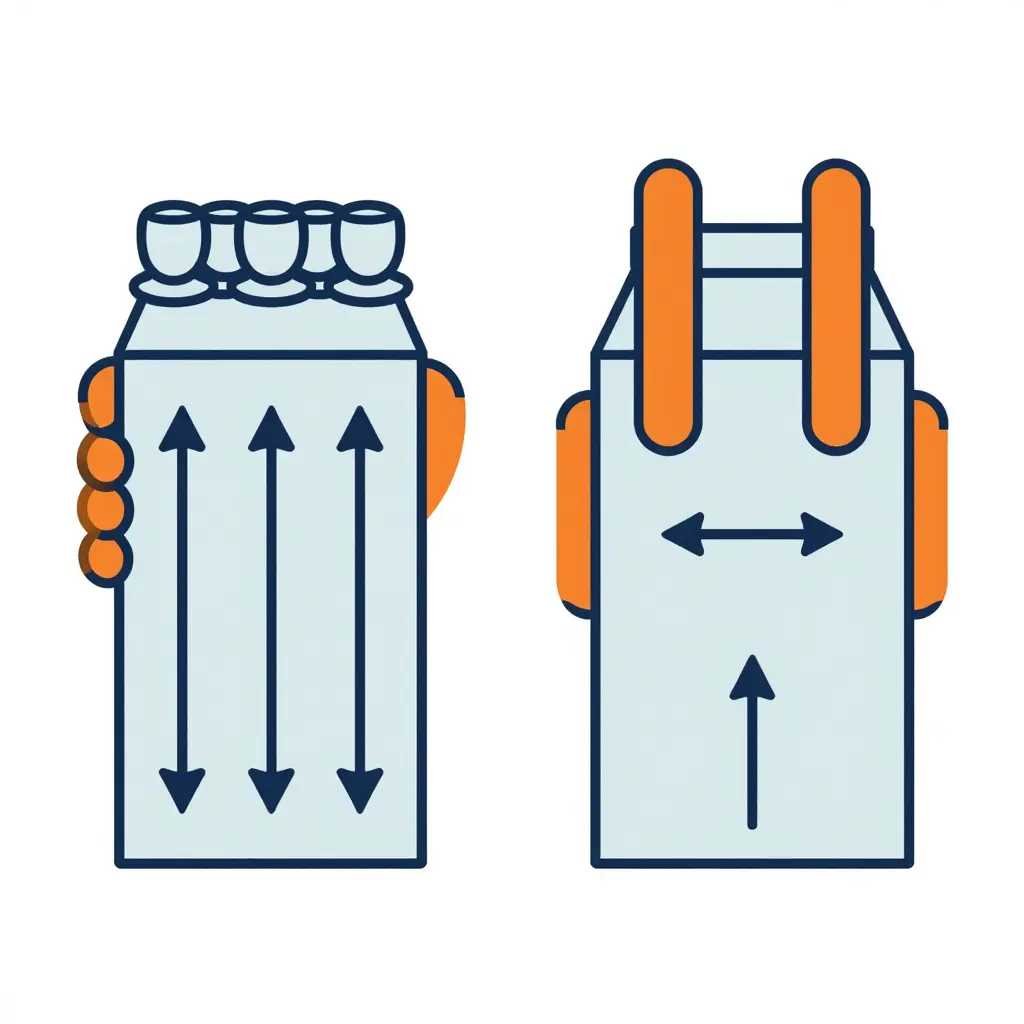
Reading the two load paths
The schematic reduces each grip family to its mechanics, and that is why the two technologies fail in different ways.
Vacuum array (left). Load transfer depends on a pressure differential across the cup lip. Vertical contact force is negligible; what matters is whether the seal holds long enough for atmospheric pressure to press the carton against the cup. Once the seal goes — dusty kraft, a bowed top panel, a crease under a cup — the load path disappears, and it disappears without warning.
Clamp fingers (right). Load transfer depends on friction from horizontal compressive contact. The grip holds only while the side panels resist that compression without buckling or crushing, so board grade, stacking height and product settlement govern the result, not surface porosity.
The load path usually settles the choice before payload does. How grip choice interacts with pattern complexity is covered in cobot palletizer setup for mixed-SKU pallet patterns.
Bag Handling Limits: the Boundary Case for End-of-Arm Tooling
A carton presents a rigid face, tolerates a few millimetres of misalignment and barely changes shape under grip force. A bag is a compliant, shifting mass wrapped in a membrane, and its behaviour under load decides whether a cobot palletizer can handle the product at all. Bag handling is therefore the boundary case for end-of-arm tooling, not the carton that usually gets the demo.
Gusseted and Flat Woven Bags
Woven PP and PE bags breathe. Weave and stitch perforations leave real fabric porosity, so vacuum flow leaks through the panel instead of building differential pressure across it. A cup array can read “sealed” on a flat bench test and fail on the first production bag, because the pump curve collapses under continuous leakage. Clamp grippers do better here, but only with proper gusset engagement: gripping the gusset keeps the bag square and stops the side folds collapsing inward. Jaws that close on the flat body instead tend to slide the bag sideways, and the resulting bag profile deformation makes a stable stack impossible.
Polyethylene Film Bags
PE film bags fail differently. The surface is smooth and low friction, so clamp jaws slip unless pressure goes up, and pressure deforms the bag profile, bulging the contents and leaving an unstable footprint. Vacuum gripping struggles because thin film wrinkles under load and opens leak paths at the cup lip. Filling-line dust settling on the film makes the failure intermittent: contamination plus film porosity destroys the seal on some picks but not others, which is harder to diagnose than a clean, total failure.
Valve Bags and Sacks with Loose Fill
Valve bags and loose-fill sacks add internal dynamics. The fill shifts during acceleration, the bag sags below the grip line, and a top-only grip leaves the base unsupported. These products almost always need bottom support: a scoop or fork that carries the weight while a light clamp only stabilises.
| Bag type | Dominant failure mode | Practical grip strategy |
|---|---|---|
| Gusseted woven bag | Vacuum bleed through weave porosity | Clamp with gusset engagement |
| Flat woven bag | Slip on low-friction weave | Wide clamp pads plus bottom support |
| PE film bag | Slip, wrinkling, bag profile deformation | Low-force clamp, form-fitting cups |
| Valve bag | Valve geometry, fill shift | Combined grip with base support |
| Loose-fill sack | Sag and content migration | Bottom support dominant |
Why Bags Force Compromise
One grip family rarely closes the case. Vacuum fails on porous, dusty fabric; clamps slip or crush. The usual answer is a combined tool: clamp jaws for control, bottom support for load carrying, gusset engagement for geometry. Each pick then has to pass handover inspection, which checks squareness and footprint before the pattern is committed, especially where bag and carton layers alternate on mixed-SKU pallet patterns.
The matrix below is a first-pass screen to use before a gripper is quoted, mounted or trialled. It maps load type to suitability in each family, the failure mode likely to dominate in production, and the verification an integrator should see documented rather than demonstrated once on a good day.
| Load type | Vacuum gripper suitability | Clamp gripper suitability | Dominant failure mode | Required verification |
|---|---|---|---|---|
| RSC corrugated carton | Good, sealed board | Good, stiff side walls | Panel bulge, vacuum decay at seams | Vacuum decay test, wall-crush check |
| Film-wrapped carton | Conditional, seal-dependent | Conditional, film slip risk | Film slip, seal leak path | Seal integrity test, slip test |
| Porous or dusty recycled-board carton | Not recommended, high leakage | Preferred, crush risk | Porosity leak-down, dust ingress | Leak-down test, filter service check |
| Gusseted woven bag | Poor, gusset voids | Preferred, gusset support | Gusset collapse, bag creep | Filled-bag creep and drop test |
| Polyethylene film bag | Conditional, bellows cup only | Poor, film buckle | Wrinkle leak path, puncture | Puncture inspection, bellows decay test |
| Heavy dense carton | Inadequate holding force | Conditional, force-limited | Pad shear, board crush | Payload margin calc, clamp force test |
Two caveats belong in the specification. Every cell is a range, not a rating: recycled-board porosity varies batch to batch, and a cup that holds on Monday can leak down by Friday as dust builds in the filter. A gripper that passes a single-SKU trial can also fail once a pattern mixes cartons and bags on the same layer, so the handover inspection and vacuum decay test have to be repeated on the mixed-SKU pallet patterns you actually intend to run, not on a simplified test case.
A supplier who presents this matrix as settled, without leak-down data, clamp-force calibration records and a stated payload margin, is offering a demonstration.
A Selection Framework That Starts With Measurement
Treat the question as a measurement problem rather than a preference problem. Teams that start from vendor demonstrations tend to revisit the choice during commissioning, when the carton or bag behaviour they assumed does not hold. The sequence below puts the measurements first, so every later decision rests on data already collected. Gripper choice also constrains achievable rates long before layout does, which is why it belongs beside the cycle time and floor space comparison in cobot palletizer versus gantry palletizer cycle time and floor space.
Scope the end-of-arm tool against the actual SKU mix, not a representative sample. A tool qualified on three cartons and two bag formats rarely survives a fifty-SKU order book, and the sequencing below keeps that risk visible instead of burying it in a representative trial. The safety and flexibility expectations in collaborative cobot palletizers for safe, flexible end-of-line palletizing apply to the same tool scope.
- Classify the load family and surface porosity. Group every carton and bag by substrate, coating, print coverage and porosity class. Record which surfaces accept vacuum flow and which bleed air.
- Measure carton stiffness and bag deformation tolerance. Quantify panel deflection under grip load, and the bag sag allowed before product pools or the seal is stressed.
- Verify generator flow against cup-array leakage, or clamp force against the crush limit. Test at worst-case porosity and worst-case stack height, not at nominal conditions.
- Confirm handover inspection criteria for the full SKU mix. Define pallet-level acceptance checks: pattern accuracy, product orientation, deformation thresholds.
- Lock the verification documents into the acceptance package. Attach pump curve records, leak test logs and grip force measurements as contractual evidence.
Steps three and four carry most of the delivery risk, and those are the two most often reduced to a verbal assurance during the sales process.
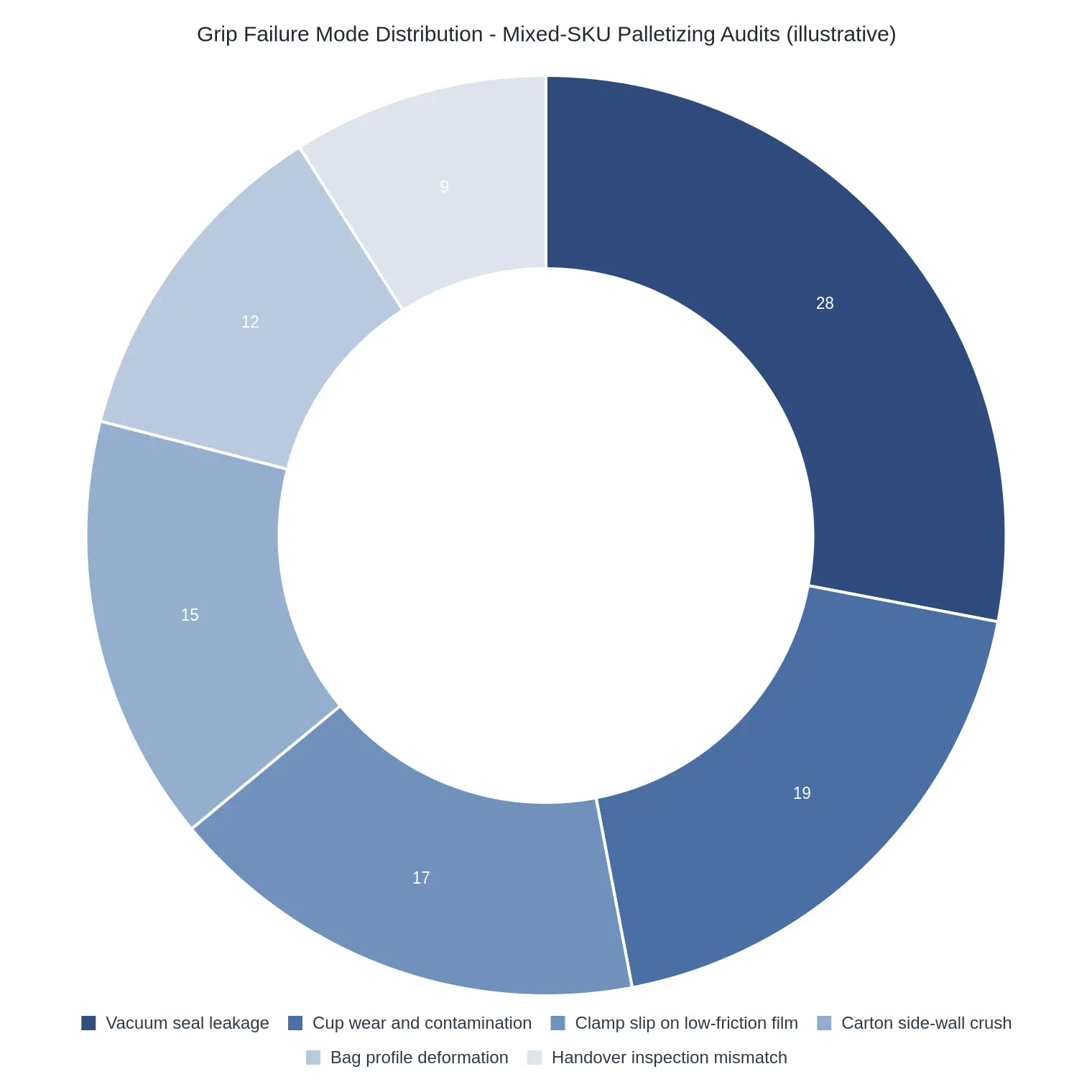
Figure 2: Grip failure mode distribution from mixed-SKU palletizing audits, expressed as a percentage of all recorded failures.
The failure mix shifts toward vacuum seal leakage in dusty, porous-board environments, and toward clamp crush where high clamp force meets cartons and film-wrapped loads. The figures are illustrative only and must be replaced with plant audit data before they are used to justify a gripper selection.
Delivery and Compliance: Write These Into Acceptance
A gripper that survives a demonstration cycle is not a validated gripper. The engineering debate usually stops at payload, carton porosity and cycle time. The risk that bites later is whether the vendor hands over evidence that the grip still works on the worst carton in the SKU mix, on a Tuesday, during third shift. That evidence belongs in the acceptance conditions, not in a favour requested after the invoice clears.
1. Pump curve verification records for vacuum systems
Vacuum performance follows the ejector or pump curve at real suction flow, not a peak vacuum number quoted at zero flow. Ask for records captured on the installed machine, with the actual cup count, hose lengths and supply pressure or line voltage. Each record should carry the test date, instrument identification, measured vacuum at each cup zone and measured flow. A curve measured on a bench with four cups says nothing about a 12-cup tool with a leaking bellows on corner four.
2. Tank leak checks and vacuum decay logs for buffered systems
A buffered system stores vacuum in a tank or reservoir so the tool can recover between picks and ride through leakage on porous corrugated. The tank and manifold need a documented leak check at commissioning, plus a vacuum decay log recording starting vacuum, time to the alarm threshold and test conditions. That decay value is the baseline. Without it every later alarm is uninterpretable, seal wear stays invisible, and the most common field fix becomes raising the threshold until the alarm stops complaining.
3. Handover inspection for clamp force settings and carton deformation limits
Clamp grippers fail by crushing rather than dropping. Handover inspection should document the clamp force setting for each carton family, the method used to measure it, and a deformation limit expressed as measurable panel deflection or dimensional change. Run sample cartons across the compression and moisture range you actually receive, and record pass or fail per sample. If the specification says only “suitable for RSC cartons,” the inspector has no limit to work against.
| Verification item | Record required | Pass condition | Failure mode it prevents |
|---|---|---|---|
| Pump curve verification | Installed-configuration curve, instrument IDs, zone-level vacuum readings | Meets specified vacuum and flow at worst-case cup leakage | Intermittent drops on porous or damaged cartons |
| Tank leak check and vacuum decay log | Commissioning leak test plus periodic decay baseline | Decay time within agreed tolerance, trend stable | Muted alarms, slow seal degradation, unattended drops |
| Handover inspection | Clamp force per SKU family, measurement method, deformation limit | Sample cartons within deflection limit across the moisture range | Crushed corners, pallet instability, customer rejects |
Missing documentation is one of the most common reasons a grip choice fails in production. The gripper is often mechanically sound; what is absent is the reference data that tells a technician whether today’s behaviour is normal. Once that gap exists, every dispute becomes an opinion and recovery means rebuilding a baseline from scratch. Skipping it in the deployment training and parts planning phase turns a two-hour tuning job into a week of trial picks and improvised settings.
Put the scope boundary in writing
Compliance also means knowing who is accountable for each record. Define OEM scope boundaries in writing before the purchase order: who configures gripper recipes, who sizes the vacuum generator against the carton range, who maintains firmware, who supplies spare cups and seals, and who re-verifies on site after a changeover. Ambiguity is where documentation quietly stops being produced, because each party assumes the other owns it. The split of responsibilities described in where in-house design ends and partner scope begins prevents that.
One practical test before sign-off: give the documentation package to a technician who was not present at commissioning and ask them to verify one carton family unaided. If they cannot find the baseline, the acceptance condition has not been met, whatever the palletizer did during the demonstration.
Can vacuum grippers handle porous or dusty cartons?
Only after the board is characterised. Uncoated or recycled corrugated leaks air through the liner, so a vacuum decay test on the actual carton SKU is the only reliable way to confirm the gripper keeps enough residual vacuum inside its handling cycle; catalogue flow figures do not describe that. Dust opens a second path: it loads filters and abrades lip seals, cutting effective flow at the duty point and producing slow slip that shows up as misplaced layers rather than as a fault alarm. If measured decay outruns what the pump and tank volume can compensate, specify multi-zone cups, a larger tank or a mechanical assist instead of accepting a marginal margin.
Can clamp grippers handle bags without deformation?
Yes, if the clamp force tolerance comes from the bag’s own compression behaviour rather than from a carton recipe. Servo-controlled pressure regulation lets the gripper run at the lowest force that still prevents slip under peak acceleration, which is normally well below the force that creases film or opens a seam. Verification should cover low-fill and over-fill conditions, because a slack bag deforms at forces a full bag tolerates without visible change. Sealed bags with trapped air usually need a venting or pressure-relief provision to stay dimensionally stable through the clamp-and-place cycle.
What should pump curve verification include in a delivery package?
A measured flow-versus-vacuum curve taken at the installed duty point, not a reproduced catalogue sheet. It should document the reserve margin against the calculated leakage of the worst-case SKU, with tank leak checks and seal integrity results recorded at commissioning. Expect a signed handover record that ties those numbers to the serial numbers of the pump, tank and gripper actually shipped.
How do we decide when a combined or bottom-support grip is required?
A combined grip becomes necessary when one technology cannot satisfy the load case: a porous carton that also arrives in a flexible outer bag, or cartons whose bottom flaps cannot carry the vacuum area a stable hold needs. Bottom support is the right answer when the vacuum area is structurally insufficient, or when the product has no self-supporting shape, such as a partly filled bag that sags under its own mass. Close the decision with a trial on production SKUs and confirm it during mixed-SKU pallet pattern setup, measuring slip over a continuous run rather than a single successful pick.
Limits, Trade-offs and Next Checks
Vacuum grippers suit non-porous flat cartons, non-porous film surfaces and shrink-wrapped trays, provided the seal budget — cup count, cup geometry, vacuum level and achievable flow — has been verified against the actual carton rather than the sample board. Clamp grippers suit heavier, denser cartons and rigid loads, with two physical constraints that tuning cannot remove: carton stiffness, because a flimsy carton buckles before clamp force is reached, and crush tolerance, because a dense carton can hold its shape while the contents deform. Bags stay the boundary case. Loose, unsupported bags generally need a bottom-support fork, a stabilising plate or a secondary retention element before a gripper specification is final.
| Gripper | Best-fit load | Binding constraint |
|---|---|---|
| Vacuum | Non-porous flat cartons, film surfaces | Seal budget and airflow through the porous material |
| Clamp | Heavier, denser cartons; rigid loads | Carton stiffness and crush tolerance |
| Bag support | Loose or partially filled bags | Lack of a stable pick surface; needs added support |
Three checks before committing capital: pump curve verification against the measured leakage rate of the worst-case carton at the worst-case cycle point; tank leak checks on every vacuum reservoir and circuit, fittings and quick-disconnects included, at the specified hold time; and a handover inspection that records cup wear, clamp force at the set point and pattern repeatability as delivered rather than as demonstrated. These separate a specified system from a delivered one, and the gap between them is where most palletizer disappointments start. The same logic governs the economics in cobot palletizer ROI on mid-volume lines.