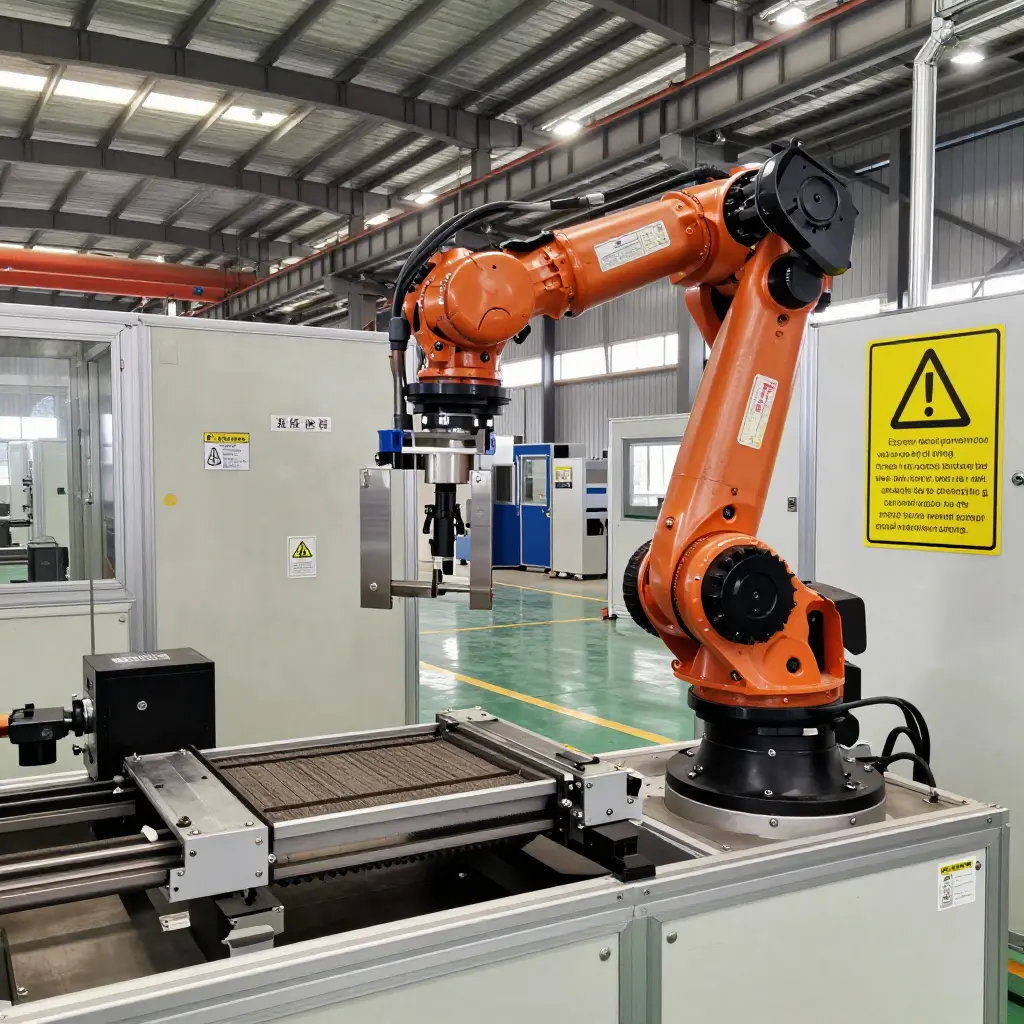
Dust Is an Ingress Problem, Not a Housekeeping Problem
Airborne dust settles on every surface of a cobot palletizer in a dusty plant. The control cabinet suffers first, because its fan draws room air through the filter and across the heat-exchanger fins, and that is where fines collect fastest. The resulting layer insulates. Drive and controller temperatures climb, fans run longer, and the thermal margin the cell was commissioned with disappears. None of this is cosmetic. It is the first link in a chain that ends in faults.
From the surface, dust works inward. Fines pass joint seals that were rated for splash, not for continuous airborne loading. They travel along cable jackets and through glands that were tightened once at commissioning and never checked again. Inside the arm they grind at linear bearings and slide surfaces. In the vacuum path they clog filters and ejector passages, so hold force drops on cartons and bags; on the gripper they pack onto cups, pads and sensing faces until vacuum detection drifts out of tolerance.
So the useful question is narrower than “what IP rating do I need”. Which rating a cobot palletizer needs depends on the dust load in your plant, and whether that protection still holds after months of production depends on the cleaning routine. A rating on a datasheet and a rating in service are different numbers. What follows covers IP selection against real dust conditions, the cleaning steps that preserve seals and airflow, and the checks that confirm protection is intact. For wear points and check intervals, see our guide to palletizer maintenance intervals and common wear points.
Ingress Protection Levels for Cobot Palletizers in Dusty Environments
These ratings describe enclosures and motors. They say nothing about the gripper or the cable routing.
| IP code | Dust protection definition | Water/cleaning exposure it tolerates | Typical plant dust conditions it suits | Cleaning method it allows |
|---|---|---|---|---|
| IP54 | Dust-protected; limited ingress permitted | Splashes from any direction | Light carton dust, low airborne lint | Dry wipe-down, occasional damp cloth |
| IP55 | Dust-protected; limited ingress permitted | Low-pressure water jets | Moderate dust, flour or paper fines | Damp cloth, low-pressure hose at a distance |
| IP65 | Dust-tight; no dust ingress | Low-pressure water jets | Heavy dust: sugar, cement, powder filling | Low-pressure hosedown with drainage |
| IP66 | Dust-tight; no dust ingress | Powerful water jets | Very heavy dust plus frequent wet cleanup | Direct jet spray at moderate volume |
| IP69K | Dust-tight; no dust ingress | High-pressure, high-temperature jets | Sticky food dust requiring daily washdown | High-pressure hot washdown, up to 80 C |
Match the arm’s rating to your worst recurring dust condition, not to the average day. Note that IP54 and IP55 share the same dust definition, and IP65 and IP66 do too: the second digit changes only what the enclosure survives from a hose. If your gripper sees the same washdown as the arm, the arm’s rating buys you nothing unless the gripper and cable routing are specified to the same level; this guide to washdown duty in food and beverage plants covers how that pairing is usually handled. Where cleaning is dry only, IP54 or IP55 keeps cost down. Once a hose enters the routine, you are at IP65 or above.
How Dust Damages a Palletizing Cell
Dust rarely destroys a cobot palletizer in one event. It acts as an abrasive and as a thermal load at the same time, and both effects accumulate. Every ingress path into a joint carries grit toward the lip seals, and grit turns slow seal wear into a grinding action that shortens bearing and cable life. In the vacuum generator, the same particles coat filters and venturi passages. Vacuum response drops, and gripper tooling begins losing cartons at the outer edges of the pattern. Porous pads load up with powder and lose sealing contact on dusty or recycled board.
Thermally, dust mats fan filters and heat-exchanger fins. Cabinet temperature climbs, the controller derates duty cycles to protect itself, and a cell sized for a fixed rate quietly loses throughput. Optics fail the same way: a blocked photo-eye reports a pallet that is not there, and a filmed safety-scanner window either stops the cell for no reason or masks a hazard that is real. Then there is the effect nobody logs. A uniform grey layer makes cracked seals, loose fittings and frayed cables look normal during a walk-around.
- Wrist and elbow joints: grit embedded in lip seals and wiper rings, seal wear accelerating.
- Vacuum generators: clogged inlet filters and ejector passages, hold force down on every pick.
- Gripper pads: glazed faces, slipping cartons and bags, more drop faults.
- Cabinet: loaded fan filters, higher internal temperature, duty cycle pulled down.
- Sensors: dust film on photo-eyes and safety windows, false faults and weak detection.
Put cleaning and inspection on a formal preventive maintenance schedule so tasks happen before faults appear, and revisit the intervals whenever ambient dust loading changes. Two controls carry most of the benefit: the right IP level, and a routine that runs the same way on every shift.

The schematic reduces the cell to the parts that matter on a dusty floor. Five ingress paths are marked, and those are the ones worth a daily look:
- Arm joints – seals and gaps where rotating shoulders, elbows and wrists draw in airborne fines with every cycle.
- Cable entry glands – the dress-pack pass-throughs on the arm and cabinet, where a loose gland lets dust track along the cable jacket.
- Control cabinet fan intake – the filter grille that quietly loads up until airflow and internal temperature both suffer.
- Gripper / vacuum line coupling – push-to-connect fittings and the gripper body recess, where fine powder packs into the vacuum path.
- Pedestal base joint – the floor-level interface that collects everything swept or spilled nearby.
Anything marked on that diagram should get a wipe, a vacuum or a visual check before the shift starts. How those checks fit the wider schedule is set out in our notes on maintenance intervals and common wear points.
Daily Cleaning Routine: 8 Steps for a Cobot Palletizer in a Dusty Plant
The whole routine rests on one distinction: dust on the outside is a nuisance, dust inside the seals is a failure. A rating is only worth as much as the boots, bellows and filter media you maintain, so block out a fixed 45-60 minutes at shift change, before startup or after the line stops, and work through the steps in order. One rule first: no compressed air on seals, joints, bearings, linear guides, sensor faces or cabinet intakes. Air at pressure drives particles past lip seals and into places a cloth cannot reach.
-
Shut down and lock out. Stop the cell from the HMI, drop the palletizer to a safe position and apply lock-out tag-out on the main disconnect. Confirm zero energy before any panel is opened.
-
Wipe joint boots and bellows. Use a damp lint-free cloth on each axis boot and bellows, working from the top down so dust does not collect in folds. Inspect for cracks, pinholes or grit trapped in the pleats.
-
Clean gripper pads and vacuum filters. Wipe pad faces with a damp cloth and check that suction cups still seal on a test carton. Remove and rinse or replace vacuum filter elements, then refit them dry and seated.
-
Check and replace cabinet filter media. Open the control cabinet filter housing and inspect mat loading; replace media when it is matted, torn or visibly grey across the face. Log the replacement rather than tapping the filter clean.
-
Wipe sensor windows and reflector targets. Clean photocell lenses, safety scanner windows and reflector targets with a soft cloth and approved cleaner. A dusty reflector can trigger phantom stops that look like programming faults.
-
Clear dust from pallet conveyor rollers and pick zones. Brush or vacuum debris from rollers, side guides and the pick zone floor, and clear any spillage around pallet pickup points. Rollers should turn freely by hand after cleaning.
-
Inspect for dust ingress paths. Check cable glands, connector collars and door gaskets for gaps or loose fittings, and reseat anything that has worked loose. This is the step that protects your ingress protection rating over time.
-
Run restart verification. Power up, home every axis and confirm homing completes without faults. Test safety sensors one by one, including scanner zones and door interlocks, before handing the cell back to production.
Record the completed check, the filter changes and any defects on the maintenance log before the cell returns to service. The interval planning behind this routine, and the wear points to watch, are in our notes on cobot palletizer daily checks and common wear points.
Where Cleaning Interval and Enclosure Class Meet
Dust-related stoppages by cleaning interval and enclosure class
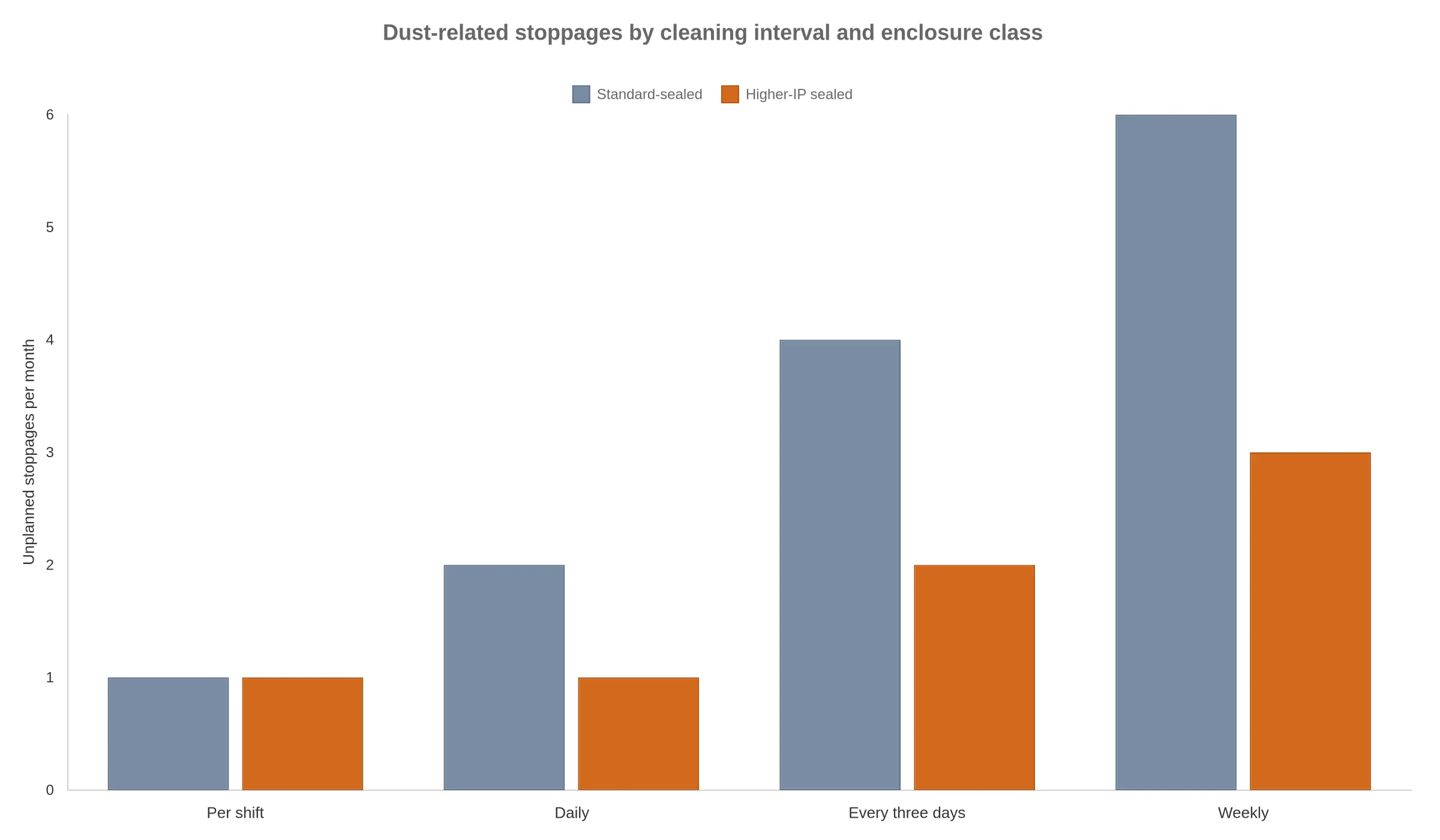
Illustrative pattern only – a conceptual model of how enclosure class and cleaning frequency interact, not measured field results.
Two variables move the bars: how often the cell is cleaned, and how much dust the enclosure keeps out. Read the shape, not the heights.
- Standard-sealed units feel the interval most. Stretch cleaning from once per shift to weekly and the illustrative stoppage count climbs steeply, because dust that is not removed keeps accumulating around bearings, linear guides and vacuum lines.
- Higher-IP sealed units flatten the curve. A better-sealed enclosure buys slack in the schedule, but it does not make cleaning optional – even the orange bars rise once the interval stretches.
- Neither control replaces the other. Cleaning per shift is labor you repeat forever; sealing alone still leaves dust on pads, light curtains and pallet surfaces. Running both keeps labor and stoppages down.
Before you change any interval on the strength of this, check the shape against your own downtime log and against the intervals in your preventive maintenance schedule.
Match the IP Level to the Dust, Not to Habit
Copying whatever the last machine used is how plants end up paying for sealed joints they never needed, or replacing bearings every quarter. Start from a dust classification instead. Fine, non-conductive dust from corrugated cartons, kraft paper, stretch film and label stock is abrasive but electrically benign: it settles slowly, brushes off easily and rarely bridges contacts. Sugar, starch, cocoa, flour, cement, carbon black, metal fines and dried syrup residue behave differently. They cling to surfaces, mat on cooling fins, and in the conductive cases can track across terminals. Three questions cover most of it: where the dust is generated, how much of it becomes airborne, and whether the residue hardens, melts or absorbs moisture. Those answers, not a catalogue default, set the floor for the IP level you need.
Cleaning method settles the rest. In a dry, non-washdown cell where the routine is brush, vacuum and a wipe-down, IP54 on the arm and controller is usually acceptable, provided someone follows a documented schedule, which is why choosing realistic planned maintenance intervals and wear-point checks matters as much as the enclosure number. Add hoses, foam, low-pressure spray or caustic washdown chemicals, as dairy, bakery and beverage plants do, and IP65 becomes the sensible baseline, with the gripper, cabling and cabinet seals getting closer scrutiny than the robot flange. Our guide to cobot palletizers in food and beverage plants on washdown duty walks through where those limits sit in practice. Specify the two together during selection, because an IP level without a matching cleaning method means very little on its own.
Frequently Asked Questions
Does a higher ingress protection rating reduce how often I need to clean the cell?
No. A higher rating slows the rate at which dust reaches internal components. It does not remove settled dust from grippers, pallet surfaces or light curtains. Treat the rating as a limit on ingress, not as a substitute for housekeeping: a cobot palletizer in a dusty plant still needs a defined daily routine. Plants that read a high IP rating as permission to skip cleaning usually find the problem weeks later, as lost vacuum flow or sensor faults.
Is compressed air acceptable for blowing dust off the robot and end effector?
Not on seals, bearings, linear guides, sensor faces or cabinet intakes, for the reason above: pressure pushes abrasive particles into places you cannot clean afterwards. On gripper bodies and recessed pockets, low-pressure air with a controlled nozzle is a reasonable way to clear powder, provided the area rules allow it. Where fine conductive or combustible dust is present, check your housekeeping and electrical area classification before making blow-off a routine step.
What should I check on the gripper and vacuum system each shift?
Start with vacuum level at the cup or pad, since a slow drop is the earliest sign of a clogged filter, a worn lip or a leaking fitting. Then inspect cups for cracking, flattening and embedded debris, confirm that hose routing has not been pinched by the wrist motion, and verify that the object-detection signal still confirms a solid grip before a lift. A short checklist tied to the daily maintenance checks and common wear points keeps these steps consistent across shifts instead of depending on who is on the floor.
How does dust affect the control cabinet, and does filter replacement become more frequent?
Dust loading on cabinet intake filters raises internal temperature and can cause nuisance over-temperature trips long before any real fault exists. In dusty plants, filters may need inspection weekly and replacement several times more often than the OEM baseline, with door seals and cable glands checked at the same time. Fine deposits inside the cabinet point to something else: either the enclosure is not being pressurised as intended, or the seals have aged out.
Can an existing cobot palletizer be upgraded with better sealing instead of being replaced?
Often yes, and it is usually the cheapest route for a cobot palletizer in a dusty plant that was specified for a cleaner area. Typical steps are sealed cable entries, a filtered and slightly pressurised cabinet, bellows or covers on exposed joints, and a gripper rebuild with sealed vacuum components. Revisit restart procedures afterwards in this guide to fault recovery after dropped cases and pallet misalignment, because dusty cells tend to report grip and placement issues in clusters rather than one at a time.
Turning These Points Into Offer Requirements
Buyers should require the ingress protection level for the robot, the control cabinet and the gripper to be stated separately in the offer. One headline figure rarely describes all three. A cabinet in a dusty aisle, an arm rated for washdown and a vacuum gripper with exposed venturis do not share an exposure profile, and the gripper’s rating usually depends on the elastomer and port design rather than on the arm. Asking for three values makes mismatches visible before the purchase order, and gives maintenance a baseline to work from.
Two operational items belong in the same document. Ask the supplier to state the filter and bellows boot replacement interval under your plant’s actual dust load rather than a generic calendar figure, and ask for the cleaning routine to be written up as an operator-level procedure at handover, for the people who will run it on shift. Both requests connect to deployment training and parts planning and to the written record expected at project handover, where consumable stock levels and the first replacement cycle should already be agreed. Six lines make a compact, verifiable checklist for any cobot palletizer heading into a dusty hall.
| Checklist item | What to ask for in the offer |
|---|---|
| Robot IP level | Stated separately, per axis rating |
| Cabinet IP level | Stated separately, with mounting location |
| Gripper IP level | Stated separately, including pad and port materials |
| Filter interval | Replacement interval at plant dust load |
| Boot interval | Inspection and replacement interval |
| Cleaning procedure | Operator-level document delivered at handover |