Why Pallet Dispenser Capacity Is a Flow-Matching Decision
An empty dispenser stops the cell the way a fault does. The robot has nothing to build on, the conveyor backs up, and the line sits until someone arrives with a pallet and a forklift. None of it lands in the fault log, which is why the stop rarely makes it into the planning discussion. The dispenser is not an accessory bolted to the side of the cell; it is the buffer that separates pallet supply from pallet consumption, and its capacity sets how long the cell runs without a person.
Two numbers define the magazine: how many empty pallets it holds, and how fast the line eats through them. Sizing comes out of cycle time, pallets per hour, and a refill interval a forklift driver can actually keep. It does not come out of the floor space left over after the layout is drawn. For the demand-side math, see throughput planning in cases versus pallets.
Size a magazine against a refill interval nobody can meet and it starves the cell every shift. Capacity and refill routine are one decision, because the buffer only does its job if pallets arrive before it empties. The arithmetic runs in one direction: throughput in cases per hour, pallets per hour, then the magazine size that covers your real refill interval with something left over.
Sizing the Pallet Magazine: From Consumption Rate to Capacity
The calculation starts with a number you already have: line throughput in cases per hour. Divide by cases per layer, divide again by layers on a full pallet, and you have pallets consumed per hour. A line running 1,800 cases per hour at 20 cases per layer and 8 layers per pallet burns about 11.25 pallets every hour, and every downstream figure hangs off that one.
Required capacity is that rate multiplied by the refill interval you are willing to accept, plus a safety margin of roughly 15 to 25 percent. Take the example above with a two-hour interval: 11.25 pallets per hour times two hours gives 22.5 pallets, and a 20 percent margin pushes the magazine to about 27. Round up to a standard stack height, then check the number against the floor plan before committing.
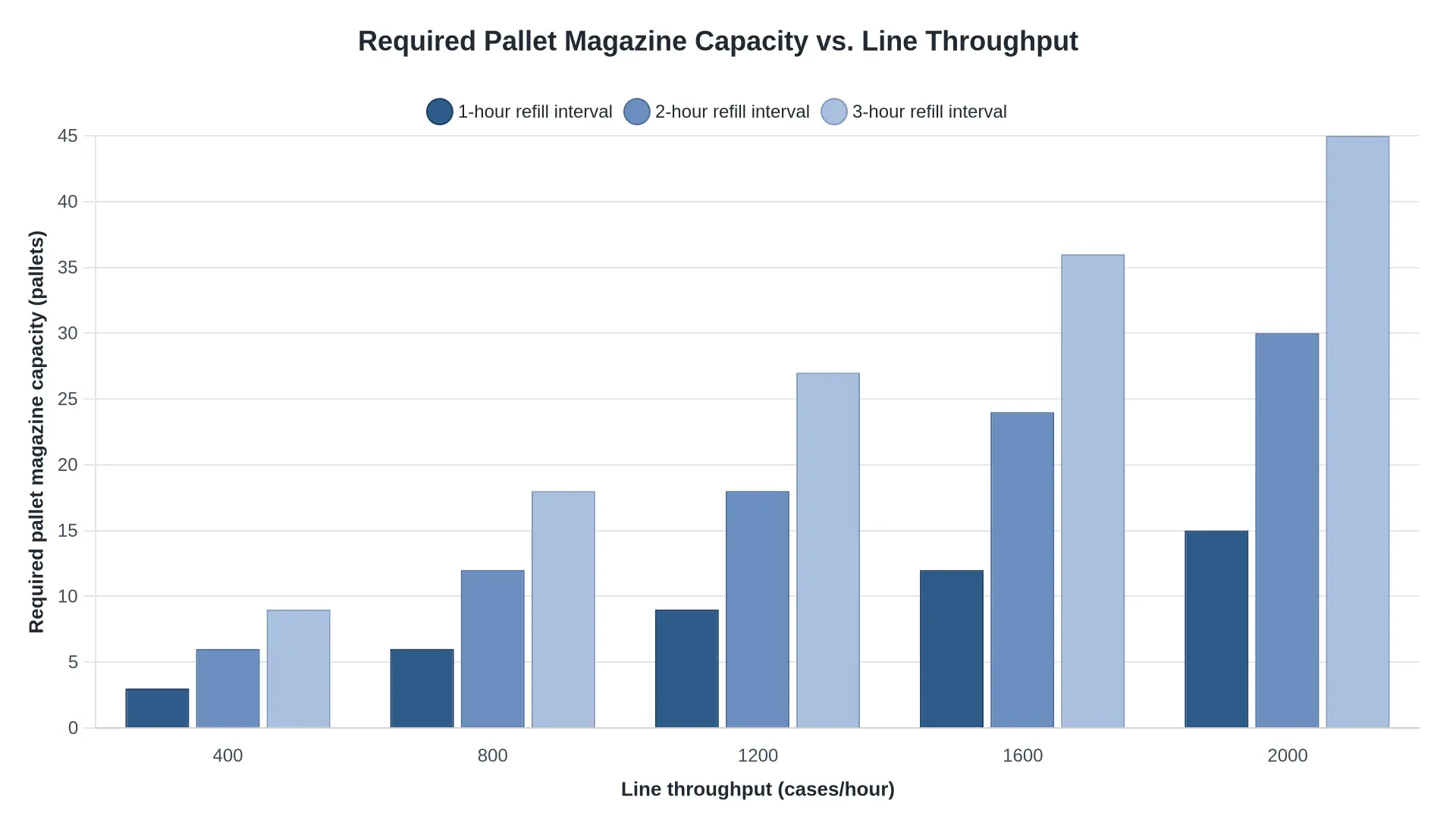
Throughput and refill interval both scale the requirement roughly linearly, which is why the shortage shows up first on fast lines with generous refill timing rather than on slow ones.
Real consumption usually runs above the calculated figure for three reasons. Mixed-SKU pallet patterns shift cases per layer from one product to the next, so the average on paper is rarely the average the dispenser sees, and pallet pattern setup that favors flexibility moves it further. Partial pallets at the end of a run consume a fresh pallet for a handful of cases. And every mis-pick that discards a damaged or skewed pallet removes stock without stacking anything.
Oversizing has its own cost: extra positions eat floor space beside the cell, and taller stacks settle and misalign in ways that slow the dispenser down. Undersizing costs more in daily operation, because every shortfall becomes an unplanned walk to the pallet pickup zone mid-shift. The practical target is a magazine that carries a full shift or half shift of pallets without pulling an operator off another task at a moment nobody chose.
Pallet Dispenser Magazine Capacity, Consumption Rate and Refill Interval
| Magazine capacity (pallets) | Line demand (pallets per hour) | Theoretical refill interval (minutes) | Recommended refill interval with 20 percent margin (minutes) | Operator trips per 8-hour shift | Recommended action |
|---|---|---|---|---|---|
| 10 | 4 | 150 | 120 | 4 | Accept manual refill |
| 15 | 8 | 113 | 90 | 5 | Accept manual refill |
| 20 | 10 | 120 | 96 | 5 | Add level sensor alarm |
| 25 | 14 | 107 | 86 | 6 | Add level sensor alarm |
| 30 | 20 | 90 | 72 | 7 | Increase capacity |
| 40 | 20 | 120 | 96 | 5 | Accept manual refill |
All figures assume 95 percent dispenser availability, with practical refill intervals set 20 percent short of theoretical so a refill always lands before the magazine empties; see palletizer throughput planning cases vs. pallets for the demand-side inputs.
A dispenser only keeps its rhythm when refill routines count as part of the cycle instead of an interruption. The list below is the handover version operators run at the start of a shift and keep running through it, so the pallet magazine stays stocked and the low-level alarm remains a warning rather than a stop.
Operator and Shift Lead Checklist
- Check the pallet magazine level against the posted minimum threshold before the shift starts.
- Stage the correct pallet grade and condition within arm’s reach of the dispenser.
- Reject warped, split, or damp pallets on the squareness check before loading.
- Square each stack in the magazine, since a skewed stack mis-picks mid-run.
- Confirm the low-level alarm trigger point matches the pallet thickness in use.
- Log refill timing on the shift sheet, which is what later validates the planned interval.
- Look for debris, broken slats, and loose banding in the magazine channel.
- Top up during planned breaks rather than mid-pattern, whenever the schedule allows.
- Report repeated early low-level alarms to maintenance for sensor and stack checks.
- Hand over the refill interval status, and any drift, at shift change.
Run the routine and the calculated margin survives contact with the shift; skip it and the buffer absorbs nothing. For related daily checks, see daily checks and common wear points.
Refill Interval vs. Magazine Capacity
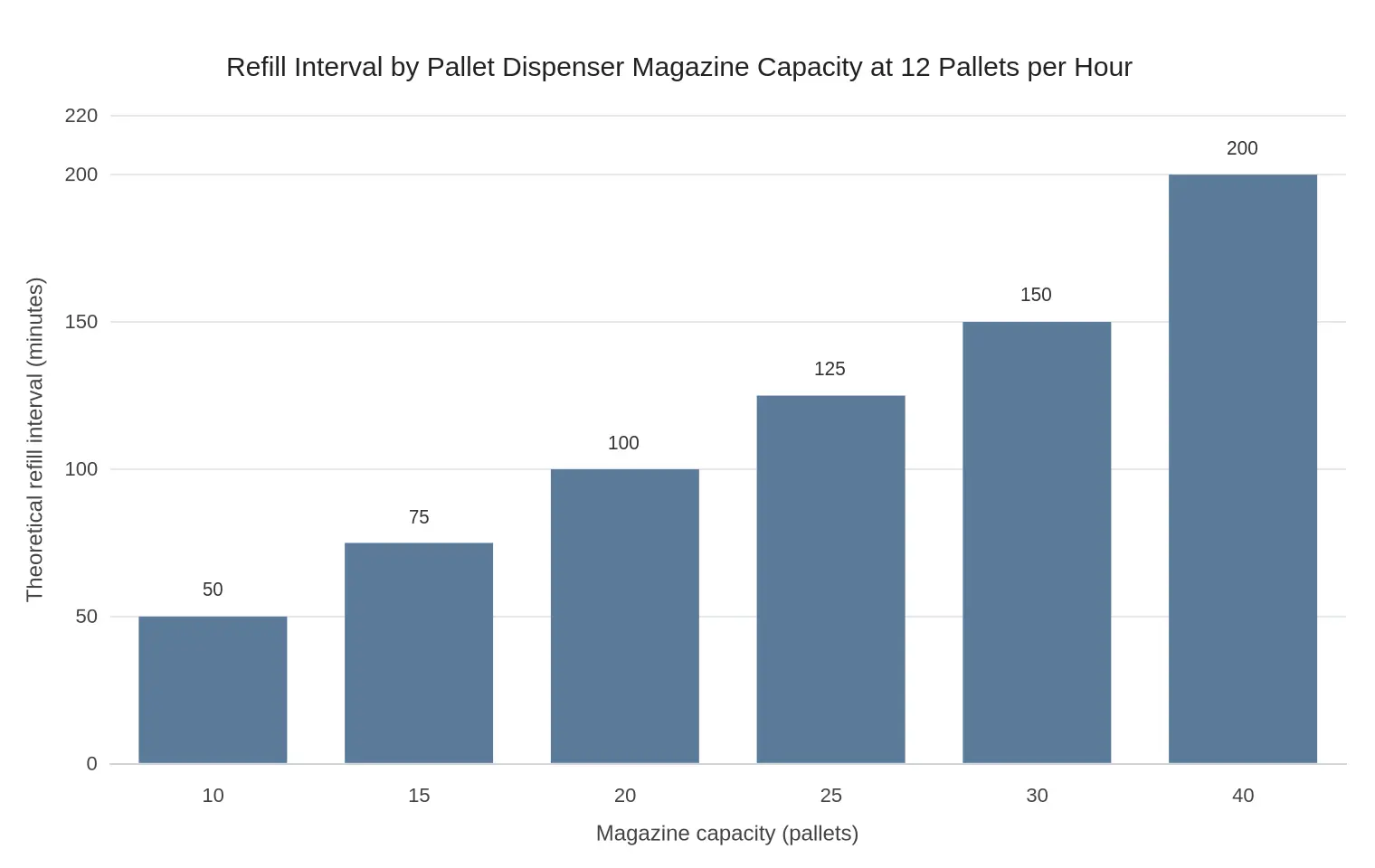
At a fixed demand of 12 pallets per hour, refill interval scales linearly with magazine capacity, so the capacity you pick is really a decision about how often an operator walks back to the cell – a trade-off worth reading alongside these throughput planning notes on cases versus pallets.
Designing Refill Routines Around Magazine Capacity
A magazine’s published capacity describes what the dispenser can hold, not what the cell can run on. If nobody owns refilling, if alarms are ignored, if reloads happen only after the cell has already stopped, the usable capacity sits well below the installed size, and layout and hardware choices end up being judged on hours the routine never delivered. Refill design deserves the same engineering attention as magazine sizing.
Set an Alarm Point, Then Defend It
Put the low-level alarm at roughly 25 to 30 percent of magazine capacity. That leaves enough pallets in the stack to cover a realistic response rather than a panic run. The exact figure follows travel distance from the pallet pickup zone to the dispenser and how long a trained operator needs for a reload. Set it too high and the alarm becomes a nuisance call; set it below 20 percent and there is no margin left for a cell that is mid-pattern when the warning appears.
Choose the Trigger Model Deliberately
Refill can run on the operator’s judgment, on the alarm, or on a fixed schedule. Pick by demand stability, not by habit.
| Trigger model | How it works | Where it fits |
|---|---|---|
| Operator-triggered | Operator reloads when the stack looks low | Low-throughput cells with continuous staffing |
| Alarm-triggered | Count or level signal fires at 25 to 30 percent | Most cobot cells; ties refill to real consumption |
| Scheduled | Refill at fixed intervals regardless of level | Stable cycle times with little SKU variation |
Assign Ownership per Shift and per Zone
Write refill responsibility into the shift plan by zone, with a primary and a backup owner on each shift so the task does not fall to whoever happens to be nearby. Refill that belongs to nobody is the usual reason a dispenser runs dry on second shift while the first-shift log shows no problems. Ownership should also name who checks the floor buffer and who escalates when a buffer stack has not been replenished.
Refill Inside Planned Changeover Windows
Put reloads inside planned changeover windows, when the line is stopping anyway, so nobody halts palletizing for a task that could have run during a line stop. Fitting refills to changeovers also reduces the chance of mixing pallet types or cutting a pattern off halfway. Same practice as conveyor changeovers: it keeps refill work off the critical path.
Plan the Floor Buffer Around Real Layout Constraints
One or two pallet stacks beside the cell make a useful buffer, but the layout decides where they can physically sit. Pallet pickup zones and forklift access lanes set the footprint, and a stack placed outside forklift reach or inside an operator walkway creates the traffic conflict it was meant to prevent. Read the ZBOSN guidance on layout for forklift access, pallet pickup zones and operator walkways before fixing buffer positions, not after.
Review Refill Frequency Monthly
Once a month, compare logged refill frequency against the shift log. A rising refill count on the same product mix usually means changed pallet supply, longer reload times, or dispenser wear, and a monthly read catches it before it turns into a surprise stop. Run it alongside the recommended dispenser wear checks and maintenance intervals, so a slipping rate can be traced either to the routine or to the hardware.
Diagram: Magazine Zones and the Refill Handoff
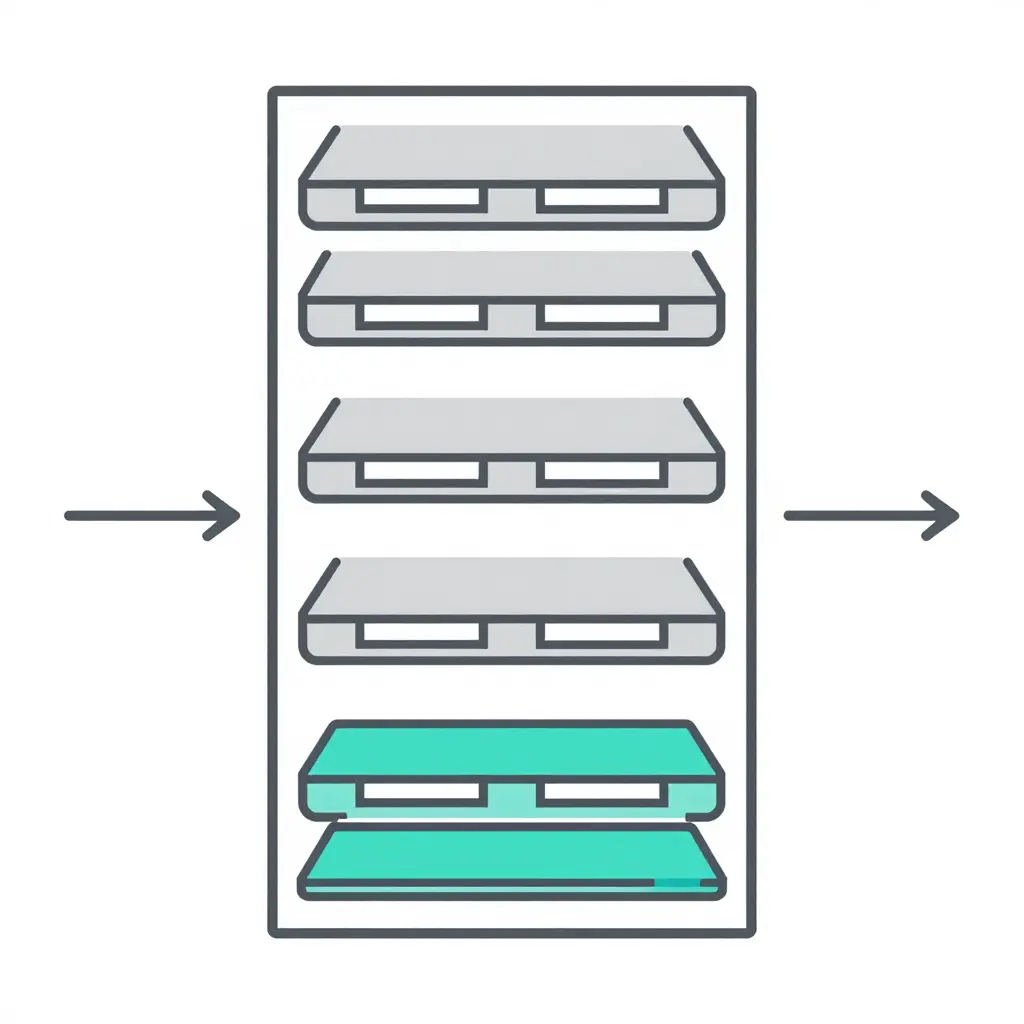
A spec sheet gives you a number. The schematic shows what the magazine does across a shift, reading top to bottom, and why the useful pallet count is never the same as the stack height.
How to read the three zones
- Full zone (top): your reserve, and the part you paid for. It keeps the cell running between refill trips.
- Working zone (middle): the active buffer. Pallets here index upward into the release position, so a pallet is waiting the moment the cobot finishes one.
- Low-level trigger zone (bottom, accent colour): the single pallet position that marks the alarm point. When the stack drops into this band, a refill request goes out early enough that the working zone never empties mid-cycle.
The arrows carry as much information as the stack. The inlet arrow on the left brings refill in at the bottom of the magazine, which is why forklift approach space and operator walkway clearances belong in the layout plan: cell buffer and exchange-floor trade-offs. The outlet arrow on the right releases pallets into the palletizer cell, the point where dispenser cycle time and cobot cycle time have to agree.
Where the buffer actually lives
Most sizing mistakes come from budgeting the full zone as if it were buffer. It is not. Only the pallets in the working zone absorb variation: a slow refill, a missed forklift window, a brief upstream stoppage. Read the full zone as autonomy and the working zone as response time, and the refill routine stops being a daily interruption.
FAQ: Pallet Dispenser Magazine Capacity and Refill Routines
How do I calculate the right pallet dispenser magazine capacity for a cobot palletizer?
Size it to one shift or to one pallet-type changeover. Multiply peak pallets per hour by the longest unattended run, then add 15 to 25 percent of buffer and confirm the result against stack height and floor space. The underlying logic is in throughput planning cases versus pallets.
How often should the pallet magazine be refilled?
Interval is capacity divided by consumption rate. A 40-pallet magazine running 30 pallets per hour needs reloading every 80 minutes. Watch the pallet magazine draw-down and refill before it empties mid-batch, not after.
Can a low-capacity magazine be compensated with more frequent refills?
Yes, and you pay for it in operator trips and palletizer idle time. A 20-pallet magazine doubles the trips of a 40-pallet one, which pulls labor off other tasks. Accept that trade-off only where floor space is tight and the refill routine stays predictable.
What happens to throughput when refill routines are missed?
The palletizer stops. An empty magazine halts stacking, so every missed refill turns straight into idle minutes. At 30 pallets per hour, a 15-minute lapse costs roughly eight pallet positions and pushes downstream staging, shipping, and forklift pickup windows back.
Specify Capacity and Refill Routine Together
Magazine capacity and refill routines have to be specified together during cell design, not one after the other. Capacity sets the refill interval, and the interval decides whether your cobot palletizer runs a whole shift or stalls waiting for a stack of empty pallets nobody planned for. Treat them as one design variable and most of the downtime question is settled before the cell ships.
Three Design Actions
- Size the magazine from measured pallet consumption, not nameplate throughput. Log actual pallets consumed per shift on your own line for a week or two; nameplate numbers usually describe an ideal pattern mix you rarely run.
- Define the low-level alarm point and the refill owner before commissioning. Agree on how many pallets remain when the alarm fires, who responds, and how long a reload physically takes, then confirm that window fits the interval between changeovers.
- Verify refill timing during acceptance runs. Run refills under realistic conditions, including a reload at peak output, and record the actual interruption against the agreed number rather than accepting a verbal assurance.
ZBOSN designs and manufactures cobot palletizers in-house, so dispenser configuration is matched to line demand at the drawing stage instead of being retrofitted later. That in-house scope covers mechanical integration with your existing conveyors, pallet magazines and safety envelope, plus export support and OEM/ODM cooperation for integrators and regional partners who need a configured machine rather than a catalogue box. For the demand side of the matching exercise, start with our guidance on throughput planning in cases versus pallets, then lock the refill numbers down using these pilot runs and acceptance criteria.
Contact ZBOSN with your pallet consumption figures and shift pattern, and we will match dispenser capacity and refill routine to your line.