A cobot palletizer platform pays off across several plants only if the shared module set is fixed early and local adaptation is held to explicit rules. Module commonality covers the parts of the cell that are identical everywhere: base frame, control cabinet, safety architecture, gripper family, pattern library and firmware baseline. They are engineered once, documented once, then copied. A large share of the cobot palletizer cost structure is settled at that point, long before the first cell ships.
Local adaptation is everything that has to change for one plant: docking height, conveyor interface, pallet pickup zone, utilities, guarding, duty rating. None of it is optional. A cell built for the wrong infeed height, or for cleaner compressed air than the plant can supply, will not run reliably however elegant the common design is. What keeps adaptation from turning into re-engineering is paperwork: every deviation written down, justified and approved as an exception, instead of being absorbed quietly into the next build.
High-mix, low-volume lines need both halves. Commonality protects spare-parts depth and engineering reuse: one gripper family and one firmware baseline mean fewer stock items and a single troubleshooting path across the network, which counts most on lines with short runs and frequent changeovers. Local adaptation protects throughput and cycle time at each site, because a dock height or pallet zone tuned to the real layout keeps travel distance and waiting time where they belong. The ROI on mid-volume lines shows the effect, since small cycle-time gains compound across many short runs.
The working rule: commonality is the default, adaptation the documented exception.
ZBOSN builds its cobot palletizers in-house, which is what lets it hold one module baseline across customer sites.
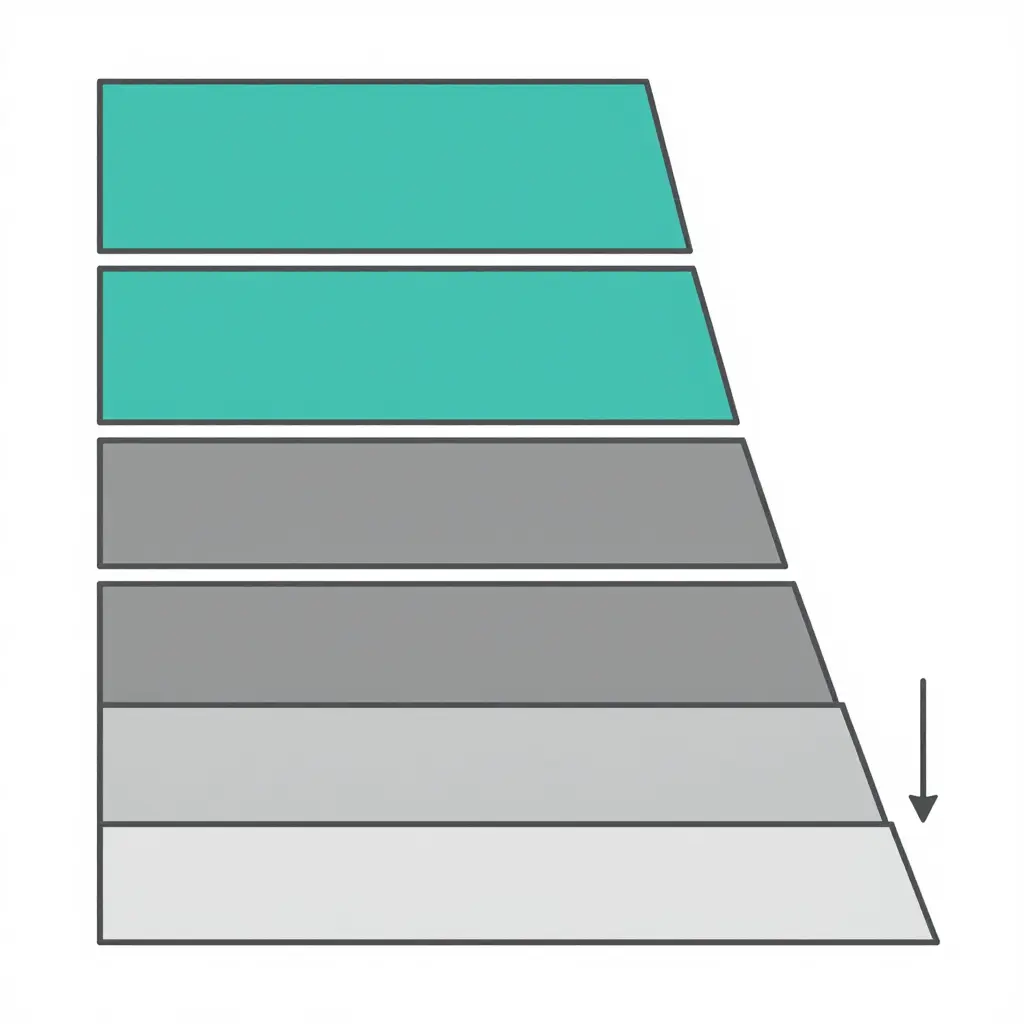
Shared layers stay identical across plants; only the uppermost blocks change per site.
How to read the stack
- Bottom, widest layer – the platform baseline: controller, safety architecture and motion stack, never forked per site.
- Middle layers – shared modules of decreasing width: pattern engine, pallet and slip-sheet handling logic, conveyor handoff sequence.
- Top blocks, offset to one side – the narrow per-plant layer: gripper variant, reach envelope and the pattern set tuned to each line’s carton mix.
The arrows on the right run downward on purpose. Everything above the split is written once and inherited; whatever has to differ gets pushed into the smallest possible surface. That is what makes a rollout repeatable. It is also where budgets leak, because the per-site end effector is usually the gripper choice that varies plant to plant, not the software core.
Seven layers are worth declaring non-negotiable before any plant starts asking for tweaks. The comparison table and the governance section below both point back to them:
- Control cabinet and safety architecture: fix the wiring, e-stop logic and guarding interfaces, so one risk assessment is written once and then re-signed per site with the local hazards added.
- Base frame and anchoring concept: a single footprint and floor-load profile keep layout surveys and civil work reusable.
- Gripper family and tool changer interface: one mounting plate lets carton, bag and slip-sheet tooling swap without redesign.
- Pattern library and offline simulation workflow: a shared pattern format means programming hours transfer between plants unchanged.
- Firmware and backup baseline: identical versions and documented rollback paths keep one plant from drifting into an untested state.
- Spare-parts catalogue and training kit: shared part numbers, plus common training and spare-parts planning, cut duplicate inventory and keep operators interchangeable between sites.
- Utilities and conveyor handshake spec: fixed power, air and signal drop points make site preparation predictable across the rollout.
Each row of the table names the shared baseline, what changes locally, and who signs it off.
| Element | Shared baseline across plants | What adapts locally |
|---|---|---|
| Base frame and floor anchoring | Welded steel base, leveling pads, anchor pattern per platform drawing | Slab condition and anchor method; approved by plant engineering |
| Conveyor interface and infeed height | Standard infeed handshake, transfer plate and sensor bracket kit | Infeed height and conveyor datum; approved by integrator |
| Pallet pickup zone and forklift access | Marshalling footprint and standard approach clearance envelope | Aisle width and zone position; approved by plant engineering |
| Gripper type for cartons versus bags | Common quick-change wrist with vacuum and clamp options | Which gripper the SKU mix needs; approved by platform owner |
| Safety guarding and risk assessment | Guarding kit, light curtain mounting points, e-stop architecture | Fence layout and risk sign-off; approved by plant engineering |
| Utilities (power and air) | Single-point power feed spec and stated air consumption | Supply voltage, air quality, routing to cell; approved by plant engineering |
| Stack height and vertical reach | Rated reach envelope and maximum stack height per model | Ceiling clearance and target stack tier; approved by integrator |
| Pattern library per SKU mix | Base pattern templates, pallet definitions, simulation files | SKU patterns and changeover rules; approved by platform owner |
| Spare-parts stocking | Recommended common spares list and wear-part kits | Stock depth and on-site holding level; approved by plant engineering |
For the mechanical and utility detail behind these splits, see our guide to utilities planning for power and air.
Spec Freeze Points and Change Control Across Sites
Freeze the shared module set before the second plant is quoted. Set a documented design-freeze point for the common modules – reach envelope, gripper interface, pallet-pattern library, safety architecture – and price every later quotation against that baseline, using the design freeze and handover timeline to anchor the dates. Anything still open when the second quote goes out becomes a negotiation, and negotiations are how a shared platform quietly turns into bespoke engineering.
Every deviation needs a written adaptation request with a named approver, a cost estimate and test evidence. A change enters the shared module set only after it has been proven in more than one plant, which is the same boundary that defines partner scope in OEM programs. Site-specific work then sits in the record as a documented exception with a scope owner, rather than as an informal tweak made on the floor and forgotten by the next commissioning team.
Unmanaged variation costs money and lead time. Each undocumented variant adds spares lines, slows training because operators have to learn a plant-specific sequence, and splits the firmware baseline as field units drift out of version sync. Across a handful of sites that drift comes back as duplicated spare stock, slower fault recovery, and spare-part lead times that stretch whenever a line stops.
Where the Effort Actually Sits Across a Rollout
Platform work gets cheaper and faster with each plant. The last mile does not. The chart below divides each rollout phase into standardized platform work (repeatable, reusable content) and plant-specific adaptation (one-off content that exists only because of a particular building, product mix or crew).
The split is uneven by design. Specification and fabrication lean on the platform, at roughly 75% and 80% of effort, because a mature design library, a fixed BOM and a pre-tested module set absorb most of that work. Engineering and design stay platform-led but start leaking as conveyors, pallet pickup zones and safety envelopes get reshaped for the site.
Then the balance flips. Installation and commissioning is the one phase where plant-specific work dominates, at around 60% of effort, and training never returns fully to platform levels, because spare-parts stocking and operator coaching follow local maintenance habits.
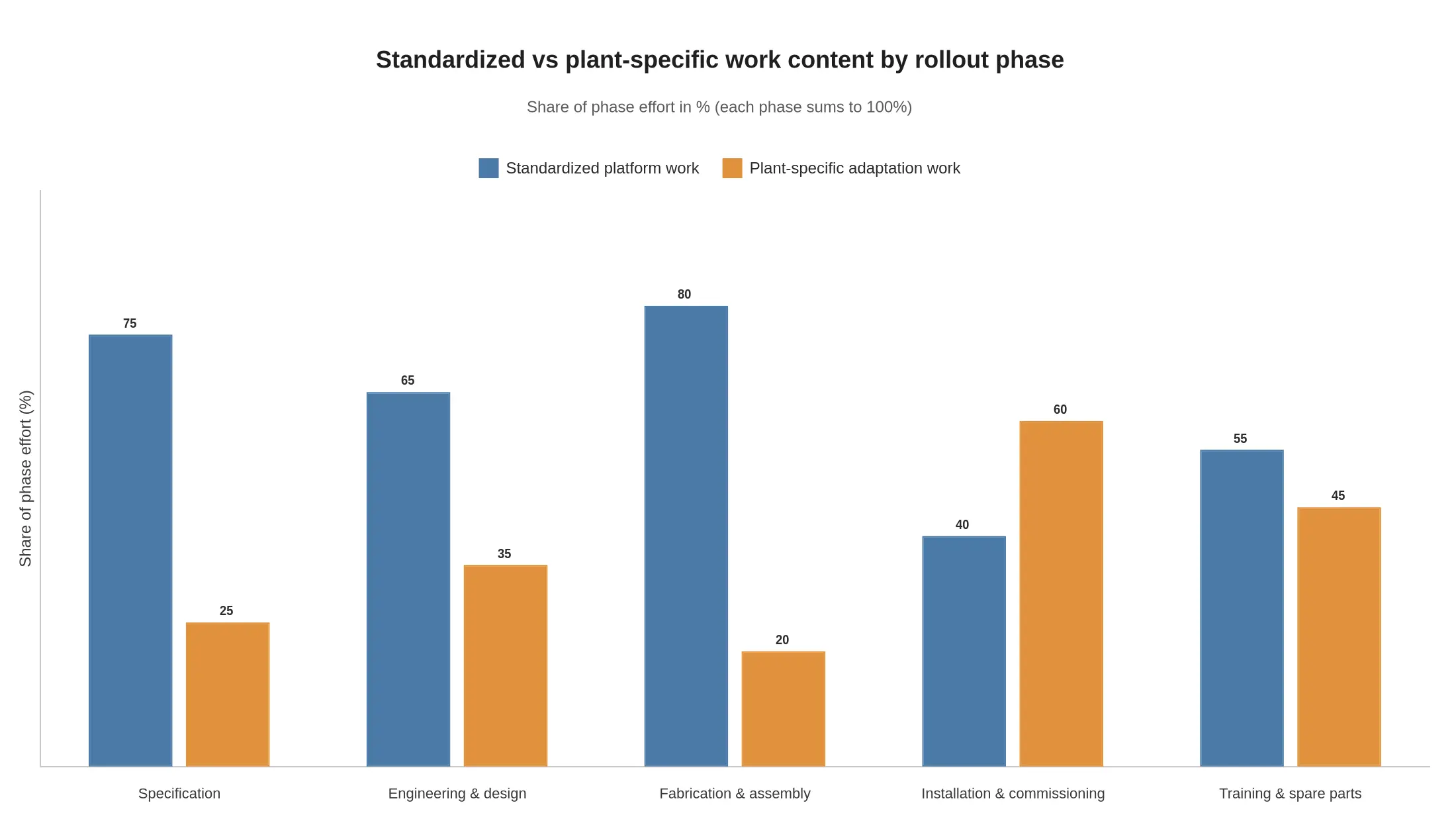
Standardized work dominates specification, engineering and fabrication, while plant-specific adaptation takes over at installation and commissioning – meaning capacity planning should reserve scarce site engineers for the back half of every rollout, not the front.
What This Means for Capacity Planning
Staff a multi-plant rollout as if effort were flat and you overload the wrong people at the wrong time. The load lands like this:
- Central platform team carries the early phases. One design freeze per platform generation, reused across plants, keeps specification and fabrication near 75-80% standardized.
- Site engineers and integrators carry the back half. Their load peaks exactly where standardized content bottoms out, and that peak repeats once per plant rather than once per program.
- Plant maintenance and supervisors absorb the long tail of deployment training and spares planning, which stays partly local by design.
For a five-plant rollout, plan site engineering hours as a per-plant multiplier rather than a program fixed cost, and expect the third plant onward to be cheaper mainly in the first three phases, not in commissioning. It is also why pilot acceptance criteria deserve more scrutiny than the design review: the risk concentrates where standardization stops.
Keep the adaptation budget visible from day one. Teams that hide it inside a general contingency line tend to find the gap on plant two, with the commissioning crew double-booked and nobody spare to send.
Integration and Local Adaptation: The Interfaces That Actually Change per Plant
Most of a cobot palletizer platform is settled at module level; the real plant-to-plant differences live at a handful of interfaces. Treat each interface as a pair: a platform-side rule the common design already commits to, and a site-side input that has to be measured and signed off before design freeze. That pairing is what keeps a multi-plant rollout from turning into a series of one-off engineering projects.
On the infeed side, the platform rule is a fixed handoff window: the gripper path assumes the conveyor discharges within a known height band, orientation and timing. The site input is the measured infeed height, discharge direction and case spacing at the transfer point. Where those drift, the fix belongs in conveyor height adjustment or a passive transition, not in a rebuilt robot cell, so settle integration with conveyors before the layout is frozen. For the base, the platform rule is either a defined anchor pattern or a self-standing frame with a stated footprint and ballast; the site input is slab condition, floor load, anchor approval and any mezzanine restriction. Power and air follow the same logic: a single-point supply with declared voltage, phases, kVA, and air flow and pressure at the frame, matched against real panel capacity, distance to drop points and ambient conditions, all worth resolving through utilities planning for power and air early. Ceiling height and stack height behave as one constraint: the platform caps stack height from reach plus gripper geometry, and the site supplies clear height under sprinklers, lights and ductwork.
Guarding is the interface most often left to the site. The platform rule is a standard guard package with safety-rated stop and defined approach distances; the site input is the local duty to complete a cell safety risk assessment, covering walkways, forklift paths, existing line hazards and lockout points. Washdown and low-temperature duty work the same way: a declared IP and temperature rating for the base build, checked against the actual cleaning regime, chemicals, temperature range and condensation risk.
SKU variation should touch none of these interfaces. Pattern programming and offline simulation keep product-specific work inside the shared software layer, so a new case size or pallet pattern gets validated and downloaded rather than re-engineered in steel.
The Rollout Sequence at a Glance
Before the first plant goes live, agree what a passed pilot looks like. The acceptance criteria for pilot runs set the baseline that every later plant is measured against.
Pilot, freeze, replicate, adapt, sustain – and the orange loop-back arrow is the only permitted path for plant-specific changes to re-enter the shared platform baseline.
FAQ: Rollouts of a Shared Cobot Palletizer Design Across Several Plants
1. How much should stay common across plants?
Keep the cobot palletizer platform, control software, safety architecture, gripper family and pallet pattern library identical. Local differences belong in end-of-arm tooling variants, infeed heights and layout. A common core cuts spare-part count and lets one training program serve every site.
2. When is a plant-specific adaptation justified?
When floor layout, ceiling height or product mix breaks a shared assumption. Structural limits, odd pallet sizes, washdown duty and cold storage qualify; cosmetic preferences do not. Document each deviation so the common baseline stays auditable.
3. Can one gripper family serve a high-mix, low-volume SKU set?
Usually yes. One gripper family with vacuum cups and an optional clamp covers most cartons; the variety comes from quick-change pads and mixed-SKU pattern setup in software. Keep a second gripper type only for genuinely different formats such as bags.
4. How do payload and reach choices interact when plant layouts differ?
Payload is rated at a given center-of-gravity offset, so a deeper reach or a higher stack tier carries the load further from the wrist and lowers the mass the arm can move at speed. Low ceilings and deep pallet positions shift that balance, so check payload and reach against real cycle data before freezing the model.
5. What should we standardize first in spares and training?
Spares, by criticality: gripper pads, suction cups, belts and pendant hardware first, because they wear fastest. Then one shared training curriculum and acceptance checklist, with deployment training and parts planning defined centrally, so every site onboards the same way.
For platforms rolling out to several sites, ZBOSN’s in-house engineering and export support keep one design consistent from the first plant to the last.